

Introduction
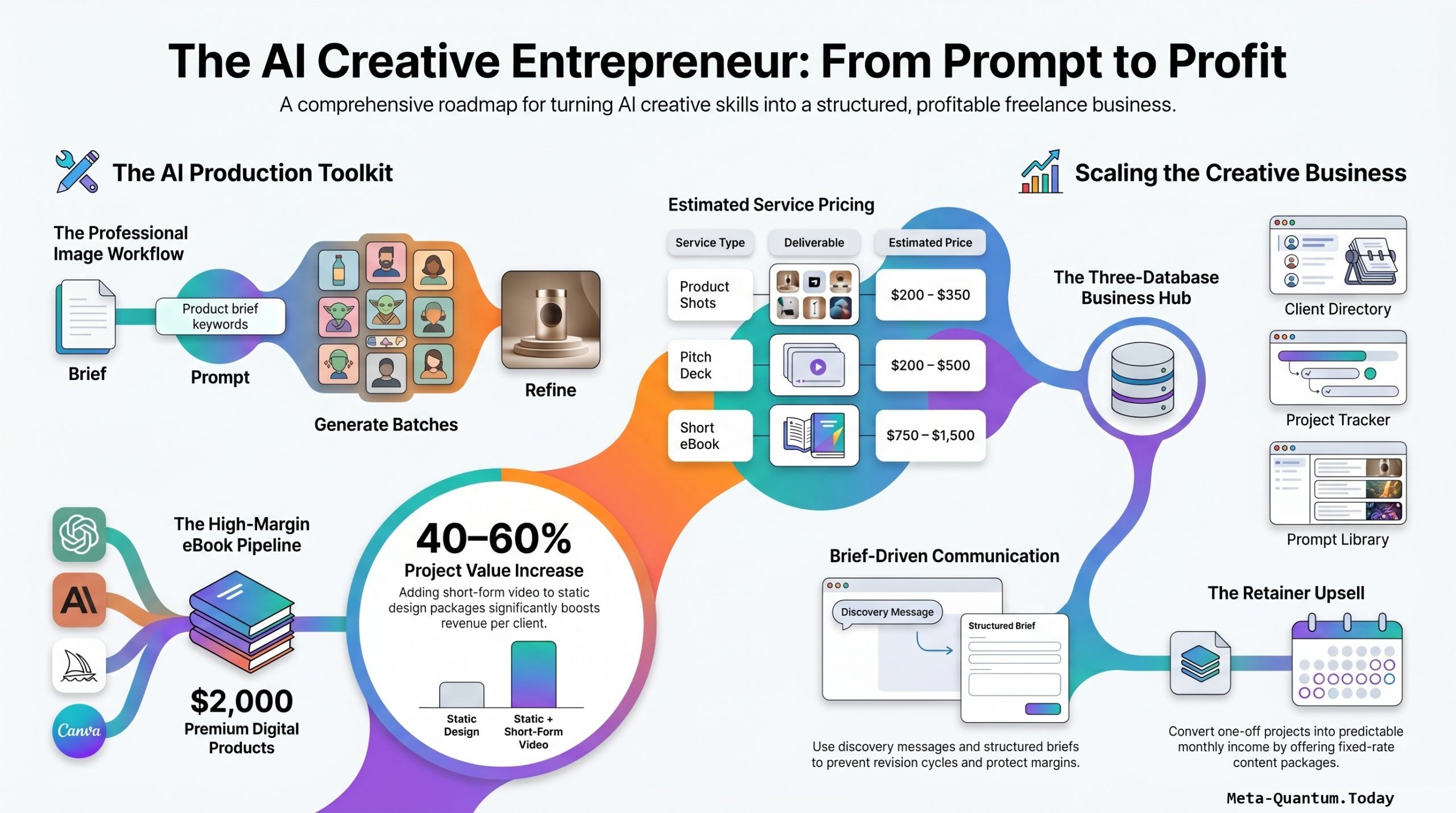
This blueprint is a practical framework for building a solo creative services agency powered by AI tools, targeting a realistic income of $2,000+/month. The core thesis is simple: stop using AI recreationally and start using it commercially. The difference between an amateur and a professional isn’t the tools — it’s the systems, briefs, and delivery standards wrapping those tools. Only 26% of companies can deploy AI agents themselves, creating massive demand for specialists who can deliver AI-powered creative work reliably. This blueprint fills that gap at the individual operator level.
Core Concept: The Professional Mindset Shift
The blueprint opens with a direct contrast — The Amateur vs. The Professional. Amateurs produce vague requests, spend hours tweaking, and deliver raw PNGs in a zip folder. Professionals operate with structured briefs, batch generation, brand-aligned deliverables, and Canva presentation mockups. The workflow is always: Market Research → Scoping Brief → Asset Generation → Delivery Mockup.
The Creative Service Layers (What You Sell)
The blueprint defines five sellable services, each AI-enabled and scalable:
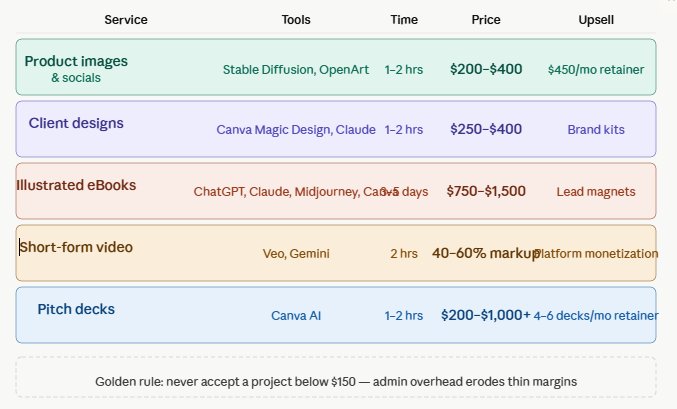
The most successful agencies use AI to handle production while humans focus on strategy, concepts, and refinement — positioning AI as a “creative accelerator” rather than a designer replacement.
The Brief-to-Asset Pipeline
Every project flows through a four-step production process:
Step 1 — Raw input: Client emails, voice notes, reference images. Step 2 — Market context: Use ChatGPT to research audience behavior. Step 3 — The Claude Brief: Merge client preferences with market data into master constraints (sign-off required before production begins — never quote before scoping). Step 4 — AI generation: Feed exact brief parameters into Midjourney, Stable Diffusion, or Veo.
The guiding principle: every hour spent creating before scope is agreed is an hour you may not get paid for.
Key Technical Sections
Anatomy of a commercial prompt – breaks down five components of a sellable AI image prompt: Subject (specific, never generic), Surface/Setting, Lighting (eliminates the “AI plastic” look), Mood/Camera, and Midjourney Parameters (–ar 3:2, –no text). The pro tip: upload 3 reference images to maintain consistent product branding across clips.
The $1,500 Digital Asset Factory – describes the eBook production pipeline:
- Module 1 (ChatGPT): generate a 5-chapter outline
- Module 2 (Claude): draft one chapter at a time with editorial feedback
- Module 3 (Midjourney): generate cover and chapter art with Style References for visual consistency
- Module 4 (Canva): apply minimalist templates, condense with Magic Write, export as PDF
Short-form video structure follows a 15-second sequence: Hook (0–3s) → Reveal (3–8s) → Use Moment (8–13s) → CTA (13–15s). Veo’s Scene Extension chains 8-second clips while preserving lighting and motion consistency.
The Premium Audio Hierarchy (ElevenLabs) is a high-margin upsell:
- Top layer (100% volume): Voiceover with TTS emotion tags
- Middle layer (30–50%): Custom sound effects
- Base layer (15–25%): Instrumental music bed 45 minutes of audio work adds $100–$200 to project value, and most clients never think to ask for it separately.
Investor-Ready Pitch Decks: Canva Magic Design generates the draft; Magic Write condenses raw AI text; client brand kit is applied in one click; exported as PDF or shared via view link.
Business Operating System
The blueprint recommends Notion as the Business OS with four linked databases:
- Client Directory — CRM for relationships, platform links, invoices
- Project Tracker — deliverables, deadlines, Notion Calendar sync
- Prompt Library — reusable IP tagged by tool, category, and output quality
- Client Templates — scoping briefs, proposals, delivery scripts
The 45-Minute Weekly Operating Rhythm keeps admin to three 15-minute sessions: Monday (review tracker, flag overdue, send invoices), Wednesday (update prompt library, log best-performing outputs), Friday (client check-ins, reach out to past clients, update pipeline).
Client Acquisition & Retainer Loop
The acquisition cycle has four stages:
- Discovery message — ask 2–4 scoping questions (format, volume, brand guidelines), promise a proposal within 24 hours
- Proposal & brief — gain sign-off on the Claude-generated brief before any production starts
- Professional delivery — present via Canva mockups, never zip files of raw PNGs
- 7-day retainer follow-up — pitch a monthly package (e.g., 12 posts for $450/mo)
The Revenue Math
The target of ~$1,950/month is achievable within 60–90 days working under 15 hours/week:
- Base (recurring): 3 retainer clients × $450/mo = $1,350/mo
- Variable: 2 one-off projects × $300 = $600/mo
The takeaway: you don’t need a large audience. You need 5 clients, a structured brief, and a repeatable AI production line.
Pricing framework baseline costs: $80/mo in tool subscriptions, 4–6 hours production per deliverable, 30% margin built in for revisions.
Dual Revenue Path
The blueprint notes an important secondary strategy — build your portfolio through your own monetized social channels (TikTok Creator Rewards at 10K followers / 100K views; YouTube Shorts at 1,000 subs; Instagram Reels via invite programs), then sell those same assets as B2B client packages.
Conclusion & Key Takeaways
This blueprint is fundamentally an operations manual for turning AI tool proficiency into a lean professional service business. The differentiator is not the AI tools themselves — those are commodities — but the systems around them: structured briefs that prevent revision spirals, value-based pricing that protects margins, a Notion hub that keeps 45 minutes/week of admin from ballooning, and a retainer loop that converts one-off clients into recurring revenue.
Leading agencies that have moved beyond tool adoption to transforming their service models report new business growth 1.6× higher and efficiency gains 2.6× higher than peers still experimenting with tools. This blueprint operationalizes that transformation at the solo level.
Key takeaways:
- Never create before scope is agreed and signed off
- Always deliver via mockups, not raw files
- Audio is the highest-margin upsell most clients never request
- The $150 minimum project fee protects your time from admin drag
- 5 clients + structured briefs + repeatable systems = $2K+/month
References
- Meta-Quantum.Today — Source of the original AI Agency Blueprint PDF
- How to Start a Profitable AI Agency in 2025 — HuMAI Blog: https://www.humai.blog/how-to-start-a-profitable-ai-agency-in-2025-the-complete-blueprint-for-success/
- The 3 Key Agency Plays for the AI Era — Google Business / BCG Research: https://business.google.com/en-all/accelerate/resources/articles/the-3-key-agency-plays-for-the-ai-era/
- How to Make Money with AI for Digital Agencies in 2026 — ALM Corp: https://almcorp.com/blog/make-money-ai-digital-agencies-2026/
- ElevenLabs (TTS & SFX tool referenced in blueprint): https://elevenlabs.io
- Canva AI / Magic Design (core delivery tool): https://canva.com
- Google Veo (short-form video generation): https://deepmind.google/technologies/veo/
