

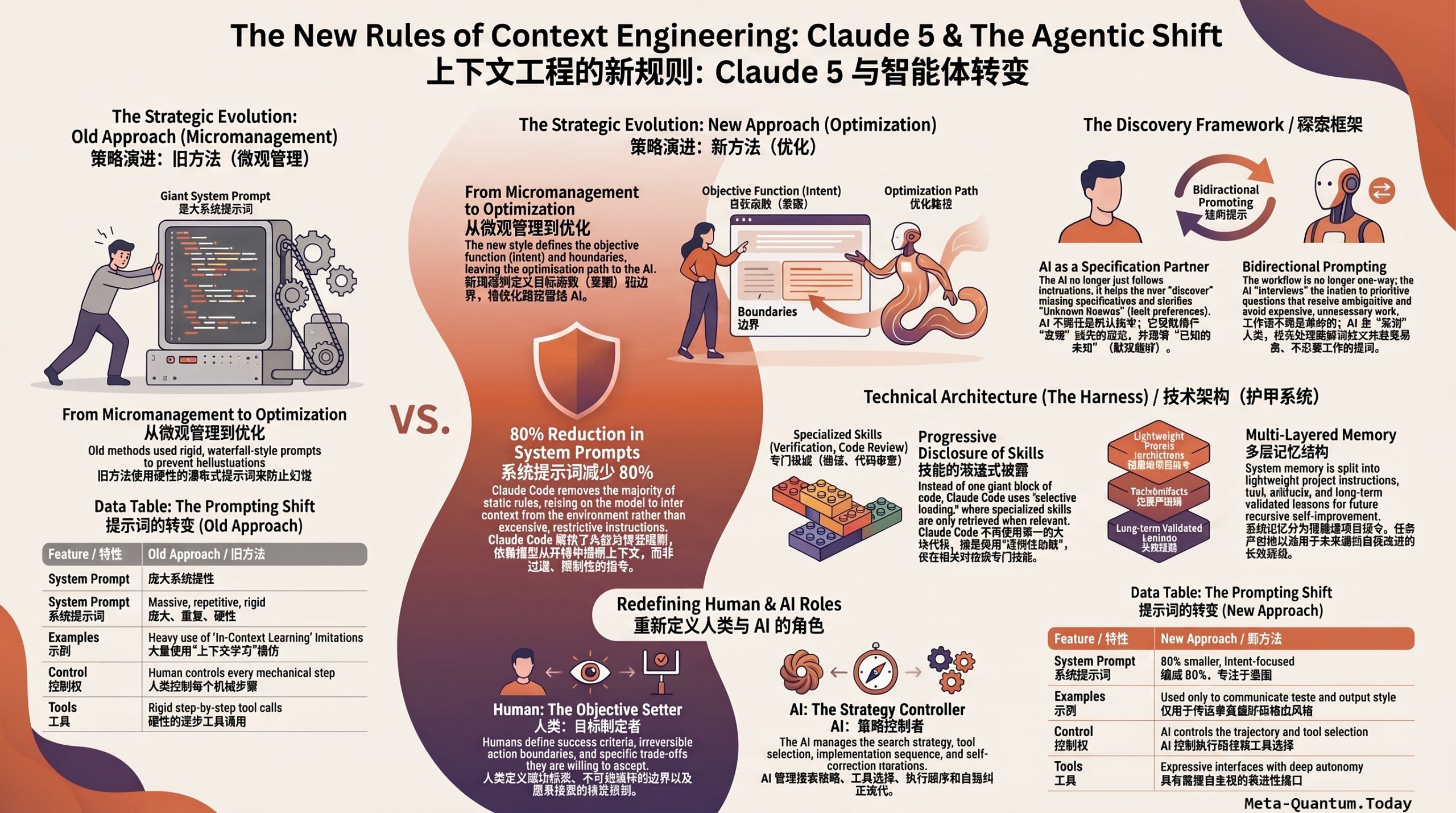
Claude 5 如何改变我们使用 AI 与 Claude Code 的方式
Introduction / 引言
This review dives into two documents released almost simultaneously by Anthropic: the official “context engineering for Claude 5 generation models” guide (published July 24, 2026) and a “field guide” for Fable 5 published two weeks earlier. The presenter — a self-described theoretical physics and mathematics power-user of Claude Code — reads both papers side by side and extracts what genuinely changes for coders and heavy AI harness users, rather than repeating example-level content anyone can read themselves.
这期评论解读了 Anthropic 几乎同时发布的两份文件:一份是 2026 年 7 月 24 日发布的官方”Claude 5 世代模型的上下文工程”指南,另一份是两周前发布的 Fable 5 “现场指南”(field guide)。视频作者是一位长期使用 Claude Code 处理理论物理与数学任务的重度用户,他将两份文件对照阅读,提炼出对程序员和重度 AI harness 用户真正有意义的变化,而不是复述人人都能自行阅读的示例内容。
The core thesis: Claude Opus 5 and the broader Claude 5 generation (Fable 5, Mythos 5) shift the bottleneck away from the model’s raw capability and toward the human’s specification. Anthropic removed roughly 80% of the Claude Code system prompt, arguing that heavily engineered, rule-dense harness prompts now constrain a more capable model rather than help it.
核心论点是:Claude Opus 5 以及更广泛的 Claude 5 世代(Fable 5、Mythos 5)把”瓶颈”从模型本身的能力,转移到了”人类给出的任务规格说明”上。Anthropic 移除了 Claude Code 系统提示词中大约 80% 的内容,理由是过度工程化、规则堆砌的 harness 提示词反而会限制一个能力更强的模型,而不是帮助它。
Features and Concepts: What’s New in This Version / 新版本的功能与核心概念
1. From Rule-Heavy Prompts to Intent-Based Specification / 从规则堆砌到”意图导向”的规格说明
The old paradigm compensated for a weaker, less reliable model with long system prompts, exhaustive examples, rigid step-by-step workflows, and explicit rules for every edge case. The new paradigm asks the human to define only: intent, environment/reality, constraints, and evidence — then lets the model discover the execution path itself.
旧范式用冗长的系统提示词、海量示例、僵化的分步流程以及针对每个边缘情况的明确规则,来弥补模型能力较弱、不够可靠的问题。新范式则要求人类只需定义:意图(intent)、环境/现实(reality)、约束条件(constraints)、以及验证证据(evidence)——然后让模型自行发现执行路径。
Anthropic frames the remaining human responsibility using a four-quadrant model of knowledge:
Anthropic 用一个四象限的知识框架来描述人类此后仍需承担的责任:
- Known knowns — facts you explicitly provide / 你明确提供的已知事实
- Known unknowns — open questions you’re aware of / 你意识到但尚未解决的问题
- Unknown knowns — tacit preferences you only recognize when you see the wrong alternative / 只有看到”不对的方案”时才会意识到的隐性偏好
- Unknown unknowns — issues neither human nor model has considered yet / 人类与模型都尚未想到的问题
2. Bi-Directional Prompting / 双向提示(Bi-Directional Prompting)
Perhaps the most practically significant shift: prompting is no longer one-directional. The agent is now expected to interview the human back — asking prioritized, one-at-a-time questions, focused only on ambiguities that would materially change architecture, interpretation, cost, or final output — rather than guessing or burning tokens on the wrong path.
也许是最具实际意义的变化:提示(prompting)不再是单向的。现在期望智能体(agent)反过来向人类提问——一次只问一个、按优先级排序的问题,并且只针对那些会实质性改变架构、解释方式、成本或最终输出的模糊点提问,而不是靠猜测或在错误方向上消耗大量 token。
3. Progressive Disclosure Replaces the Monolithic System Prompt / 渐进式披露取代”巨石型”系统提示词
Instead of stuffing coding rules, review procedures, documentation standards, deployment/testing instructions, and every organizational policy into one giant system prompt, Claude Code now starts with a small, high-level context and lets the agent retrieve specialized instructions — via selectively loaded Skills — only when it decides they’re relevant. Some tool definitions are similarly deferred until the model actively searches for them.
Claude Code 不再把编码规则、代码审查流程、文档标准、部署与测试说明以及各种组织政策全部塞进一个巨大的系统提示词,而是从一个精简的、高层级的上下文开始,让智能体在自行判断”确实需要”时,再通过按需加载的 Skills(技能模块) 去检索专门的指令。部分工具定义(tool definitions)同样被延后加载,直到模型主动搜索它们。
This mirrors a broader industry pattern documented in community write-ups on progressive-disclosure skill architectures: a lightweight YAML/markdown frontmatter (roughly ~100 tokens) determines whether a skill activates, while the full skill body (kept under roughly 5k tokens) only loads when triggered — keeping the resting context small while expert-level capability stays one retrieval away.
这与社区文档中记录的更广泛的”渐进式披露技能架构”模式相呼应:一个轻量的 YAML/markdown 前置元数据(约 100 tokens)决定某个技能是否被激活,而完整的技能正文(控制在约 5000 tokens 以内)只有在被触发时才会加载——这样既能保持静息状态下上下文精简,又能让专家级能力”一触即达”。
4. References Instead of Exhaustive Examples / 用”参考范例”取代穷举式示例
Rather than listing every desired attribute of an output (font size, background, layout — and inevitably forgetting one or two), the new approach hands the model a structural reference — a prior output the human was happy with — and specifies what to preserve (typography, hierarchy, ideas-per-slide, progressive reveal pattern) and, just as importantly, what not to preserve.
新方法不再是逐条列出输出的所有期望属性(字体大小、背景、排版——而且难免会漏掉一两条),而是给模型一个结构性参考范例(人类之前满意的某个输出),并明确指出哪些元素需要保留(排版风格、层级结构、每页信息密度、渐进展示的节奏),同样重要的是,也要说明哪些元素不需要保留。
5. A New Planning Loop with Self-Learning / 具备自我学习能力的新规划循环
The workflow expands from plan → implement → result into: discover unknowns → brainstorm alternatives → build a prototype → interview the human → study references → produce a reviewable plan → implement → record deviations → explain and verify. Anthropic recommends maintaining an implementation notes file that records deviations from the plan, discovered edge cases, assumptions made, and lessons for future attempts — turning execution into a source of context for self-learning, not just a pass/fail result.
工作流从”规划 → 实现 → 结果”扩展为:发现未知项 → 头脑风暴备选方案 → 构建原型 → 向人类提问确认 → 研究参考范例 → 生成可审阅的计划 → 实施 → 记录偏差 → 解释并验证。Anthropic 建议维护一份实施笔记文件(implementation notes file),记录与原计划的偏差、发现的边缘情况、所做的假设以及为后续尝试总结的经验教训——让”执行过程”本身成为自我学习的上下文来源,而不仅仅是一个通过/失败的结果。
6. A Layered Memory Model / 分层的记忆模型
Claude Code has moved from manually stuffing everything into CLAUDE.md to an automatic memory function — but this doesn’t eliminate the need for a deliberate memory structure. Anthropic recommends keeping CLAUDE.md lightweight, reserved mainly for unusual repository-specific gotchas, while a sensible layered structure looks like:
Claude Code 已经从手动把所有内容塞进 CLAUDE.md,升级为一个自动记忆功能——但这并不意味着不再需要有意识地设计记忆结构。Anthropic 建议让 CLAUDE.md 保持轻量,主要用于记录该代码仓库特有的”反常规”注意事项。一个合理的分层记忆结构大致如下:
- Project instructions — the project, its rules, usual/unusual limitations / 项目说明——项目本身、规则、常规与特殊限制
- Task artifacts — current spec, markup, test plans / 任务产物——当前规格说明、标记、测试计划
- Long-term memory — validated lessons affecting future runs / 长期记忆——经过验证、影响未来执行的经验教训
- Current execution state — what’s been completed this run, and why prior steps succeeded or failed / 当前执行状态——本次运行已完成的内容,以及之前步骤成功或失败的原因
7. Claude Code as a Harness Around the Model, Not the Model Itself / Claude Code 是围绕模型的”外壳”,而非模型本体
A key conceptual clarification: Claude Code is a product — a harness (system prompt, project context, CLAUDE.md, skills, file tools, shell execution, web access, permissions, sub-agent spawning, agentic looping, API access) wrapped around a core LLM (Opus 5, Fable 5, or Mythos 5). The harness constructs context, retrieves memory and skills, manages tools, executes actions, and runs repeated model calls — a layer distinct from the core model’s own reasoning.
一个关键的概念澄清:Claude Code 是一个产品——是一个围绕核心 LLM(Opus 5、Fable 5 或 Mythos 5)构建的”外壳”(harness),包含系统提示词、项目上下文、CLAUDE.md、技能模块、文件工具、shell 执行、网络访问、权限管理、子智能体生成、智能体循环(agentic looping)以及 API 访问。这个 harness 负责构建上下文、检索记忆与技能、管理工具、执行动作、并反复调用模型——它是与核心模型自身推理能力相独立的一层。
This reframing also explains why some long-running, autonomous-agent workflows in the wild — where a coding agent is given a single prompt and left to run for hours without interference — succeed or fail based as much on harness design as on the underlying model’s intelligence, a pattern echoed in community case studies of long-running Claude Code agents building projects end-to-end without human interruption.
这一重新定位也解释了为什么现实中一些”长时间自主运行”的智能体工作流——即给编码智能体一个提示词,然后让它连续运行数小时而不加干预——其成败往往同样取决于 harness 的设计,而不仅仅是底层模型的智能水平。这一点在社区中记录的、Claude Code 智能体在无人干预下端到端构建项目的案例研究中也得到了印证。
Video about Claude 5 / 关于 Clause 5 的视频
Setup, Configuration, and Practical Examples / 设置、配置与实践示例
Try the /doctor command / 尝试 /doctor 命令
Anthropic has folded its context-engineering best practices into a built-in command: running /doctor in Claude Code is intended to help “right-size” your skills and CLAUDE.md files, flagging bloat or misconfiguration rather than requiring manual audits.
Anthropic 已经把其上下文工程最佳实践整合进了一个内置命令:在 Claude Code 中运行 /doctor 旨在帮助你”合理调整”技能模块与 CLAUDE.md 文件的规模,自动标记冗余或配置不当之处,而不需要人工逐一排查。
Reworking your CLAUDE.md / 重新调整你的 CLAUDE.md
- Strip it down to unusual, repository-specific gotchas only / 只保留该项目特有的”反常规”注意事项
- Move coding rules, review procedures, and deployment/testing instructions into selectively loaded skills instead of the root file / 将编码规则、审查流程、部署与测试说明迁移到按需加载的技能模块中,而不是塞进根目录文件
- Reserve the automatic memory feature for durable, cross-session lessons — don’t try to replicate it manually / 把自动记忆功能留给可持续、跨会话的经验教训,不要手动重复实现它
Rewriting prompts: rule-based → objective-based / 提示词重写:从”规则导向”到”目标导向”
Old style example (rule-based):
“Never write multi-line comments. Never create documentation unless I ask. Use one-line comments only. Do not explain obvious code.”
旧式写法示例(规则导向):
“永远不要写多行注释。除非我要求,否则不要创建文档。只用单行注释。不要解释显而易见的代码。”
New style example (objective-based):
“Match the conventions of the surrounding code. Preserve existing public interfaces. Do not introduce unrelated changes.”
新式写法示例(目标导向):
“与周围代码的风格保持一致。保留现有的公共接口(public interfaces)。不要引入无关的改动。”
Example: research/paper-summarization task, restructured / 示例:重新设计一个”论文总结”任务
Old style: “Read this paper, summarize the abstract, explain every section, explain every mathematical term, analyze every equation, discuss every table, use exactly 10 sections.”
旧式写法: “阅读这篇论文,总结摘要,解释每一节,解释每一个数学术语,分析每一个方程,讨论每一张表格,并使用恰好 10 个小节呈现。”
New style: Define the objective (“identify the paper’s genuine scientific delta, not a summary”), define the audience (“technically sophisticated but not necessarily domain-expert”), then request a structured analytical pass: a blind-spot pass (what background concepts must be understood, which claims are genuinely new vs. reframed known facts, what evidence would falsify the central interpretation), followed by an output that covers the prior bottleneck, the new mechanism, why it matters, the strongest evidence, and the limitations.
新式写法: 先定义目标(“找出论文真正的科学增量,而不是做摘要”),再定义受众(“技术上较为成熟,但未必是该细分领域的专家”),然后要求进行结构化的分析:先做一次”盲点排查”(需要理解哪些背景概念、哪些主张是真正新颖的、哪些只是已知事实的重新包装、什么样的证据能证伪其核心论点),接着输出内容应涵盖:此前的科学瓶颈、新机制、其重要性、最有力的证据,以及局限性。
Configuring tool interfaces for the new model generation / 为新一代模型配置工具接口
Rather than relying on in-context example-heavy tool-call demonstrations, Anthropic recommends designing:
与其依赖大量示例来演示工具调用,Anthropic 建议在设计工具接口时做到:
- Meaningful, self-explanatory function/parameter names / 有意义、自解释的函数与参数命名
- Clear constraint enumeration and explicit state transitions / 清晰的约束条件枚举与明确的状态转换
- Informative tool results / 信息量充分的工具返回结果
- Tools that expose the right degree of freedom — not too rigid, not too open-ended / 提供恰当自由度的工具——既不过于死板,也不过于开放
Examples are still useful, but now primarily to communicate taste and output form rather than to teach step-by-step imitation.
示例依然有用,但现在主要用于传达”品味偏好”与输出形式,而不是用来手把手地教模型逐步模仿。
Conclusion and Key Takeaways / 结论与核心要点
The presenter is candid that this is his own interpretation of two Anthropic documents, not a settled consensus, and that he remains skeptical of fully trusting a black-box agent — especially for specialized domains like theoretical physics or finance where hallucination is unacceptable. Several open questions are flagged as undisclosed by Anthropic: whether the serving stack uses hidden planner models, neural context compressors, model routers, separate verifier models, or prompt-rewriting layers.
视频作者坦言,这只是他个人对 Anthropic 两份文件的解读,并非已成定论的共识,他本人也对”完全信任一个黑箱智能体”持保留态度——尤其是在理论物理、金融等对”幻觉”零容忍的专业领域。他也指出了 Anthropic 尚未公开的几个问题:服务端(serving stack)是否使用了隐藏的规划模型(planner models)、神经上下文压缩器、模型路由器、独立的验证模型,或提示词重写层。
Key takeaways / 核心要点:
- Specification, not the model, is now the bottleneck. Write intent, environment, constraints, and evidence — not exhaustive rule lists.
瓶颈已从模型转移到规格说明。 应写清楚意图、环境、约束条件与验证证据,而不是穷举式的规则清单。 - Prompting is bi-directional now. Let the agent ask prioritized clarifying questions instead of guessing.
提示现在是双向的。 让智能体按优先级提出澄清问题,而不是靠猜测。 - Adopt progressive disclosure. Keep the system prompt/
CLAUDE.mdlean; push detail into selectively loaded skills.
采用渐进式披露。 保持系统提示词与CLAUDE.md精简,把细节下放到按需加载的技能模块中。 - Use structural references, not exhaustive spec lists, when the desired output is stylistic or hard to fully enumerate.
在输出偏向风格化、难以完全枚举的场景下,使用结构性参考范例,而不是穷举式的规格清单。 - Treat execution as a learning loop — maintain an implementation-notes file that captures deviations, edge cases, and lessons.
把”执行过程”当作一个学习循环 ——维护一份实施笔记文件,记录偏差、边缘情况与经验教训。 - Separate your memory layers: project instructions, task artifacts, long-term validated lessons, and current execution state.
区分不同的记忆层级: 项目说明、任务产物、长期验证过的经验教训,以及当前执行状态。 - Remember Claude Code is a harness, not the model. Optimizing your workflow means optimizing the harness (context, memory, skills, tools) around whichever core model — Opus 5, Fable 5, or Mythos 5 — you’re using.
牢记 Claude Code 是一个 harness,而非模型本身。 优化你的工作流,意味着围绕你所使用的核心模型(Opus 5、Fable 5 或 Mythos 5)去优化 harness 本身(上下文、记忆、技能、工具)。 - Validate independently, especially in specialized domains. These are general recommendations from Anthropic — not universal law for every field.
在专业领域中要独立验证。 这些是 Anthropic 给出的通用建议,并非适用于每个领域的普适法则。
Related References / 相关参考资料
- Anthropic Engineering, Claude Code: Best practices for agentic coding — foundational best-practices post on CLAUDE.md, context gathering, and harness customization: https://www.anthropic.com/engineering/claude-code-best-practices
- Community research on progressive-disclosure skill architecture for Claude Code (
SKILL.mdformat, ~100-token frontmatter, on-demand loading): via Glasp-indexed source — https://glama.ai/mcp/servers/@bobmatnyc/mcp-skills/blob/888755c2756ea666a44b4301a6410eb66943fd91/docs/research/progressive-skills-format-2025-11-29.md - Stop Using Claude Code the Normal Way — case study on long-running, largely unsupervised Claude Code agents building full projects from a single prompt, illustrating the harness-design stakes discussed in this video: https://glasp.co/youtube/lGWFlpffWk4
- Claude Skills Explained: 4 Skills to 10x Your Coding Workflow (referenced via “How I Use 10 AI Agents in Claude Code to Build Features Faster”) — practical walkthrough of skill-based workflow design: https://glasp.co/youtube/c68Rqn8PriE
