

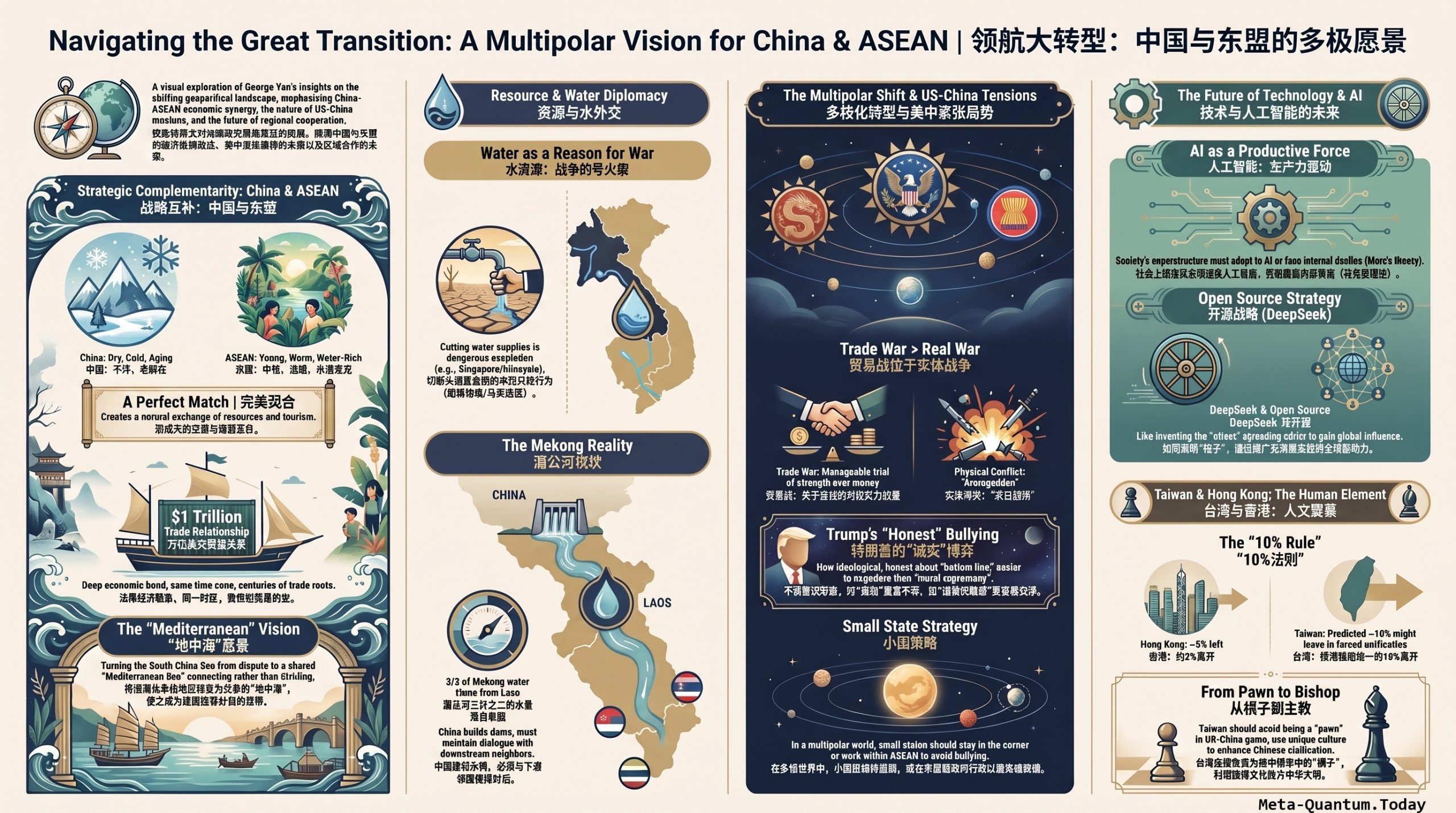
引言 | Introduction
中文:
这期访谈的嘉宾是新加坡前外交部长杨荣文(George Yeo)——一位横跨军人、部长、外交官与企业顾问多重身份的资深政治人物。他曾在1990年代初亲历中美建交前后的关键外交场合,长期担任华为的顾问,也是长期观察中国、东盟与美国三边关系的”老友”型评论员。整场对话信息密度极高,从台湾问题、香港模式,谈到中美贸易战的两个回合、湄公河流域的水资源政治、朝贡体系的历史误读,再到DeepSeek开源策略与多极世界的”三个太阳”比喻,几乎覆盖了理解当代东亚地缘政治所需的全部关键词。
English:
This interview features George Yeo, Singapore’s former Foreign Minister — a man who has worn the hats of air force general, cabinet minister, diplomat, and corporate advisor (notably to Huawei). Having personally taken notes in closed-door meetings between Chinese and American leaders back in 1990–91, Yeo brings a rare insider’s perspective to a conversation that ranges across the Taiwan question, the Hong Kong precedent, two rounds of the US-China trade war, Mekong River water politics, a historical reinterpretation of the tributary system, China’s DeepSeek open-source strategy, and his “three suns” metaphor for a multipolar world. It’s a dense, wide-ranging conversation — essential listening for anyone trying to make sense of today’s East Asian geopolitics.
核心观点 | Core Concept
中文:
贯穿全场访谈的核心论点,其实是杨荣文对”中国治国术”(Chinese statecraft)的一套解释框架:中国的战略文化本质上是防御性的,其根源来自《孙子兵法》”不战而屈人之兵”的思想——尽量避免动用军事力量,优先使用经济与外交手段实现目标。他用”棋子 vs. 棋手”的比喻贯穿了对台湾问题的讨论:台湾人可以选择做被牺牲的”卒子”,也可以选择成为能塑造自己命运的”车”或”象”。这个框架同样适用于理解香港、东盟、乃至中美关系。
English:
The thread running through the entire conversation is George Yeo’s interpretive framework for Chinese statecraft: he argues Chinese strategic culture is fundamentally defensive, rooted in Sun Tzu’s principle of “subduing the enemy without fighting” — favoring economic and diplomatic leverage over military force wherever possible. His central metaphor for Taiwan is a chess one: Taiwanese people can choose to remain a pawn that gets sacrificed, or become a rook or bishop that shapes its own fate. This same lens — defensive, relationship-based, face-conscious — is what he applies to Hong Kong, ASEAN, and the US-China relationship throughout.
相关主题深度解析 | Related Sections
1. 台湾问题:家人,而非棋子 | Taiwan: Family, Not a Pawn
中文:
杨荣文预测,若发生强制统一,可能有5%到10%的台湾人会选择离开,其余的人会留下并逐渐适应——他直接类比香港:自2020年国安法实施后,约30万香港居民离开了这座城市,但留下的大多数人生活照常,甚至不少大陆游客反而觉得香港人如今”待客更友善”。他特别谈到自己儿子曾患白血病,最终骨髓配型来自台湾捐赠者,因此他常对台湾领导人说”我儿子的血是台湾的血”,这也是他对台湾抱有深厚情感的原因。他的政策建议是:大陆不应把台湾当作”面子问题”或强行索回的”离家出走的儿子”,而应该像对待即将回归的家人一样,给予耐心、理解与尊重——因为”即使抓回来了,也只是一个沉默而不快乐的儿子,这对整个家庭都不好”。
English:
George Yeo estimates that if forced reunification occurred, perhaps 5-10% of Taiwan’s population would leave, while the rest would stay and adapt — drawing a direct parallel to Hong Kong, where roughly 300,000 residents left after the National Security Law, yet most who stayed carried on, and mainland visitors today often find Hongkongers friendlier than before. He shares a deeply personal detail: his own son survived leukemia thanks to a bone marrow donor found in Taiwan, which is why he tells Taiwanese leaders “my son’s blood is Taiwanese blood.” His policy advice to Beijing is to treat Taiwan not as a matter of pride or a “runaway son” to be forcibly dragged home, but with the patience of a parent trying to genuinely win back a child — because “even if you capture him, he’ll come home silent and unhappy, and that poisons the whole family.”
2. 香港模式的启示 | The Hong Kong Precedent
中文:
杨荣文特别强调,香港今天的现实与外界的刻板印象有很大出入——他指出,过去曾有大陆游客到香港旅游时感到被本地人歧视、态度冷淡,如今情况完全反转,大陆的网红、游客在香港随处拍照打卡,感受到的是友善而非敌意。他也坦言香港”一国两制”下的经济结构问题(例如零售业疲软)依然存在,但这与”是否被善待”是两回事。这一节内容为理解台湾未来可能面临的场景提供了一个真实的参照系。
English:
George Yeo pushes back on stereotypes about Hong Kong’s current reality — he notes that where mainland tourists once felt looked down upon by locals, the dynamic has now reversed, with mainland influencers and visitors moving freely and being treated warmly. He acknowledges genuine structural economic issues remain (like weak retail spending), but stresses that’s a separate question from whether Beijing has “mistreated” the city. This section functions as his real-world reference case for what a post-unification Taiwan scenario could actually look like.
3. 中美贸易战:两个回合 | The US-China Trade War: Two Rounds
中文:
对话回顾了2018年与”这一次”(第二轮)贸易战的巨大心态差异:2018年时,中国网络舆论普遍弥漫着”我们会输””必须服软”的悲观情绪,一家全国性媒体甚至拒绝播出一段展现强硬立场的视频,担心中国若真的输了会显得”很傻”。而这一次,中国的准备明显更充分——过去几年双循环政策的收紧、房地产市场的调整,如今回头看都像是在为这场”大考”提前布局。杨荣文提醒:即便中国这一轮表现良好,也绝不能过度自信,因为特朗普永远会宣称自己获胜,而下一轮的”考试”只会更难,因为对手已经摸清了你的底牌。
English:
The two discuss the stark mood shift between the 2018 trade war and the current round. In 2018, Chinese online sentiment leaned pessimistic — “we’re going to lose, we have to submit” — to the point a major state broadcaster refused to air a defiant promotional video out of fear China might look foolish if it actually lost. This time, Yeo says, China is far better prepared; the tightening of the “dual circulation” policy and the multi-year real-estate correction now look, in hindsight, like advance preparation for exactly this test. His caution: even a strong showing this round is no reason for overconfidence — Trump will always declare victory regardless of outcome, and the next round of tests will be tougher precisely because the opponent has now gauged China’s real strength.
4. 东盟与中国的深度融合 | ASEAN-China Deep Integration
中文:
杨荣文用了大量篇幅描绘中国与东南亚在气候、时区、物产上的天然互补性——中国北方干燥寒冷、人口老龄化,东南亚年轻、温暖、水资源丰富,双方处于相近时区,贸易与人员往来自然而紧密。他还提到历史上”海参、燕窝、鱼翅”等海产贸易早已将中国与东南亚连结数百年。他抛出一个颇具创意的构想:让海南成为”东盟的伙伴”,把南海从”你的、我的”争议海域,重新定义为一片连接彼此、带来共同利益的”地中海”,海南可以独立与东盟国家谈判更深入的自由贸易协定。这是访谈中最具建设性、也最少被主流媒体报道的一段。
English:
George Yeo spends considerable time on the natural complementarity between China and Southeast Asia — a dry, cold, aging north paired with a young, warm, water-rich south, operating in similar time zones, historically linked through centuries-old trade in sea cucumber, bird’s nest, and shark fin. His most creative proposal: make Hainan an “ASEAN partner,” reframing the South China Sea not as contested “yours vs. mine” territory but as a shared “Mediterranean” that connects rather than divides — with Hainan potentially negotiating its own deeper free trade arrangements with ASEAN states, going further than what’s possible with the mainland proper under WTO rules. This is arguably the most constructive and least-covered segment of the interview.
5. 水资源与区域安全 | Water, Rivers, and Regional Security
中文:
杨荣文提到印巴之间因水资源引发的紧张局势令他”担忧”,并联系到新加坡自身对马来西亚供水的敏感依赖——”切断供水历来被视为宣战的理由”。他澄清了一个常见误解:湄公河流入南海的水量中,三分之二来自老挝而非中国,中国修建水坝确实需要与下游国家沟通,但这更多是一个多国协调问题,而非单纯的”中国控水”叙事。
English:
George Yeo describes being genuinely worried about India-Pakistan tensions over water, drawing a parallel to Singapore’s own sensitivity around its water supply from Malaysia — “cutting off water has traditionally been considered grounds for war.” He also corrects a common misconception: two-thirds of the Mekong’s flow into the South China Sea comes from Laos, not China, meaning dam-building requires coordination among multiple downstream states rather than fitting a simple “China controls the water” narrative.
6. 朝贡体系的重新解读 | Rethinking the Tributary System
中文:
这是全场最具历史纵深的一段。杨荣文纠正了”朝贡”(tribute)这一翻译本身带来的误导——历史上蒙古金帐汗国式的”进贡”是弱者向强者交保护费,而中国的”通”(朝贡贸易)体系实际上是反过来的:中国给予朝贡国远超其所献贡品价值的赏赐与贸易优惠,本质是一种”面子换实惠”的贸易安排,而非强制征税。他还提到中国历史上对造纸术、丝绸工艺长期保密数百年,是当时最重要的”信息技术”垄断,也解释了中国为何长期能组织全球最大规模人口的治理体系。
English:
This is the most historically rich segment. George Yeo challenges the very translation of “tribute” — pointing out that while Mongol-era vassals paid genuine protection money upward to the Golden Horde, the Chinese tributary trade system historically worked the other way around: the emperor’s gifts and trade privileges to tributary states routinely exceeded the value of what was “offered” — a face-for-benefits exchange rather than coerced extraction. He draws a parallel to China’s centuries-long secrecy over papermaking and silk production — essentially the “information technology” monopoly of its era — as part of explaining how China was able to administer the largest population on earth for so long.
7. 华为与DeepSeek:经济治国术的两个案例 | Huawei and DeepSeek: Two Cases of Economic Statecraft
中文:
杨荣文坦言自己起初并不愿意为华为担任顾问,直到看到该公司遭受打压后仍展现出的韧性,才决定支持。他谈到中国选择将DeepSeek开源,是一次极具战略眼光的举动——与美国大型科技公司靠垄断收费的”车轮专利”模式不同,中国选择把”轮子”免费开放给所有人使用,这种模式对经济与社会的长远影响巨大,而那些试图靠垄断收费维持优势的美国公司未来可能会陷入麻烦。他借用马克思”生产力与上层建筑矛盾论”的框架指出:AI是一种新的生产力,如果制度(上层建筑)不能与之适配,社会内部矛盾将加剧;那些愿意快速试错、调整、前进的国家会更能适应新技术浪潮,而这正是中国多个”DeepSeek”式项目并行出现的市场基础。
English:
George Yeo admits he initially hesitated to advise Huawei, deciding to support the company only after witnessing its resilience under pressure. He frames China’s decision to open-source DeepSeek as a strategically savvy move — rather than charging royalties on a “patented wheel” the way dominant US tech firms do, China effectively said “use the wheel for free,” a choice he believes carries major long-term economic and social implications, while companies clinging to monopoly-rent models may eventually run into trouble. Invoking Marx’s base/superstructure framework, he argues AI is a new productive force, and societies whose institutions (superstructure) fail to adapt will face sharpening internal contradictions — while nations willing to experiment fast, fail, adjust, and move on will adapt best, which is also why multiple “DeepSeek-style” models are emerging in parallel across China’s single large market.
8. 多极世界:三个太阳的比喻 | Multipolarity: The “Three Suns” Metaphor
中文:
谈到世界秩序的转变,杨荣文用了一个极具画面感的比喻:单极世界像只有一个太阳,轨道早已注定,简单却缺乏自由;两极世界像两个太阳,带来更多空间但也更多不确定性;而三极或多极世界则像三个太阳同时存在——”那简直是一场头痛”。他认为这种高度不确定的多极格局,恰恰需要一种共同的伦理框架来约束技术(尤其是AI)可能带来的毁灭性力量,这也是中国提出”人类命运共同体”、教皇方济各提出”共同人性”等理念的背景所在。
English:
On the shifting world order, George Yeo offers a vivid image: a unipolar world is like having one sun — your orbit is fixed and predictable, simple but unfree; a bipolar world, two suns, gives more room to maneuver but also more uncertainty; a multipolar world with three or more suns is, in his words, “a headache.” He argues this high-uncertainty multipolar environment is precisely why a shared ethical framework is needed to govern potentially destructive technologies like AI — the same underlying impulse behind China’s “shared future for mankind” concept and Pope Francis’s notion of a “common humanity.”
问答环节精选 | Q&A Highlights
Q: 中国是否为这场贸易战做好了准备?Q: Is China well-prepared for this trade war?
杨荣文:看起来是的,但永远不该过度自信,也不该僵化——打击总会到来,必须持续适应。
George Yeo: It looks that way, but one should never be overconfident or rigid — blows will come, and you must keep adapting.
Q: 新加坡与东盟是否终将被迫在中美之间选边站?Q: Will Singapore and ASEAN eventually be forced to choose sides between China and the US?
杨荣文:东盟的本能是——贸易好、投资好、关系好,但要保持一定的正式距离,并广交朋友。他引用朱镕基总理2000年主动向东盟提出自贸协定、并承诺”十年后若协议对中国更有利,我们愿意重新谈判”的往事,强调中国从未要求东盟”选边站”,只要东盟仍是朋友即可。
George Yeo: ASEAN’s instinct is that trade is good, investment is good, relations are good — but maintain a degree of formal distance and keep other friends too. He recalls Premier Zhu Rongji proactively offering ASEAN a free trade deal in 2000, promising to renegotiate in ten years if it favored China unfairly — evidence, in Yeo’s view, that China has never demanded ASEAN “choose sides” as long as it remains a friend.
Q: 特朗普的谈判风格是怎样的?Q: What is Trump’s negotiating style like?
杨荣文用了一个生动的比喻:特朗普如果想要两美元,他会先开口要十美元,用近乎恐吓的方式施压,最后你可能”心甘情愿”地给他三美元——比他原本想要的还多,而你却因为”只给了三美元、不是十美元”而如释重负。
George Yeo, with a vivid analogy: if Trump wants two dollars, he opens by demanding ten, applies almost frightening pressure, and you end up “gladly” handing over three — more than he originally wanted — while you feel relieved you only gave three instead of ten.
Q: 西方对中国最大的误解是什么?Q: What is the West’s biggest blind spot about China?
杨荣文:最大的恐惧是”中国一旦强大,就会像西方列强一样行事”——但中国的战略文化本质上是防御性的,这源于深厚的儒家等级观念与”面子”文化,也源于历史上屡次因过度扩张而招致灾难的教训。
George Yeo: The biggest Western fear is that a powerful China will behave like a Western imperial power once did. But Chinese strategic culture is fundamentally defensive, rooted in Confucian hierarchy and face-consciousness, and in the historical lesson that overreach has repeatedly led to regret.
结论与要点总结 | Conclusion & Key Takeaways
中文:
这场访谈的价值不在于给出一个乐观或悲观的确定答案,而在于提供了一整套理解”中国如何看待自己、如何看待邻居、如何看待美国”的分析框架。杨荣文本人也坦承对台湾问题并不乐观——”我认为我们已经错过了那个窗口”,尤其是两岸年轻一代在教育与身份认同上的分歧正在加深。但他同时强调,历史的伤口”可以愈合”,关键在于双方是否愿意投入时间、耐心与真正的理解,而不是把彼此当作可以被强行拉回或强行推开的对象。
关键要点 | Key Takeaways:
- 若发生强制统一,杨荣文估计约5%–10%的台湾人会离开,其余多数人会留下并逐渐适应——这与香港国安法后约30万人离开、但社会整体运转如常的经验类似。
- 中国的战略文化被杨荣文定义为”防御性”,其根源可追溯至《孙子兵法》与儒家伦理,倾向以经济、外交手段而非军事手段达成目标。
- 2018年与当前这轮贸易战,中国社会的心态已从悲观转向更有准备的自信,但杨荣文提醒切勿过度自信。
- “朝贡体系”常被误译为单向纳贡,实际上历史上是中国给予贸易国远超贡品价值的回馈,是一种”面子换实惠”的双向安排。
- DeepSeek开源与华为的韧性,被杨荣文视为中国”经济治国术”的两个关键案例,其长远影响可能重塑全球科技产业的商业模式。
- 面对多极世界这个”三个太阳”的高度不确定环境,杨荣文认为迫切需要一种共同的伦理框架来驾驭AI等颠覆性技术。
- 关于台湾的个人立场:杨荣文因儿子接受台湾骨髓捐赠而对台湾抱有深厚情感,主张大陆应以”赢回家人”的耐心,而非”抓回逃家儿子”的强硬姿态处理两岸关系。
English:
The value of this interview isn’t a definitive optimistic or pessimistic verdict — it’s the analytical framework it offers for understanding how China sees itself, its neighbors, and the United States. Yeo himself is candid that he isn’t optimistic about Taiwan — “I think we’ve missed that window” — especially as younger generations on both sides of the strait diverge further in education and identity. Yet he insists historical wounds “can heal,” provided both sides invest the time, patience, and genuine understanding needed, rather than treating each other as objects to be forcibly reclaimed or forcibly pushed away.
Key Takeaways:
- George Yeo estimates 5–10% of Taiwanese would leave under forced reunification, with the majority staying and adapting — a parallel he draws to Hong Kong’s ~300,000 post-National-Security-Law departures, after which society largely functioned as normal.
- George Yeo frames Chinese strategic culture as fundamentally defensive, rooted in Sun Tzu and Confucian ethics, favoring economic and diplomatic leverage over military force.
- Chinese sentiment shifted from pessimism in the 2018 trade war to greater preparedness and confidence today — though George Yeo warns against overconfidence.
- The “tributary system” is often mistranslated as one-way tribute; historically it was closer to a two-way exchange where China’s gifts and trade privileges exceeded what was “offered” — face for benefit.
- DeepSeek’s open-sourcing and Huawei’s resilience are, in George Yeo’s view, two key case studies in Chinese economic statecraft with potentially industry-reshaping global implications.
- In a “three suns” multipolar world of heightened uncertainty, George Yeo argues a shared ethical framework is urgently needed to govern disruptive technologies like AI.
- On Taiwan personally: George Yeo’s deep affinity stems from his son’s bone marrow donor being Taiwanese, and he advocates that Beijing approach cross-strait relations with the patience of winning back family, not the force of dragging home a runaway child.
参考资料 | References
- 原始视频 / Original video: 如果被迫统一,10%的人会离开台湾,杨荣文:中国从未亏待过香港
- Kishore Mahbubani, Has China Won?: The Chinese Challenge to American Primacy (PublicAffairs, 2020) — relevant background on multipolarity and China-US relations discussed in the interview
- Global Times, “Mainland to unswervingly advance reunification, oppose secessionism and uphold peace: Taiwan Affairs Office” (Jan 17, 2024) — for official mainland policy language on peaceful reunification and “one country, two systems”
- Bloomberg, “Singapore Ex-Diplomat Warns to Not Underestimate China on Taiwan” (Sept 5, 2022) — earlier public remarks by George Yeo on Taiwan risk
