

Video Reviewed / 视频来源: 台湾本可不做棋子,但自愿为棋,杨荣文香港大学回应”死亡”提问,话很难听
Introduction / 引言
Former Singapore Foreign Minister George Yeo (杨荣文) delivered this address at the inaugural event of the Centre on Contemporary China at the University of Hong Kong, marking the launch of his memoir Musings. What starts as a personal reflection on Lee Kuan Yew, Hong Kong, and old friendships quickly opens into one of the clearest and most unsentimental accounts of the emerging multipolar world you’re likely to hear from a former minister — and it ends with an audience Q&A blunt enough to make the room go quiet, especially on the question of Taiwan.
杨荣文是新加坡前外交部长,此次演讲是香港大学”当代中国研究中心”的开幕活动,同时也是他新书《省思》(Musings) 的发布会。演讲从他与李光耀、香港、旧友的私人回忆展开,逐步过渡到对多极世界秩序最清醒、最不带感情色彩的分析之一——而随后的问答环节更是直言不讳,尤其在台湾问题上,让全场为之一静。
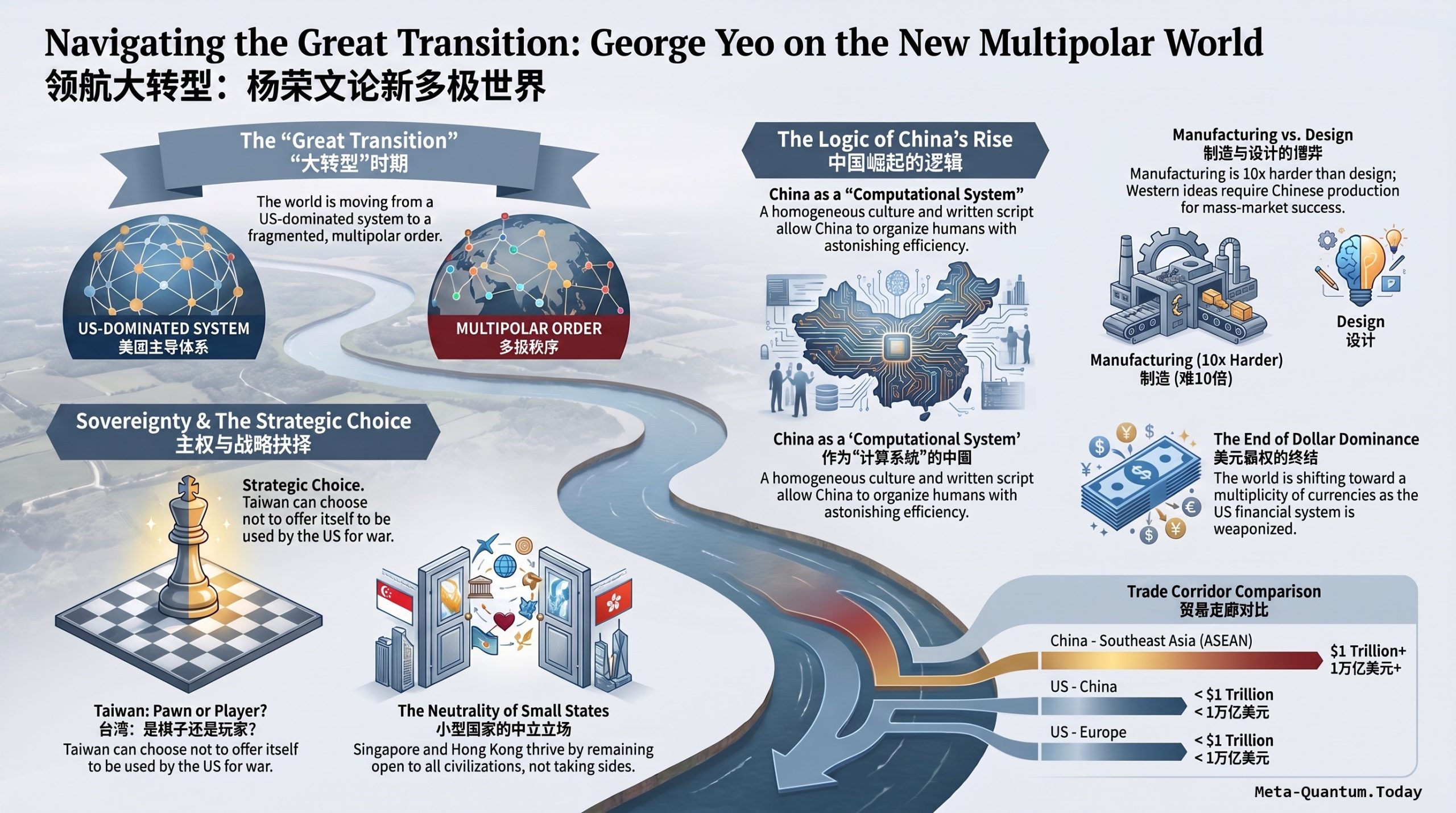
The now-famous line comes early, almost as an aside, in response to a moderator’s question about what Singapore would do in a US-China conflict over Taiwan: Taiwan cannot determine US-China relations, but Taiwan can decide whether to let itself be used. If Taiwan says no, the US cannot use it. If Taiwan says yes — hoping American pressure might “so devastate China” that opportunity opens up — that is Taiwan’s own choice, and its own risk.
那句如今广为流传的话,其实出现得很早,几乎是随口一提——回应主持人关于”若美中因台湾开战,新加坡会怎么做”的提问时,杨荣文说:台湾无法决定美中关系,但台湾可以决定是否甘愿被利用。 如果台湾说不,美国就无法利用台湾;如果台湾说好——寄望美国的施压能让中国”元气大伤”从而出现机会——那也是台湾自己的选择,自己的风险。
Video – Speech
Video – Q&A
The Core Concept: Taiwan as a Chosen Pawn, Not a Forced One / 核心概念:台湾是”自愿”而非”被迫”的棋子
Yeo’s framing is worth unpacking carefully, because it cuts against the more common narrative (in both Western and Chinese-language media) that Taiwan is simply caught between two great powers with no agency of its own.
杨荣文的论述值得细细拆解,因为它挑战了一个中西媒体都很常见的叙事——即台湾只是被两大强权夹在中间、别无选择的棋子。
His argument in three parts:
- Taiwan cannot shape the US-China relationship itself. The relationship is determined by the two great powers’ own interests and calculations — Taiwan is not a variable in that larger equation.
- Taiwan can decide whether to offer itself as an instrument. If Washington wants to use the island to provoke or pressure Beijing, that only works if Taipei agrees to play the role.
- The choice carries consequences either way. Refusing the role removes Taiwan from the crosshairs — “this is not my problem,” in Yeo’s words. Accepting it, in hope that US pressure might fracture or weaken China enough to create an opening (the “Red Sea parting” image he borrows from Lee Teng-hui’s own words to Japanese writer Ryotaro Shiba), is a bet — and a dangerous one if the wished-for opening never comes: “if you base a policy on a wish or build your hopes on an illusion, then it can lead to tragedy.”
他的论点分为三层:
- 台湾无法左右美中关系本身——这层关系由两大强权自身的利益和算计决定,台湾并非这个大方程式中的变量。
- 台湾”可以”决定是否让自己成为工具。如果华盛顿想利用台湾来刺激或施压北京,这只有在台北同意扮演这一角色时才能成立。
- 无论怎么选,都有代价。拒绝扮演这个角色,台湾便可从风口浪尖上抽身——用杨荣文的话说,”这不是我的问题”。而若选择接受,寄望美国的施压能让中国”元气大伤”进而出现机会(他借用了李登辉对日本作家司马辽太郎所说的”红海分开”的意象),这是一场赌博——而且是危险的赌博,一旦期待中的机会始终没有到来:“如果一项政策建立在一厢情愿或幻想之上,那可能酿成悲剧。”
Notably, Yeo separates this from any judgment of Taiwan’s elections themselves, which he calls “a sideshow” — even a pro-independence winner “cannot start the war,” because only the US and China hold that power, and Washington in practice keeps considerable control over what any Taiwanese leader can do or say abroad (he cites the tightly managed itinerary of Taiwanese leaders during US visits).
值得注意的是,杨荣文将这一判断与台湾选举本身区分开来——他称选举只是”配角戏”:即便是主张独立的候选人当选,也”无法挑起战争”,因为真正握有开战权力的只有美中两国;而实际上,华盛顿在很大程度上仍能约束台湾领导人出访时的言行(他举例说,台湾领导人访美时的行程安排一向受到严格限制)。
Related Section: The Multipolar World and the Logic of Chinese Civilization / 相关议题:多极世界与中华文明的逻辑
The Taiwan comment doesn’t stand alone — it’s a single application of a much broader thesis Yeo lays out: the world is transitioning from a US/Western-dominated order into a multipolar one, driven fundamentally by the acceleration of technology transfer, which lets once-“backward” societies catch up to former masters faster than history’s usual pace.
台湾问题上的这段发言并非孤立存在,它只是杨荣文更宏大论述中的一个应用实例:世界正从美国/西方主导的秩序,过渡到一个多极化的世界,而这一转变的根本驱动力,是科技传播速度的加快,使得曾经”落后”的社会能够以远超历史常态的速度追赶上曾经的”宗主”。
A few of the analytical threads he weaves through the talk:
他在演讲中编织了以下几条分析主线:
- China as a “computational system.” Yeo credits China’s early and prolonged monopoly on paper — centuries ahead of parchment, palm leaf, or papyrus-based civilizations — for enabling a scholar-bureaucrat class that could record, process, and transmit information at a scale no other civilization matched. This, he argues, is why China’s written script (separating meaning from sound) still lets a modern reader parse the Analects in the original, something impossible with most other ancient texts.
中国是一套”计算系统”。 杨荣文认为,中国长期垄断造纸术——比羊皮纸、贝叶或纸莎草文明早了数百年——造就了一个能够以其他文明无法比拟的规模记录、处理、传递信息的士大夫阶层。他进一步指出,正因中文的书写系统将”字义”与”字音”分离,现代人今天仍能直接读懂《论语》原文,这在多数其他古代文明中是做不到的。 - Homogeneity as strength, not accident. At roughly 92-93% Han, Yeo frames China’s ethnic composition as a deliberate, deep-seated cultural instinct rather than a historical accident — foreigners are tolerated “like garnish,” but the “main dish” must remain Chinese, which is also why, he argues, China has no structural wish to dominate the world (doing so would dilute the Han proportion and make the country “ungovernable” by its own logic).
同质性是一种优势,而非偶然。 汉族占比约92-93%,杨荣文认为这并非历史的偶然,而是深植于文化本能中的选择——外国人可以被容忍,”就像菜肴上的点缀”,但”主菜”必须是中国的。他也据此论证,中国在结构上并无支配世界的意愿:那样做只会稀释汉族比例,让国家依其自身逻辑变得”无法治理”。 - The US dollar’s exorbitant privilege — and its cost. Yeo traces the dollar’s dominance to a specific 1945 deal between Roosevelt and Abdul Aziz of Saudi Arabia (oil priced in dollars in exchange for US protection), and argues that America’s 800 global military bases function as “a little tax on everybody in the world” — a system he sees fraying as the dollar and financial system are increasingly “weaponized” (freezing Russian oligarch assets, Bank of England impounding Venezuelan gold), pushing other nations toward diversification.
美元的”过度特权”及其代价。 杨荣文将美元的主导地位追溯至1945年罗斯福与沙特国王阿卜杜勒·阿齐兹的一项协议(石油以美元计价,换取美国的保护),并指出美国遍布全球的800个军事基地,实质上是”向全世界征收的一种小税”。他认为,随着美元与金融体系被日益”武器化”(冻结俄罗斯寡头资产、英国央行扣押委内瑞拉黄金),这套体系正在松动,也促使更多国家寻求多元化。 - Small-state strategy in an earthquake zone. Perhaps the most practically useful metaphor of the talk: in a period of high unpredictability, “don’t build tall buildings — build buildings which can flex,” favoring smaller, adaptable moves over large, rigid bets, both for nations and for individuals and businesses.
地震带中的小国生存策略。 这或许是整场演讲中最具实用价值的比喻:在高度不确定的时代,”不要盖高楼,要盖能弯曲的建筑”——无论是国家、个人还是企业,都应偏好灵活、可调整的小步策略,而非僵化的大赌注。
On this last point, one Glasp-highlighted analysis of a related geopolitical piece makes a compatible observation about the practical limits facing US strategy in the Western Pacific: it argues that the shifting naval balance in the West Pacific raises real doubts about whether direct American military intervention against China remains feasible, and that Washington has leaned increasingly on arming and backing allies as proxies rather than committing its own troops — both threads that echo Yeo’s own point about the limits of what small states, or Taiwan itself, actually control in a great-power confrontation.
(Source: Glasp – “The Illusion of Omnipotence: Revisiting U.S. Influence and Global Economic Dynamics”)
关于这一点,Glasp 上一篇相关地缘政治分析的划线笔记也提出了类似的观察,涉及美国在西太平洋战略所面临的现实局限:该文指出,西太平洋的海军实力差距——中国的能力增长速度已超过美国——使人们对美国是否真的具备对华军事干预的可行性产生实质性质疑;同时也提到,华盛顿越来越倾向于武装和支持盟友充当代理人,而非直接派兵介入。这两点都与杨荣文所强调的——小国乃至台湾自身在大国对抗中实际能掌控的范围其实有限——遥相呼应。
(来源:Glasp —《全能的幻觉:重新审视美国的影响力与全球经济动态》)
Related Section: Hong Kong, Singapore, and the “Sister Cities” Relationship / 相关议题:香港与新加坡——”姐妹城市”的关系
Much of the talk’s emotional core is Yeo’s account of his personal history with Hong Kong: joining government just after June 4th, running Singapore’s program granting “approval in principle” for right-of-abode applicants in the early 1990s (with vivid cameos — Li Ka-shing negotiating on behalf of relatives, Louis Cha’s post-Tiananmen bitterness slowly softening into reconciliation with the mainland), and his post-2011-election decade at Kerry Group in Hong Kong under Robert Kuok.
演讲情感浓度最高的部分,是杨荣文讲述自己与香港的私人渊源:六四事件后不久加入政府;1990年代初主持新加坡为香港居民发放”原则性批准”(AIP)居留权的项目(其中不乏生动细节——李嘉诚为亲属出面协商、查良镛在六四后由愤怒逐渐走向与大陆的和解);以及2011年选举落败后,在郭鹤年旗下的嘉里集团(Kerry Group)在香港度过的十年。
His framing of the Hong Kong-Singapore relationship deliberately downplays rivalry: he insists Hong Kongers are “more bothered by Singapore than Singaporeans by Hong Kong,” attributing this asymmetry not to any deliberate Singaporean strategy but to Hong Kong’s own “fewer sense of insecurity” — a psychological rather than strategic explanation that some in the audience (notably Emily Lau, of Hong Kong’s Democratic Party) visibly pushed back on.
他刻意淡化了两地之间的竞争关系,坚称香港人比新加坡人更在意对方,而这种不对称并非源于新加坡的刻意策略,而是香港自身”较强的不安全感”——这是一种心理层面而非战略层面的解释,现场部分听众(尤其是香港民主党的刘慧卿)对此明显有所质疑。
He also draws a sharper structural distinction: Hong Kong has China’s backing but not sovereignty; Singapore has sovereignty but no equivalent backing — “each has the strength of its weakness.”
他也点出了两者更根本的结构性差异:香港有中国撑腰,却没有主权;新加坡有主权,却没有类似的靠山——”各有各的优势,也各有各因优势而生的弱点”。
Q&A Highlights / 问答环节精选
The fireside chat and audience Q&A cover a wide range of ground. Selected exchanges:
炉边对谈与观众问答环节涉及话题广泛,以下为精选摘录:
Q: If there’s a US-China conflict over Taiwan, what will Singapore do?A: “Singapore will not take sides… I can’t speak for the Singapore government, I’ve left government a long time ago.” Yeo notes that historically (from 1990, when the US was expelled from Philippine bases), Singapore’s position was that it would not be drawn into a Taiwan conflict, though he cannot confirm whether that policy has since changed.
问:若美中因台湾爆发冲突,新加坡会怎么做?答:“新加坡不会选边站……我无法代表新加坡政府发言,我离开政府已经很久了。”杨荣文指出,历史上(自1990年美国被逐出菲律宾基地起),新加坡的立场一直是不会被卷入台海冲突,但他无法确认这一政策目前是否已有改变。
Q (Daniel Bell): Comparing the CCP and the Catholic Church — which is more meritocratic?A: “Both tries to be meritocratic… both had big corruption problems, both are trying hard to overcome them… both are fallen, both are human.”
问(贝淡宁):比较中国共产党与天主教会,哪个更”任人唯贤”?答:“两者都力求任人唯贤……都曾有严重的腐败问题,也都在努力克服……两者都会犯错,都终究是”人”的组织。”
Q (Eddie Tam, fund manager): The numbers suggest China’s contribution to global growth is near zero this year — doesn’t that contradict the multipolar narrative?A: Yeo disputes the framing on a PPP basis, but pivots to a qualitative argument: watch whether people in a society are “happy… spirited,” whether families stay intact, whether education remains an obsession — these, he says, are better indicators of societal health than headline GDP contribution figures.
问(谭新强,基金经理):数据显示中国今年对全球增长的贡献接近于零,这难道不与”多极化”的说法相矛盾吗?
**答:**杨荣文以购买力平价(PPP)角度提出异议,但随即转向一种质性论证:应观察一个社会里的人是否”快乐、有精神”,家庭是否完整,教育是否仍被高度重视——他认为,这些指标比头条GDP贡献数字更能反映一个社会的真实状态。
Q: Biggest worry about China?A: Corruption. Yeo credits Xi Jinping with tackling a level of institutionalized corruption (positions and promotions effectively for sale) that he compares to the terminal decline of the Qing dynasty — “if corruption index goes up in China, then it’s the beginning of a long decline.”
问:对中国最大的担忧是什么?
**答:**腐败。杨荣文认为习近平所整治的,是一种堪比清朝末年衰亡时期的制度性腐败(官位与晋升实际上可被”买卖”)——”如果中国的腐败指数上升,那便是长期衰落的开端。”
Q: Advice for young people navigating global uncertainty?A: Read widely, resist rushing to judgment, and — above all — do not neglect the family, which he calls the primary vehicle for transmitting knowledge and culture across generations; he warns against a “discard” mentality (genetic testing used to eliminate perceived imperfection) that, taken to its logical end, corrodes the basis of human society itself.
问:给在不确定的世界中前行的年轻人有什么建议?
**答:**广泛阅读,不要急于下判断——最重要的是,不要忽视家庭,他认为家庭是知识与文化代际传承的主要载体;他也警示了一种”淘汰”心态(借助基因检测来消除被认为”不完美”的因素),若任其发展到逻辑尽头,将侵蚀人类社会本身的根基。
Conclusion and Key Takeaways / 结语与要点总结
Yeo’s talk is, on its surface, a memoir launch event — but its real content is a working framework for how small, non-great-power states (and, by extension, individuals and businesses operating in Southeast Asia and Greater China) should think about agency in a world where the big variables are genuinely outside their control.
从形式上看,这是一场新书发布活动;但其核心内容,实则是一套关于”小国”(乃至身处东南亚与大中华区的个人与企业)如何在无法掌控大局变量的世界中思考自身能动性的实用框架。
Key takeaways / 核心要点:
- Agency exists even without power. Taiwan cannot shape US-China relations, but it can decide whether to be used — a distinction Yeo applies more broadly to any small actor caught between great powers.
即便没有实力,能动性依然存在。 台湾无法左右美中关系,但可以决定是否甘愿被利用——杨荣文将这一区分,推广到任何身处大国夹缝中的小型行动者身上。 - Don’t build policy on a wish. The line about illusion leading to tragedy is arguably the single sharpest piece of strategic advice in the whole talk, applicable well beyond geopolitics.
不要将政策建立在一厢情愿之上。 “幻想导致悲剧”这句话,或许是整场演讲中最尖锐的一句战略建议,其适用范围远超地缘政治本身。 - In an earthquake zone, build flexible, not tall. Favor small, reversible moves over large irreversible bets — for nations, businesses, and individuals alike.
身处地震带,宁可盖能弯曲的建筑,也不要盖高楼。 无论国家、企业还是个人,都应偏好小而可逆的行动,而非大而不可逆的赌注。 - Watch the qualitative signs, not just the headline numbers. Social cohesion, family stability, and public morale are, in Yeo’s view, more reliable long-term indicators than any single quarter’s growth statistic.
关注质性信号,而非只看头条数字。 在杨荣文看来,社会凝聚力、家庭稳定与公众士气,比任何一个季度的增长数据都更能反映长期趋势。 - The dollar-based order has a shelf life, and it’s structurally expensive to maintain. Whether or not one agrees with Yeo’s timeline, the underlying mechanics he describes — dollar dominance funding hundreds of overseas bases, financial weaponization eroding trust — are worth understanding on their own terms.
以美元为基础的秩序有其”保质期”,且维护成本在结构上十分高昂。 无论是否认同杨荣文的时间预判,他所描述的底层机制——美元主导地位支撑着数百个海外基地、金融武器化正在侵蚀信任——都值得独立理解和审视。
References / 参考资料
- George Yeo, fireside chat at the University of Hong Kong Centre on Contemporary China launch event — YouTube video
- George Yeo, Musings (memoir, multi-volume) — book referenced throughout the talk
- Lee Teng-hui’s interview with Ryotaro Shiba — source of the “Red Sea” / “out of Egypt” metaphor referenced by Yeo
- Glasp — “The Illusion of Omnipotence: Revisiting U.S. Influence and Global Economic Dynamics” — supporting analysis on US military/financial overreach in the Pacific
