

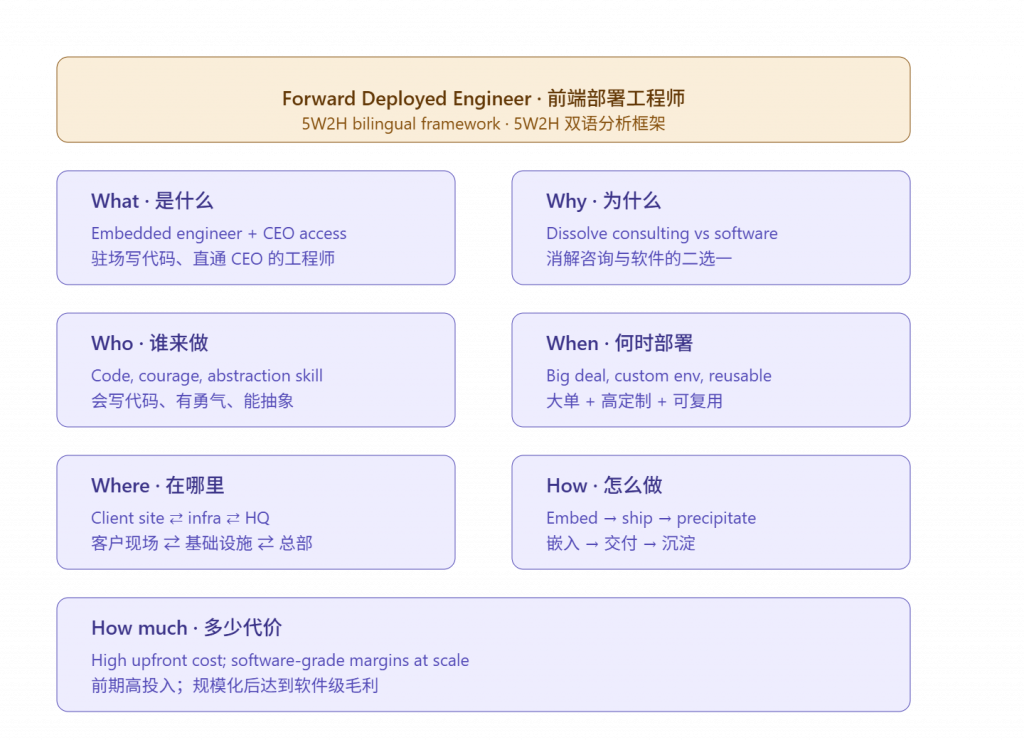
WHAT — 是什么 | What is an FDE?
A senior software engineer embedded inside a client organization who ships production code on the client’s infrastructure and is accountable for the business outcome, not the deliverable. The role is a hybrid of three classical roles — software engineer, consultant, and product manager — fused into one person with CEO-level access.
一名被嵌入到客户组织内部的资深软件工程师,在客户的基础设施上写生产代码,对业务结果而非交付物负责。这个角色是软件工程师、咨询顾问、产品经理三个传统岗位的融合体——压缩在同一个人身上,并拥有直达客户 CEO 的通道。
Core identity | 核心定位: “An embedded startup CTO inside the client.” | “派驻到客户内部的初创 CTO。”
WHY — 为什么 | Why does this role exist?
Because the conventional trade-off between bespoke consulting and scalable software is a false dichotomy that leaves enormous value on the table. Pure consulting can’t scale; pure packaged software can’t penetrate regulated, data-sovereign, operationally complex enterprises. The FDE was invented to dissolve that boundary — converting custom human service into compounding software equity, one engagement at a time.
因为”定制咨询”和”可扩展软件”之间那条传统的二选一,是一个假命题——夹在中间被浪费掉的价值极其巨大。纯咨询无法规模化;纯标品软件又打不进有数据主权要求、监管严格、流程复杂的真实大型企业。FDE 的存在,就是为了把这条边界拆掉——一次项目一次项目地,把定制化的人工服务转化为可复利的软件资产。
Underlying bet | 底层赌注: Marginal software cost → 0 only works if you can absorb messy enterprise reality. FDE is the absorber. | 软件边际成本趋零的前提,是有人能吸收企业现实里的混乱。FDE 就是那个吸收器。
WHO — 谁来做 | Who makes a successful FDE?
Specific profile, not the obvious one:
- An engineer who writes production code, not just architecture diagrams.
- Comfortable challenging the customer, not just pleasing them.
- Capable of switching registers — Python in the morning, CFO conversation at lunch, IT debugging at night.
- Hires fast on domain absorption: three white papers, two ops meetings, useful questions by week two.
- Has political courage — willing to deliver inconvenient truths to senior people.
The companies that copy FDE structure but hire polite consultants fail every time.
具体特征,而非显而易见的特征:
- 一名真写生产代码的工程师,不是只画架构图的人。
- 敢顶回客户,而不是只想取悦客户。
- 能在不同语境间切换——早上写 Python,中午跟 CFO 聊取舍,晚上和客户 IT 联调故障。
- 领域吸收速度极快:读三篇白皮书、坐两次运营会,第二周就能问对问题。
- 具备政治勇气——敢把不中听的话讲给位高权重的人听。
那些抄了 FDE 组织架构、但招的是”听话的顾问”的公司,无一例外地失败。
WHEN — 何时部署 | When should you deploy an FDE?
The FDE model pays off when all four of these conditions are present:
- The deal size is large enough to justify embedded humans (typically 7-figure ACV and up).
- The customer’s environment is too custom for off-the-shelf software.
- The underlying capability has reuse potential across future customers (otherwise you’re just consulting).
- The client has an executive sponsor who can clear political obstacles.
Deploy too early in a sales cycle and you give away engineering time. Deploy too late and you’ve already lost the customer to a competitor who embedded earlier.
当下列四个条件同时成立时,FDE 模式才划算:
- 单笔合同金额足够大,足以养活一支驻场团队(通常 ACV 七位数美元以上)。
- 客户环境定制化程度高到现成软件搞不定。
- 解决方案对未来客户具有复用潜力——否则你只是在做咨询。
- 客户内部有高层支持者,能帮你清除政治阻力。
部署太早,等于白送工程师工时;部署太晚,客户已经被先嵌入的对手抢走了。
WHERE — 在哪里 | Where does an FDE work?
Three places, in rotation:
| Location | Activity | Output |
|---|---|---|
| Client site (driveway / war room) | Embedded with the operational team, debugging real data | Working solution for this customer |
| Client’s production infrastructure | Writing code that touches live business workflows | Measurable business outcome |
| Home product organization | Abstracting patterns, contributing to the platform core | Reusable capability for all future customers |
Most failure modes come from spending all time in only one of these three.
三个工作场所,必须轮转:
| 地点 | 活动 | 产出 |
|---|---|---|
| 客户现场(驻场作战室) | 与客户运营团队同吃同住,对着真实数据 debug | 当前客户的可运行方案 |
| 客户的生产基础设施 | 写直接影响真实业务流程的代码 | 可量化的业务结果 |
| 自家公司产品组织 | 把模式抽象出来,贡献到平台内核 | 服务所有未来客户的可复用能力 |
绝大多数失败模式,都是因为只待在其中一个场所。
HOW — 怎么做 | How does an FDE operate?
The operating loop has six steps:
- Embed. Land at the client, build trust, secure direct access to the executive sponsor.
- Diagnose. Identify the real business problem, not the stated requirement.
- Ship. Write production code, against real data, with real users.
- Measure. Tie the work to a moved business metric. No metric, no win.
- Abstract. Look for the structural pattern underneath this specific solution.
- Precipitate. Hand the abstraction to the product organization to harden into platform capability.
Then return to step 1 with a shorter, cheaper deployment because the platform is now stronger.
操作循环六步:
- 嵌入。 落地客户现场,建立信任,拿到高层支持者的直通通道。
- 诊断。 找到真正的业务问题,而不是被写出来的需求。
- 交付。 用真实数据、面对真实用户,写生产代码。
- 度量。 把工作绑定到一个被推动的业务指标上。指标不动,就不算赢。
- 抽象。 在这个具体方案底下,找出结构性的模式。
- 沉淀。 把抽象交给产品团队,把它固化为平台能力。
然后回到第 1 步,但下一次部署会更短、更便宜——因为平台已经更强了。
The loop’s secret | 这套循环的秘密: Each cycle should make the next cycle cheaper. If it doesn’t, you are doing consulting in disguise. | 每一轮循环都应该让下一轮更便宜。如果做不到,那你只是在做披着皮的咨询。
HOW MUCH — 多少代价 | How much does it cost & what does it return?
Cost side:
- A senior FDE in the US runs $250K–$500K+ all-in annually (salary + equity).
- Engagements typically embed 2–5 FDEs for 3–6 months before the platform-side abstraction lands.
- Upfront cash burn before a customer “lights up”: often $500K–$2M.
Return side:
- A single FDE-led engagement that precipitates even one platform capability can pay back across 10+ future customers — that’s the entire economic engine.
- Palantir’s own published economics: contracts start small (a bootcamp + limited licenses), then expand 5–10× as software adoption deepens. Services subsidize product, not vice versa.
- At scale, the gross margin profile converges to software (70%+), not consulting (30–40%).
成本端:
- 美国一位资深 FDE 的全包成本约 25 万至 50 万美元以上(薪酬 + 股权),每年。
- 一次部署通常需要 2–5 名 FDE,驻场 3–6 个月,平台侧的抽象才能落地。
- 在客户”被点亮”前,前期现金消耗常在 50 万到 200 万美元之间。
回报端:
- 只要一次 FDE 主导的项目能沉淀出哪怕一个平台能力,未来 10+ 客户都能复用——这就是整套商业模式的发动机。
- Palantir 公开的财务模型:合同从小处起步(训练营 + 有限授权),随着软件渗透加深,扩张 5 到 10 倍。服务补贴产品,而非反过来。
- 规模化之后,毛利率向软件靠拢(70%+),而不是咨询(30–40%)。
The economic punchline | 商业模型的题眼: You’re not selling hours. You’re funding R&D that becomes a moat. | 你卖的不是工时,你是在为一条护城河买单——而那条护城河会自己生长。
Quick-Reference Summary Card | 速查总结卡
| 5W2H | One-Line Answer | 一句话答案 |
|---|---|---|
| WHAT | Embedded engineer who ships product and feeds the platform | 驻场写代码、同时反哺平台的工程师 |
| WHY | To dissolve the consulting-vs-software trade-off | 消解”咨询 vs 软件”的二选一 |
| WHO | Code-writing engineer with political courage & abstraction skill | 真写代码、有政治勇气、会抽象的工程师 |
| WHEN | Large ACV + bespoke environment + reuse potential + exec sponsor | 大单 + 高定制环境 + 可复用 + 有高层背书 |
| WHERE | Client site → client infra → home product org (in rotation) | 客户现场 → 客户基础设施 → 自家产品部门(轮转) |
| HOW | Embed → Diagnose → Ship → Measure → Abstract → Precipitate | 嵌入 → 诊断 → 交付 → 度量 → 抽象 → 沉淀 |
| HOW MUCH | High upfront cost; software-grade margin at scale | 前期高投入;规模化后达到软件级毛利 |
Palantir Secret: FDE Model & Service as a Software | Palantir 的秘密:FDE 模型及服务即软件
1. The Paradox That Created the Role | 催生这个角色的悖论
Traditional business logic insists on a trade-off: you can build bespoke, high-value consulting, or you can build infinitely scalable software — but not both. Consulting scales linearly with headcount; software scales exponentially with code. Wanting both has historically been considered a delusion.
Palantir’s contribution to the industry is to prove this dichotomy false. The mechanism it invented to dissolve the boundary is a role: the Forward Deployed Engineer (FDE). The FDE is the human bridge that turns one-off custom service into compounding software equity — the operational unit of what the deck calls Service as a Software (服务即软件).
传统商业逻辑规定了一个必须妥协的二选一:你要么做高度定制、高单价的咨询,要么做可以无限扩展的软件产品,鱼与熊掌不可兼得。咨询的成本随人头线性增长,软件的边际成本却趋近于零。”既要又要”,长期以来被视为妄想。
Palantir 的贡献,是用一个角色——前端部署工程师(FDE)——击穿了这条边界。FDE 是把一次性定制服务转化为可复利的软件资产的”人形桥梁”,也是”服务即软件”这一模式的最小操作单元。
2. What an FDE Actually Is (and What It Isn’t) | FDE 到底是什么、不是什么
An FDE is not a solutions architect, not a presales engineer, not a traditional consultant, and not a customer success manager. The closest honest description: an FDE is a startup CTO embedded inside the client’s environment, with a direct line to the client’s CEO, writing production code on the client’s infrastructure, and accountable for the business outcome — not the deliverable.
Three things distinguish the role:
- Production code, not slide decks. The deliverable is working software running on the client’s data, not a recommendation deck.
- CEO-level access. FDEs report into the client’s most senior decision-maker, which protects them from being routed onto low-impact problems by middle management.
- A dual employer. The FDE is operationally serving the client and feeding the home product organization with the abstractions that emerge from the work.
FDE 不是解决方案架构师,不是售前工程师,不是传统咨询顾问,也不是客户成功经理。最诚实的类比是:FDE 是一名被派驻到客户内部的初创公司 CTO——直接对接客户 CEO、在客户的基础设施上写生产代码、对业务结果而非交付物负责。
这个角色有三个关键标志:
- 交付的是生产代码,不是 PPT。 跑在客户真实数据上的可运行软件,才是产出。
- 直达天听。 FDE 直接对接客户最高决策层,避免被中层”分配”到价值低的问题上。
- 双重雇主关系。 FDE 在为客户解决问题的同时,把工作中沉淀出的抽象规律反哺给自己公司的产品团队。
3. The Three Non-Negotiable Mindsets | 三个不可妥协的思维模式
3.1 Value-Driven, Not Customer-Pleasing | 价值导向,而非取悦客户
A consultant builds what the customer asks for. An FDE builds what is right to solve the underlying problem, which is frequently not the same thing. This is uncomfortable — it means pushing back on requirements, killing pet projects, and occasionally telling a senior client they are wrong. The companies that try to copy the FDE model and fail almost always fail here: they hire engineers who are too polite.
顾问做的是”用户想要的事”,FDE 做的是”我们认为对的事”——而这两者经常并不相同。这种立场会带来摩擦:要顶回需求、要砍掉客户的”心爱项目”、有时甚至要当面告诉资深客户”你想错了”。绝大多数模仿 FDE 模式失败的公司,都不是死在结构上,而是死在招聘上——他们招的工程师太”乖”了。
3.2 Outcome Ownership, Not Output Ownership | 拥有结果,而不是拥有交付物
“I shipped the feature” is not a win. “Mechanical downtime dropped 30%” is. An FDE is judged on whether the underlying business metric moves, not on whether a Jira ticket closed.
“我把功能交付了”不算赢,”机械故障停机时间下降了 30%”才算。衡量一个 FDE 的标准,是底层业务指标有没有动,而不是 Jira 上有没有关掉一张工单。
3.3 Precipitation Discipline | 沉淀的纪律
Every engagement must leave behind a reusable module — a “brick” that lowers the cost of serving the next ten similar clients. If the work doesn’t precipitate into the core platform, it was just expensive consulting. This is the single discipline that separates Palantir’s economics from a Big Four consultancy’s.
每一次项目都必须留下一块可复用的模块——一块”砖”,让未来服务相似的十个客户成本更低。如果工作没有沉淀进核心平台,那它就只是昂贵的咨询而已。这条纪律,是 Palantir 的财务模型和四大咨询公司之间最根本的区别。
4. The Dual Mission: Ship + Precipitate | 双重使命:交付 + 沉淀
Day-to-day, a successful FDE oscillates between two modes:
| Mode | Activity | Output |
|---|---|---|
| Ship mode | Onsite with the client, writing code against their data, debugging the integration that broke at 2am | A working solution for this customer |
| Precipitate mode | Back at HQ, abstracting the pattern, generalizing the code, contributing it to the Ontology | A reusable capability for all future customers |
The Ontology — Palantir’s living, expandable software core — is the destination of the precipitate. Without that substrate, FDE work accumulates as technical debt across one-off deployments. With it, every engagement compounds.
优秀的 FDE 在日常工作中会在两种模式间来回切换:
| 模式 | 内容 | 产出 |
|---|---|---|
| 交付模式 | 驻场客户、对着客户数据写代码、凌晨两点处理崩掉的集成 | 一个能解决当前客户问题的方案 |
| 沉淀模式 | 回到总部,把模式抽象化、把代码通用化、把成果贡献到 Ontology(本体) | 一个能服务未来所有客户的可复用能力 |
Ontology——Palantir 那个活的、可扩展的软件内核——就是这些沉淀的归宿。没有它,FDE 的工作只会变成散落在一堆一次性项目里的技术债;有它,每一次项目都在复利。
5. The Skills That Separate Great FDEs from Good Ones | 区分卓越与合格的能力
Technical competence is the entry ticket, not the differentiator. The FDEs who break out tend to share a specific profile:
- Domain absorption speed. They can read three white papers, sit through two operations meetings, and start asking the right questions by week two. Industry fluency is not optional.
- Comfort with messy reality. Enterprise data is dirty, legacy systems are undocumented, and stakeholders have political agendas. Great FDEs treat this as the work, not as friction.
- Translation across registers. Same person, same day: writing Python to wire a model into a legacy ERP in the morning, walking a CFO through trade-offs in plain language at lunch, debugging an integration with the client’s IT team in the evening.
- Pattern abstraction. The ability to look at five superficially different client problems and see the one structural problem underneath. This is the muscle that drives precipitation.
- Political courage. Willingness to deliver an inconvenient truth to a senior person and survive the room.
技术能力是入场券,不是分水岭。真正脱颖而出的 FDE 通常有几个共同特质:
- 领域吸收速度。 读三篇白皮书、坐两次运营会议,第二周就能问对问题。行业语言不是可选项。
- 对混乱现实的耐受度。 企业数据脏、老系统没文档、利益相关方有政治算计——优秀的 FDE 把这些当作工作本身,而不是阻力。
- 跨语境的翻译能力。 同一个人、同一天:早上用 Python 把模型接进客户的旧 ERP,中午用大白话给 CFO 讲清楚取舍,晚上和客户 IT 团队联调出故障的集成。
- 抽象与归纳。 能从五个表面上完全不同的客户问题里,看出底层那一个共同的结构问题。这块肌肉,正是”沉淀”的发动机。
- 政治勇气。 敢把不中听的真相讲给位高权重的人听,并且还能留在房间里。
6. Common Failure Modes | 常见的失败模式
- Becoming a glorified consultant. Stops writing code, only writes recommendations. Once this happens, the precipitate dries up and the role degrades into managed services.
- Going native. Identifies more strongly with the client than with the home company; loses the second half of the dual mission.
- Customizing without abstracting. Ships great bespoke solutions that never make it back into the platform. Looks productive, builds technical debt for the company.
- Avoiding hard conversations. Optimizing for the relationship instead of the outcome. The customer will be happy in the short term and underwhelmed in the long term.
- Solo heroics. Refusing to bring in product engineering when the abstraction is ready. Hoarding context kills compounding.
- 沦为”高级顾问”。 不再写代码,只写建议。沉淀立刻停止,角色退化为托管服务。
- 被客户同化。 对客户的认同感超过了对自家公司的认同感,丢掉了”双重使命”的另一半。
- 只定制不抽象。 交付出漂亮的定制方案,但没有一项回流到产品平台。看起来很高产,实际是在帮公司攒技术债。
- 回避艰难对话。 优化”关系”而不是”结果”。客户短期满意、长期失望。
- 个人英雄主义。 抽象已经成熟却不愿移交给产品工程团队。囤积上下文,等于谋杀复利。
7. The Career Arc | 职业发展轨迹
A useful way to think about progression:
- Year 1 — Survive the deployment. Learn the client’s domain fast enough to be useful. Ship one production thing end-to-end.
- Year 2 — Identify the pattern. Notice that the same underlying problem appears across two or three accounts. Propose the abstraction.
- Year 3 — Lead the precipitation. Work with the product organization to turn that abstraction into a first-class platform capability. Now you are no longer billing time — you are building equity.
- Year 4+ — Multiply yourself. Either lead a pod of FDEs, or move into product engineering with field-earned conviction about what the platform actually needs. Either path is unusually high-leverage.
一个有用的成长路径划分:
- 第 1 年——活下来。 快速把客户的业务学到能干活的程度,端到端交付一件能进生产的东西。
- 第 2 年——看见模式。 在两到三个不同客户身上发现同一个底层问题,提出抽象方案。
- 第 3 年——主导沉淀。 和产品团队合作,把这个抽象变成平台的一等公民能力。这一刻起,你卖的不再是工时,而是在累积股权。
- 第 4 年及以后——复制自己。 要么带一支 FDE 小队,要么带着前线打过仗的直觉转去做产品工程。两条路的杠杆都极大。
8. Why This Matters Now | 这件事为什么在此刻重要
The FDE model is no longer a Palantir curiosity. OpenAI, Anthropic, Scale AI, Ramp, Databricks, and a long tail of frontier AI companies have stood up FDE functions, because deploying LLMs into real enterprises has the exact same shape as Palantir’s original problem: highly customized integration with messy enterprise reality, on top of a model whose marginal cost wants to go to zero. The role that worked for the intelligence community in 2005 is the role that works for AI deployment in 2026.
If you are deciding whether to invest a career chapter into being an FDE, the underlying bet is straightforward: the next decade of enterprise software value will be created at the seam where general-purpose AI meets specific, messy operational reality. FDEs sit exactly on that seam.
FDE 模式早已不是 Palantir 的独门绝技。OpenAI、Anthropic、Scale AI、Ramp、Databricks,以及一长串前沿 AI 公司,都已经搭建了自己的 FDE 团队——因为把大模型部署进真实企业,问题的形状和当年 Palantir 面对的几乎一模一样:在一颗边际成本趋零的内核之上,去做高度定制化的集成,去面对乱糟糟的企业现实。2005 年管用的那个角色,2026 年依然管用。
如果你正在权衡是否要把一段职业生涯押在 FDE 上,底层赌注其实非常清晰:未来十年企业软件的价值,会在”通用 AI”与”具体、混乱的运营现实”接缝处被创造出来。 而 FDE,就坐在那条缝上。
9. Closing: Turn Delusion into Reality | 结语:化妄想为现实
The deeper lesson behind the FDE model is not about a job title. It is a posture toward apparent contradictions. Bespoke or scalable. Service or software. Customer-driven or value-driven. The conventional move is to pick a side. The Palantir move is to refuse the framing, build the machinery that dissolves it, and walk away with both.
FDE 模式背后真正的启示,跟职位无关,跟”面对看似矛盾时的姿态”有关。是定制还是规模化?是服务还是软件?是客户驱动还是价值驱动?常规打法是选一边。Palantir 的打法是拒绝这个二选一,亲手造出能让矛盾消解的机器,然后把两样都拿走。
Reference | 参考资料
1. Palantir Engineering Blog — Ontology-Oriented Software Development帕兰泰尔工程博客——以”本体”为核心的软件开发 Peter Wilczynski (Product Lead, Ontology System). The canonical primary source on why Palantir built the Ontology and how it “drives the marginal cost of bespoke enterprise software development to zero.” 🔗 https://blog.palantir.com/ontology-oriented-software-development-68d7353fdb12 核心价值 | Why it matters: First-party explanation of the technical substrate that makes precipitation work. | 一手资料,解释了”沉淀机制”赖以成立的技术底座。
2. 8VC — The AI Services Wave: Lessons from Palantir in The New Age of AI8VC——AI 服务浪潮:Palantir 给新 AI 时代的启示 Written by Palantir/8VC insiders. The clearest articulation of “we productized our services” and how services subsidize product, not the other way around. 🔗 https://www.8vc.com/resources/the-ai-services-wave-lessons-from-palantir-in-the-new-age-of-ai 核心价值 | Why it matters: Insider framing of “Service as a Software” before the term became popular. | 在”服务即软件”成为流行词之前,内部人士对该模式最清晰的阐述。
3. a16z — The Palantirization of Everythinga16z——一切皆”帕兰泰尔化” Andreessen Horowitz’s analysis of why every AI company is now copying Palantir’s go-to-market — small contracts that expand into software-dominant revenue. 🔗 https://a16z.com/the-palantirization-of-everything/ 核心价值 | Why it matters: Top-tier VC perspective on why the model now defines enterprise AI go-to-market. | 顶级 VC 视角下,FDE 模式如何重新定义企业 AI 的市场切入方式。
4. Silicon Valley Product Group — Forward Deployed EngineersSilicon Valley Product Group——前端部署工程师 Marty Cagan’s product-management lens on the FDE role and why most companies that copy it miss the point. 🔗 https://www.svpg.com/forward-deployed-engineers/ 核心价值 | Why it matters: Product-leadership reading of FDE — required for anyone thinking about org design. | 从产品管理视角解读 FDE,对组织设计者必读。
5. Pragmatic Engineer — What are Forward Deployed Engineers, and why are they so in demand?Pragmatic Engineer——什么是 FDE?为什么现在如此抢手? Gergely Orosz’s market-side analysis with hiring data from Palantir, OpenAI, and Ramp. 🔗 https://newsletter.pragmaticengineer.com/p/forward-deployed-engineers 核心价值 | Why it matters: Most credible labor-market read on FDE demand across frontier AI companies. | 关于前沿 AI 公司 FDE 招聘市场最可信的分析。
6. Medium / balaji bal — Understanding Palantir: FDEs and the Making of an Unusual Platform CompanyMedium / balaji bal——理解帕兰泰尔:FDE 与一家非典型平台公司的诞生 Strong piece on why the point of the FDE is not customer proximity — it’s pattern abstraction that flows back into the platform. 🔗 https://medium.com/@balajibal/understanding-palantir-forward-deployed-engineers-and-the-making-of-an-unusual-platform-company-494dc7812f24 核心价值 | Why it matters: Sharpest articulation of “abstraction-back-to-platform” as the real FDE deliverable. | 把”将模式抽象回流到平台”作为 FDE 真正交付物,阐述得最锋利的一篇。
7. Medium / Tao An (陶安) — Forward Deployed Engineers: AI’s Answer to the SaaS Customization ParadoxMedium / 陶安——前端部署工程师:AI 时代对 SaaS 定制化悖论的回答 Bilingual-friendly author. Particularly strong on why the FDE model is mandatory, not optional, for the Chinese market given data-localization and industry-specificity constraints. 🔗 https://tao-hpu.medium.com/forward-deployed-engineers-ais-answer-to-the-saas-customization-paradox-1223e6425b6f 核心价值 | Why it matters: Best China-market-aware analysis; explains why FDE is “must-have” in regulated, data-sovereign environments. | 最贴近中国市场的分析,解释了在数据主权和行业强监管下,FDE 为何是”刚需”而非”可选”。
8. Medium / Diogo Silva Santos — A Comprehensive Analysis of Palantir’s Forward Deployed Engineering ModelMedium / Diogo Silva Santos——帕兰泰尔 FDE 模式的深度剖析 Long-form deconstruction. The most useful section is on why imitators fail at hiring, not at structure — they hire polite consultants instead of pragmatic engineers. 🔗 https://medium.com/activated-thinker/a-comprehensive-analysis-of-palantirs-forward-deployed-engineering-model-4502a036b5e4 核心价值 | Why it matters: Best diagnosis of why most FDE imitations fail (it’s the hire, not the org chart). | 对”模仿 FDE 为何屡屡失败”诊断得最准的一篇——问题出在招聘,不在组织架构。
9. Palantir Foundry Docs — Why Create an Ontology?Palantir Foundry 官方文档——为什么要建”本体”? First-party documentation on what the Ontology is technically — a “decision-centric semantic representation of the enterprise.” 🔗 https://www.palantir.com/docs/foundry/ontology/why-ontology 核心价值 | Why it matters: Definitive technical reference for the substrate the FDE precipitates into. | FDE 沉淀工作的最终归宿——Ontology——的权威技术参考。
10. 10Clouds — What is a Forward Deployed Engineer? (with 2026 bloomberry hiring analysis)10Clouds——什么是 FDE?(含 2026 年 bloomberry 招聘分析) Practical operator-level guide. Cites the bloomberry analysis of 1,000 FDE job listings showing 1,165% YoY hiring growth. 🔗 https://10clouds.com/blog/a-i/what-is-a-forward-deployed-engineer/ 核心价值 | Why it matters: Most up-to-date hiring data and salary benchmarks for the role. | 对该角色最新的招聘数据与薪酬基准。
Reading Order Suggestion | 推荐阅读顺序
For a strategic read on why the model exists → start with #2 (8VC) and #3 (a16z). 想理解”为什么会有这套模式”——先读 #2 (8VC) 和 #3 (a16z)。
For a technical read on how it works → #1 (Palantir Blog) then #9 (Foundry Docs). 想理解”它在技术上怎么跑起来”——读 #1(Palantir 博客) 再读 #9(Foundry 文档)。
For an operator read on how to do it → #4 (SVPG), #6 (balaji bal), #8 (Silva Santos). 想理解”怎么把它做出来”——读 #4 (SVPG)、#6 (balaji bal)、#8 (Silva Santos)。
For a market & career read → #5 (Pragmatic Engineer), #7 (Tao An), #10 (10Clouds). 想理解”市场与职业前景”——读 #5 (Pragmatic Engineer)、#7 (陶安)、#10 (10Clouds)。
