

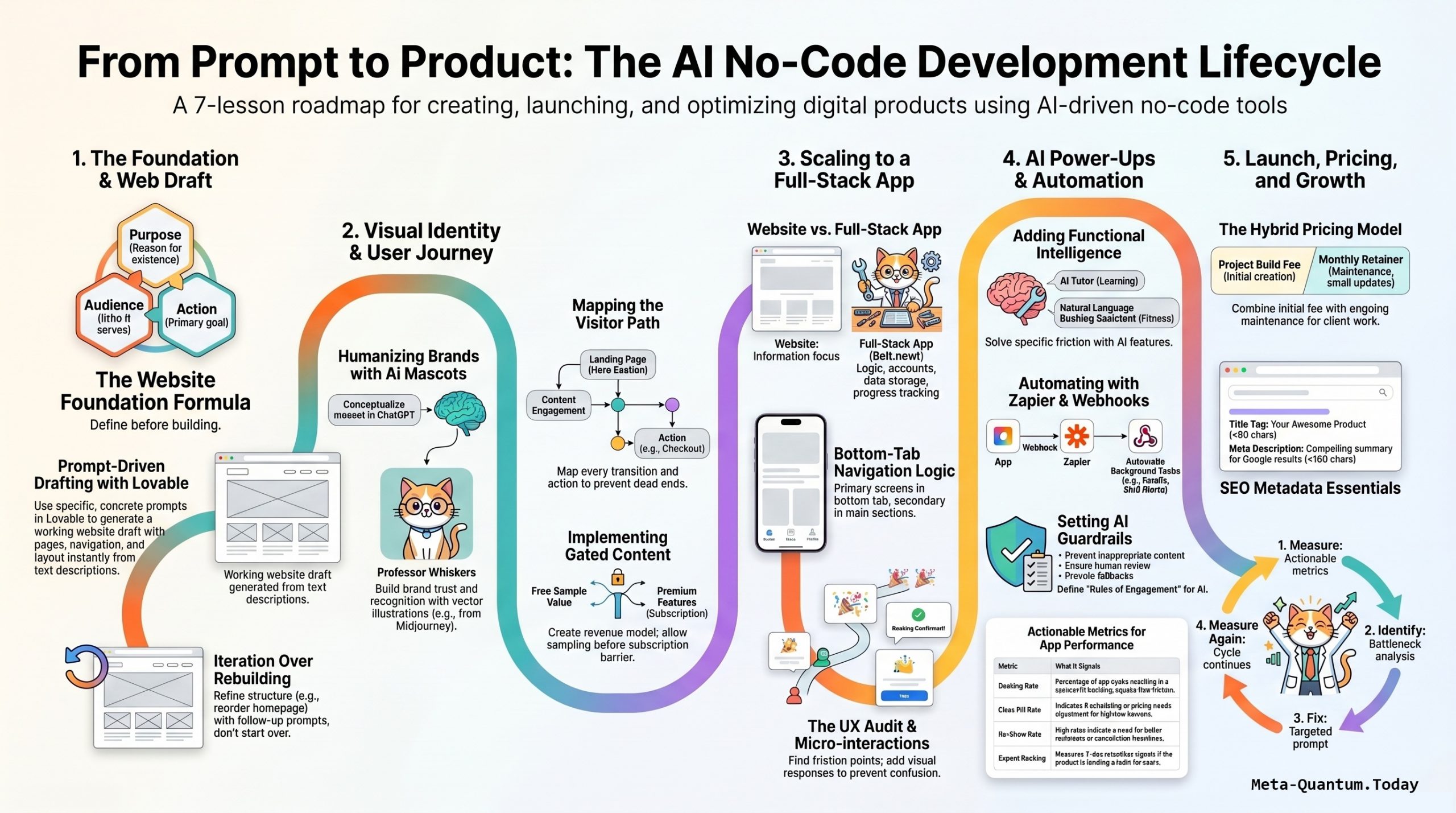
A bilingual deep-dive into building real apps and websites without writing a single line of code.
一篇双语长文,带你不写一行代码,做出真正能上线的 App 和网站。
Introduction / 引言
There’s a quiet shift happening in software. For decades, the hard part of turning an idea into a product was writing the code. That’s no longer true. A new generation of no-code AI builders lets you describe what you want in plain language and watch a working draft appear in seconds. Zero to One with No-Code AI is a 15-part playbook that treats the AI builder not as a tool you operate, but as a product partner you direct. It walks through the entire lifecycle — first prompt, design, AI features, automation, monetization, launch, and endless iteration — using two running case studies: BrightMinds (a B2C children’s education website) and FitBase (a B2B fitness-class booking app).
The core premise matches exactly where the industry landed in 2025–26: the bottleneck is no longer code, it’s knowing what to ask for. As practitioners now put it, successful building depends on context engineering — designing prompts, providing examples, and knowing when to intervene.
软件行业正在悄悄发生一场变革。过去几十年里,把一个想法变成产品,最难的部分是写代码。如今这已不再成立。新一代的「无代码 AI 构建工具」让你只需用大白话描述需求,几秒钟就能看到一个能跑的初稿。
《从零到一玩转无代码 AI》是一份共 15 个部分的实战手册。它的核心理念是:不要把 AI 构建工具当成一个「你操作的工具」,而要当成一个「你指挥的产品搭档」。手册完整覆盖了产品全生命周期——从第一条提示词、设计、AI 功能、自动化、变现、上线,到永不停歇的迭代——并贯穿两个案例:BrightMinds(面向消费者的儿童教育网站)和 FitBase(面向企业的健身课程预约 App)。
它的核心论点恰好印证了 2025–26 年行业的现状:瓶颈不再是代码,而是「你知不知道该问什么」。正如业内人士所说,成功的关键在于情境工程(context engineering)——设计提示词、提供示例,并知道何时该亲自介入。
1. The Foundation Formula: Specificity Drives Quality / 地基公式:具体性决定质量
Everything starts with three inputs fed into a “Specificity Engine”:
- Purpose — the core reason the product exists (e.g., “Make science accessible and fun”).
- Audience — the specific users it serves (e.g., “Parents seeking trustworthy after-school content”).
- Action — the primary call to action (e.g., “Start a free trial”).
The thesis is blunt: the difference between a useless AI output and a working first draft is the concrete specificity of your initial prompt. This is well supported — the quality of AI-generated output is only as good as the instructions given, and every added constraint narrows the model’s hypothesis space, reducing variance.
一切都始于喂给「具体性引擎」的三个输入:
- 目的(Purpose)——产品存在的核心理由(例如:「让科学变得易懂又有趣」)。
- 受众(Audience)——它服务的具体人群(例如:「想为孩子找可靠课外内容的家长」)。
- 行动(Action)——首要的行动召唤(例如:「开始免费试用」)。
这一论点很直白:一个废柴 AI 输出和一个能用的初稿之间的差距,就在于你第一条提示词够不够具体。这个观点有充分依据——AI 生成结果的质量,完全取决于你给的指令;每多加一个约束,就缩小一次模型的「假设空间」,从而降低输出的不确定性。
2. The Prompt-to-Product Pipeline /「提示词到产品」的流水线
You define pages, audience, and style direction conversationally, while the AI renders layout, components, and navigation in real time. The single most important discipline here:
Refine, don’t rebuild. When something is off, you don’t start over — every follow-up prompt builds sequentially on what’s already generated.
This matches the consensus that vibe coding works best as iterative conversational collaboration: a continuous dialogue between you and the AI. Trying to one-shot an entire product in a single mega-prompt is a losing battle — no matter how detailed, the AI won’t honor every aspect of it.
你用对话的方式定义页面、受众和风格方向,AI 则实时渲染出布局、组件和导航。这里最重要的一条纪律是:
要打磨,不要重做。 当某处不对劲时,不要推倒重来——每一条后续提示词都应在已生成的内容上「顺次叠加」。
这符合业界共识:vibe coding(氛围编程)最有效的模式是迭代式对话协作——你和 AI 之间持续不断的对话。妄想用一条「超级提示词」一次性生成整个产品,是一场注定失败的战斗——无论你写得多详细,AI 都不可能照顾到每一个细节。
3. The Web vs. App Paradigm / 「网站 vs. App」范式
The playbook splits tooling by goal:
| Websites | Apps | |
|---|---|---|
| Tool | Lovable | Bolt.new |
| Primary Goal | Discovery & Acquisition | Daily Workflows & Retention |
| Structure | Top nav bar, broad browsing | Bottom tab bar, focused recurring tasks |
| Case Study | BrightMinds (B2C, gated content) | FitBase (B2B, needs auth + stored data) |
A current-reality caveat: both tools have evolved past this neat split. Lovable Cloud (late 2025) now auto-provisions a Supabase backend per workspace, and Bolt V2 / Bolt Cloud added built-in databases, auth, storage, and hosting. The old “Lovable = full-stack, Bolt = frontend-only” gap has narrowed. Still, the practical division holds: a non-technical founder can ship a prototype in Lovable in an afternoon, while the same person would likely struggle with Bolt.new’s IDE-style interface.
手册按「目标」来划分工具:
| 网站 Websites | App | |
|---|---|---|
| 工具 | Lovable | Bolt.new |
| 首要目标 | 发现与获客 | 日常工作流与留存 |
| 结构 | 顶部导航栏,适合广泛浏览 | 底部标签栏,适合聚焦的高频任务 |
| 案例 | BrightMinds(B2C,付费墙内容) | FitBase(B2B,需登录 + 数据存储) |
一个符合当下现实的提醒: 这两款工具其实都已超越了上面这种整齐的划分。Lovable Cloud(2025 年底推出)现在会为每个工作区自动配置 Supabase 后端;Bolt V2 / Bolt Cloud 也加入了内置数据库、认证、存储和托管。过去「Lovable 是全栈、Bolt 只能做前端」的差距已经缩小。不过手册划分的实用逻辑依然成立:一个没有技术背景的创始人,能在一个下午用 Lovable 做出原型,而同一个人面对 Bolt.new 类似 IDE 的界面,多半会吃力。
4. Designing the Visitor Journey / 设计访客旅程
Navigation must mirror the user’s actual path:
Google Search → Homepage Hero → Subject Catalog → Free Sample Lesson → Pricing Page → Checkout
The architectural rule: only pages that support the primary flow belong in main navigation. Distractions go to the footer. Your menu is not a sitemap — it’s a funnel.
导航必须映射用户的真实路径:
谷歌搜索 → 首页 Hero 区 → 学科目录 → 免费试听课 → 价格页 → 结账
架构铁律:只有支撑主要转化流程的页面才配进主导航,其余干扰项一律放到页脚。 你的菜单不是网站地图,而是一条转化漏斗。
5. The UX Audit & Refinement / UX 体检与打磨
A raw AI draft (e.g., a bare calendar with no onboarding and no visual feedback) gets refined into something polished:
- 3-Screen Onboarding: Welcome → How booking works → Book your first class.
- Micro-Interactions: A “Booking Confirmed” card appears instantly to prevent double-booking and give the user reassurance.
The friction in a first draft is the feature you haven’t asked for yet.
一个原始的 AI 初稿(比如一个光秃秃的日历,没有引导、没有视觉反馈),会被打磨成精致的成品:
- 三屏新手引导: 欢迎 → 预约怎么用 → 预约你的第一节课。
- 微交互: 「预约成功」卡片立即弹出,既防止重复预约,又给用户即时的安心感。
初稿里的每一处「摩擦」,都是你还没来得及开口要的那个功能。
6. Contextual AI: Responding in the Moment / 情境式 AI:在当下做出回应
The best AI features respond to exactly what the user is doing in that exact moment.
- BrightMinds (B2C): Smart search matches natural-language queries to lesson tags; an in-lesson tutor chatbot answers follow-ups in a 3-sentence, age-appropriate voice.
- FitBase (B2B): A natural-language booking assistant — type “Yoga tomorrow morning” and book the specific class in a single tap.
最好的 AI 功能,会精准回应用户「此时此刻」正在做的事。
- BrightMinds(B2C): 智能搜索把自然语言查询匹配到课程标签;课内的辅导聊天机器人用三句话、贴合年龄的口吻回答追问。
- FitBase(B2B): 自然语言预约助手——输入「明天早上的瑜伽」,一键就能预约到那节具体的课。
7. Establishing AI Guardrails / 设立 AI 护栏
A traffic-light system governs AI behavior:
| Light | Meaning | BrightMinds (Tutor) | FitBase (Assistant) |
|---|---|---|---|
| 🔴 Stop | Never do | Discuss adult content / give personal advice | Book overlapping classes / bypass capacity limits |
| 🟡 Review | Flag for humans | A child asks the same question 5+ times (confusion) | A user tries to book 3+ classes in one day |
| 🟢 Go | Safe fallback | “Great question — I’m struggling with it, ask a parent!” | Display the full manual schedule to browse |
This reflects the broader lesson: treat AI as a collaborator with review and constraints built in, not a magic box you trust blindly.
用一套红绿灯系统来约束 AI 的行为:
| 灯 | 含义 | BrightMinds(辅导机器人) | FitBase(预约助手) |
|---|---|---|---|
| 🔴 停 | 绝不可做 | 讨论成人内容/给个人建议 | 预约时间冲突的课/突破满员上限 |
| 🟡 审 | 标记交人工 | 孩子把同一问题问了 5 次以上(说明困惑) | 用户试图一天预约 3 节以上的课 |
| 🟢 行 | 安全兜底 | 「问得真好——我这会儿答不上来,去问问爸妈吧!」 | 直接展示完整的手动课表供浏览 |
这体现了一个更宏观的道理:把 AI 当成一个内建了「审核与约束」的协作者,而不是一个你盲目信任的魔法黑箱。
8. The Automation Engine / 自动化引擎
A no-code backend chain handles the invisible logic:
Trigger (Bolt.new) → Bridge (Webhook) → Engine (Zapier) → Action (Gmail)
A user taps “Confirm Booking”; the app pushes class name, date, and email to a unique URL; Zapier’s “Catch Hook” listens and sorts the data; a personalized confirmation email goes out automatically.
Key insight: Automations handle background logic — confirmations, waitlists — silently, making a small business feel like an enterprise.
一条无代码后端链路,处理所有「看不见」的逻辑:
触发(Bolt.new)→ 桥接(Webhook)→ 引擎(Zapier)→ 动作(Gmail)
用户点击「确认预约」;App 把课程名、日期和邮箱推送到一个专属 URL;Zapier 的「Catch Hook」监听并整理这些数据;一封个性化的确认邮件随即自动发出。
关键洞察: 自动化在后台默默处理各种逻辑——确认、候补名单——让一家小作坊用起来像一家大企业。
9. Monetization & Client Pricing Models / 变现与客户定价模型
- One-Time Project Fee — best for fixed scope, no ongoing updates. You build, hand off, exit.
- Monthly Retainer — best for maintenance-heavy projects needing constant adjustment.
- The Hybrid (Recommended) — a project fee to build + a smaller monthly retainer for maintenance. Example FitBase proposal: $2,500 build fee + $350/month (includes 5 hours of updates). Aligns maximum mutual value.
- 一次性项目费 —— 适合范围固定、无需持续更新的项目。做完、交付、退出。
- 月度服务费(Retainer) —— 适合需要不断调整的「重维护」型项目。
- 混合模式(推荐) —— 一笔建设项目费 + 一笔较小的月度维护费。FitBase 报价示例:2,500 美元建设费 + 350 美元/月(含 5 小时更新)。 这种模式让双方利益最大程度地对齐。
10. The Launch Control Board / 上线控制台
Four pre-launch checkboxes:
- Custom Domains (Trust): Move off builder subdomains (e.g.,
lovable.app) onto a real domain (e.g.,fitbasestudio.com). - Hosting (Deployment): Use built-in hosting from Lovable/Bolt.new, or export to Vercel/Netlify for advanced needs.
- SEO Metadata (Discovery): Title tags (<60 chars) and meta descriptions (<160 chars) targeting specific keywords.
- Final Testing (Verification): Test payment flows in Stripe test mode; verify mobile responsiveness and post-payment content unlocking.
上线前的四个勾选项:
- 自定义域名(信任): 摆脱构建工具的子域名(如
lovable.app),换成真正的域名(如fitbasestudio.com)。 - 托管(部署): 使用 Lovable/Bolt.new 的内置托管,或为高级需求导出到 Vercel/Netlify。
- SEO 元数据(被发现): 标题标签(<60 字符)、meta 描述(<160 字符),针对具体关键词。
- 最终测试(验证): 用 Stripe 测试模式跑通支付流程;验证移动端响应式和「付款后内容解锁」。
11. Actionable Metrics vs. Noise / 可行动指标 vs. 噪音
Don’t track everything — track the numbers that signal product health.
- ❌ Vanity (Ignore): Total page views, time on site, bounce rate.
- ✅ Actionable (FitBase):
- Booking Rate — % of app opens that result in a booking (drop = booking-flow friction).
- Class Fill Rate — are classes full? (low = scheduling/pricing issue).
- No-Show Rate — booked but didn’t attend (high = weak reminders).
- Repeat Booking Rate — booked again within 7 days (drop = lack of habit).
不要什么都追踪——只追踪能反映产品健康度的数字。
- ❌ 虚荣指标(忽略): 总页面浏览量、停留时长、跳出率。
- ✅ 可行动指标(以 FitBase 为例):
- 预约率 —— 打开 App 后真正完成预约的比例(下降 = 预约流程有摩擦)。
- 满班率 —— 课程是否坐满?(偏低 = 排课/定价有问题)。
- 爽约率 —— 预约了却没来(偏高 = 提醒机制太弱)。
- 复购率 —— 7 天内再次预约(下降 = 没形成习惯)。
12. Finding & Fixing the Bottleneck / 找到并修复瓶颈
The Diagnosis: FitBase has a 30% no-show rate — members book 3 days out, then forget. The AI Prompt Solution (“Deploy targeted UI fixes to prevent no-shows”):
- A push notification 2 hours before class with a clear “Confirm or Cancel” button.
- A soft penalty in system logic (3 no-shows = loss of priority booking).
- A dynamic “Your class is in 2 hours” card on the home dashboard.
诊断: FitBase 有 30% 的爽约率——会员提前 3 天预约,然后就忘了。AI 提示词解法(「部署有针对性的 UI 修复来减少爽约」):
- 开课前 2 小时推送通知,带一个清晰的「确认或取消」按钮。
- 在系统逻辑里加一条软性惩罚(爽约 3 次 = 失去优先预约权)。
- 在主页仪表盘上加一张动态卡片:「你的课程将在 2 小时后开始」。
13. The Endless Iteration Loop / 永不停歇的迭代循环
Measure Data → Identify Bottleneck → Prompt a Fix → Measure Again → (repeat)
The real point: No-code AI doesn’t just change how fast you build the first draft — it changes how fast you can iterate the final product. Sample sprint: Week 1 focus entirely on No-Shows; Week 2 pivot entirely to Booking Rate.
测量数据 → 定位瓶颈 → 提示词修复 → 再次测量 →(循环往复)
真正的重点在于:无代码 AI 改变的不只是你做出初稿的速度,更是你迭代最终产品的速度。 冲刺示例:第一周全力攻克爽约问题;第二周完全转向提升预约率。
Conclusion & Key Takeaways / 结语与核心要点
The playbook’s closing line says it all: “You no longer need to learn to code. You just need to learn what to ask for.” Its deepest contribution is reframing no-code AI not as a faster way to produce a first draft, but as a faster way to iterate the final product.
The essentials:
- Specificity is the lever — define Purpose, Audience, and Action before you build.
- Match the tool to the goal — Web/acquisition → Lovable; App/retention → Bolt.new (both now more full-stack than the deck implies).
- Refine, never rebuild — treat building as a layered conversation; solve small problems in sequence.
- Design around the journey, audit for UX friction, add contextual AI that responds in the moment.
- Put guardrails on the AI and automate the invisible backend work.
- Track signal, not noise — then run the measure-fix-measure loop forever.
One honest caveat the deck understates: real builders consistently hit a “technical cliff” — a gorgeous AI mockup appears, then stalls at “configure RLS policies” and “debug this build error.” The framework is sound; just expect that gap when moving from prototype to production.
手册的结尾一语道破:「你不再需要学会写代码,你只需要学会该问什么。」 它最深刻的贡献,是重新定义了无代码 AI——它快的不只是「做出初稿」,更是「迭代最终产品」。
核心要点:
- 具体性是杠杆 —— 动手前先定义好目的、受众、行动。
- 按目标选工具 —— 网站/获客 → Lovable;App/留存 → Bolt.new(如今两者都比手册描述的更全栈)。
- 要打磨,绝不重做 —— 把构建当成分层叠加的对话,按顺序解决小问题。
- 围绕旅程设计,体检 UX 摩擦,加入能即时回应的情境式 AI。
- 给 AI 装上护栏,并把看不见的后端工作自动化。
- 追踪信号,而非噪音 —— 然后永远跑「测量-修复-再测量」的循环。
一个手册没明说的诚实提醒: 真实的搭建者几乎都会撞上一道「技术悬崖」——一个漂亮的 AI 原型出现了,却卡在「配置 RLS 权限策略」和「调试这个构建报错」上。这套框架本身没问题;只是从原型走向正式上线时,要对这道坎有心理准备。
References / 参考资料
- Lovable vs Bolt.new 2026 Comparison — NxCode — https://www.nxcode.io/resources/news/lovable-vs-bolt-new-2026-ai-app-builder-comparison
- Best AI App Builder 2026 (the “technical cliff”) — Mocha — https://getmocha.com/blog/best-ai-app-builder-2026
- Lovable vs Bolt Official Guide — Lovable — https://lovable.dev/guides/lovable-vs-bolt
- How to Vibe Code with No-Code Tools — PromptHub — https://www.prompthub.us/blog/how-to-vibe-code-with-no-code-tools-prompting-tips-and-how-to-troubleshoot
- Level Up Your AI Workflow: 11 Vibe Coding Best Practices for Real-World Builders – https://hexaware.com/blogs/level-up-your-ai-workflow-11-vibe-coding-best-practices-for-real-world-builders/
- Vibe Coding Explained: Platforms, Prompts & Best Practices — Clarifai — https://www.clarifai.com/blog/vibe-coding-explained
- Vibe Coding Best Practices — Softr — https://www.softr.io/blog/vibe-coding-best-practices
