

Introduction
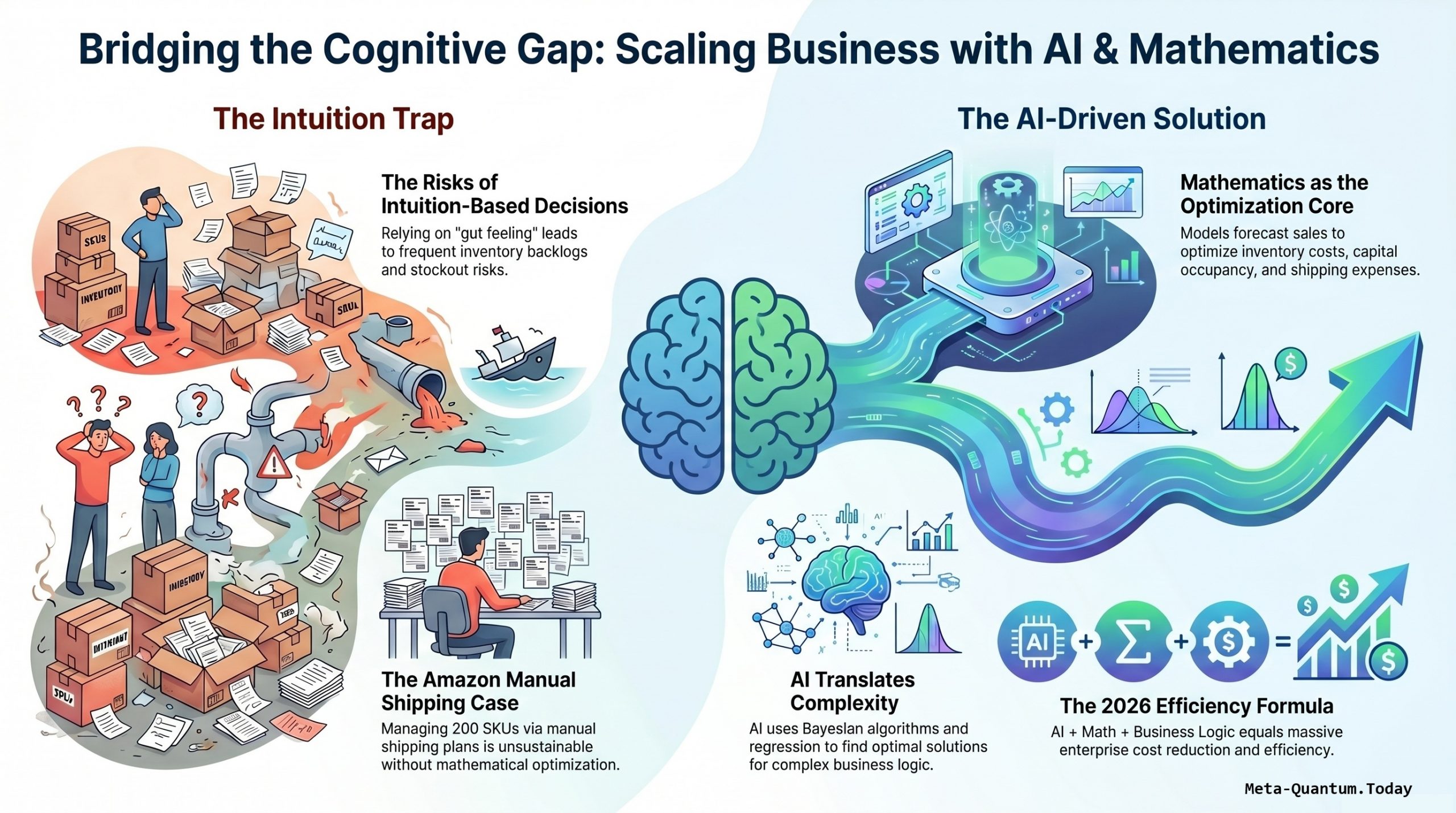
2026 Enterprise era: the most expensive business problems can no longer be solved by human guesswork. It positions an “Enterprise Cognitive Gap” — the chasm between human intuition and the mathematical optimization required to run modern operations at scale — and argues that AI is the bridging mechanism. The opening cover slide juxtaposes “The Intuition Trap” (chaotic inventory, stressed managers, manual paperwork) against “The AI-Driven Solution” (mathematical models, forecasting curves, optimization engines), establishing the entire narrative arc in a single image.
The core formula promoted throughout: AI + Mathematics + Business Logic = Explosive Cost Reduction & Efficiency Increase.
Key Features and Concepts
1. The Cognitive Gap. The presentation opens by diagnosing the problem. Human cognition simply does not scale to operational complexity. It uses the now-classic illustration of trying to manually plan shipments for 200 distinct SKUs — relying entirely on memory and instinct produces systemic failure, manifesting as either inventory backlog or stockout. This kind of multi-SKU complexity is exactly what current 2026 research is targeting: modern inventory optimization software calculates SKU-specific safety stock levels based on forecasts, supplier lead times, usage patterns, and target service levels, treating each SKU separately rather than applying blanket reorder points.
2. The Impossible Balancing Act. A scale visualization shows the manager’s dilemma: tip toward inventory backlog (capital tied up in unsold goods) or tip toward stockout risk (lost sales, damaged customer trust). Without an optimization framework, leaders are reduced to guessing which loss hurts less — described as “the ultimate friction point.”
3. The Total Cost Optimization (TCO) Blueprint. This is the mathematical heart of the presentation. Four cost variables — Inventory Management Cost, Capital Occupation, Stockout Loss, and Freight Costs — all feed into a central Sales Forecast Model. The slide displays representative formulas (summation expressions involving variables like μ, ε, and exponential terms) to convey that optimization means balancing all four variables simultaneously, not sequentially.
4. AI as Universal Mathematical Translator. A pivotal concept: AI sits as a middle layer between Business Logic (constraints and goals, expressed in natural language) and Complex Mathematics (formulas, integrals, summations). The quoted promise: “AI takes complex mathematical principles and explains them as if to a junior high student.” Business leaders no longer need to be mathematicians — they provide logical constraints, and AI writes, translates, and executes the high-level math.
5. The 4-Step Execution Workflow. “Algorithmic Execution at the Speed of Thought” lays out the operating model:
- Step 1 — Define the Friction: Identify the single most expensive business problem.
- Step 2 — Business Logic Prompting: Translate the operational goal into AI-readable constraints.
- Step 3 — Algorithmic Calculation: Apply Bayesian algorithms (probabilistic forecasting) and regression algorithms (curve fitting, trend analysis).
- Step 4 — The Optimal Solution: Mathematically verified strategies delivered instantly.
This Bayesian-plus-regression pairing is well-supported in current literature: a two-echelon inventory system with Bayesian learning continuously updating parameter estimates achieved 7.4% cost reduction in stable environments and 5.7% improvement during supply disruptions versus traditional static optimization.
6. The Efficiency Flywheel. Three interlocking gears — Mathematics, Programming, and Business Underlying Logic — drive an upward-pointing arrow labeled “Explosive Commercial Efficiency.” The catalyst flagged at the bottom: AI bootcamps that empower underlying business teams, suggesting the value capture happens when domain experts (not just data scientists) gain AI fluency.
Related Subject Context
On regression and Bayesian methods in retail. The video’s emphasis on these two algorithm families reflects mainstream practice. Regression models quantify relationships between sales and influencing variables such as price, promotions, and marketing spend, enabling scenario planning, while machine learning uncovers non-linear patterns ideal for high-SKU environments. The “Sales Forecast Model” hub in the TCO blueprint is the operational manifestation of this.
On AI as a translator between business logic and optimization math. This framing matches an emerging academic direction where AI methods are applied across the operations research pipeline — risk analysis, forecasting, inventory control, supply chain management — with Bayesian belief networks predicting supply chain disruption risk and reinforcement learning agents predicting order quantities and restocking needs. The video’s “Universal Mathematical Translator” metaphor is essentially a consumer-friendly version of this research program.
On the “200 SKU” framing. This vivid framing — one human trying to mentally juggle 200 product lines — is a useful rhetorical anchor because it sits at the exact scale where intuition breaks but classical OR methods (manual EOQ calculations, static safety stock tables) also become unwieldy. The pitch is that AI collapses the gap between “too complex for a person” and “too custom for a spreadsheet.”
Conclusion and Key Takeaways
The closing slide delivers the mandate plainly: “AI + Mathematics + Business Capability = Explosive Cost Reduction & Efficiency Increase. Embrace the AI explosion. Stop guessing. Start optimizing.”
Distilled takeaways:
- Intuition does not scale. Past a certain operational complexity threshold (the 200-SKU example is the marker), gut-feel decisions produce systemic losses.
- Optimization is multi-variable by nature. Inventory, capital occupation, stockout loss, and freight costs must be solved simultaneously — single-axis decisions create the “balancing act” trap.
- AI’s role is translation, not magic. It converts natural-language business constraints into the math that classical OR has used for decades, lowering the expertise barrier.
- The workflow is repeatable. Define friction → prompt with business logic → let AI run Bayesian/regression calculations → receive verified strategy. This is a procedure, not an experiment.
- The competitive moat is fluency. Companies that train their business teams to invoke mathematical optimization through AI — rather than waiting for a centralized data science function — capture the “flywheel” effect first.
Related References
- TechVerx — Retail Inventory Optimization with Predictive Analytics in 2026: https://www.techverx.com/retail-inventory-optimization-predictive-analytics/
- StockIQ — Utilizing Inventory Optimization Software in 2026: https://stockiqtech.com/blog/inventory-optimization-software/
- arXiv preprint 2511.06479 — Bridging Theory and Practice: A Stochastic Learning-Optimization Model for Resilient Automotive Supply Chains (Bayesian learning + stochastic optimization): https://arxiv.org/pdf/2511.06479
- ScienceDirect — Artificial intelligence for optimization: Unleashing the potential of parameter generation, model formulation, and solution methods: https://www.sciencedirect.com/science/article/abs/pii/S0377221725006666
- American Journal of Advanced Technology and Engineering Solutions — AI-Based Predictive Analytics for SKU Performance and Revenue Optimization (2026): https://ajates-scholarly.com/index.php/ajates/article/view/71
- ResearchGate — SKU Optimization Using AI: Boosting Efficiency and Profitability: https://www.researchgate.net/publication/392968224
