

Introduction
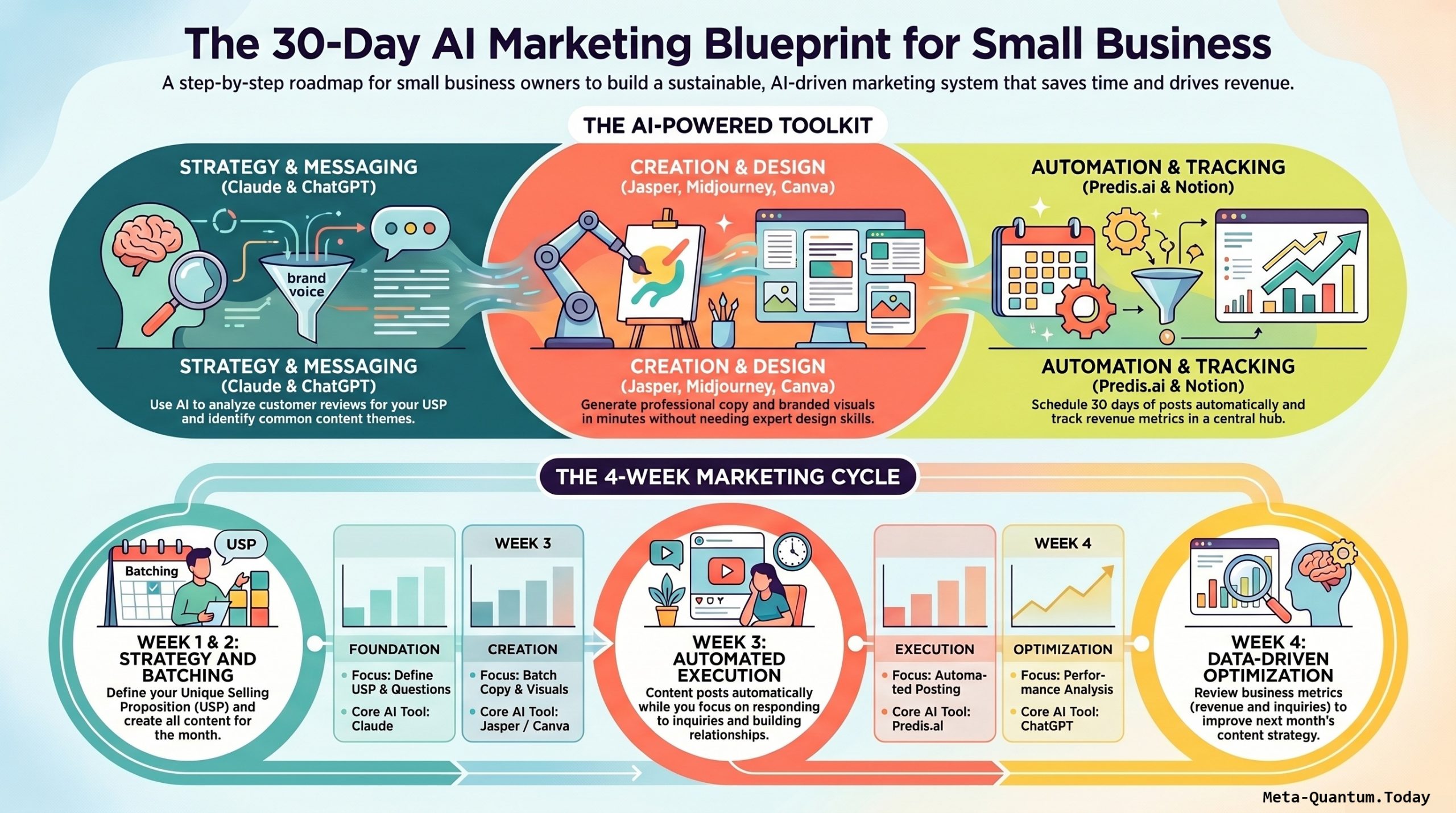
The AI Marketing Engine is a 30-day playbook aimed at small-business owners who want professional-quality marketing without the cost of a full marketing team. Its core thesis is that AI has dissolved the classic “time vs. quality” tradeoff: tasks that once required three hours of design tweaking or three days of agency revisions can now be generated in under five minutes, at a fraction of historical costs, while sounding more authentic — because AI can mine real customer language instead of recycling generic templates.
Rather than treating AI as a single magic tool, the deck frames it as a modular suite working in a continuous loop across four zones: Fuel → Factory → Assembly → Dashboard. The same framing matches what practitioners are converging on in 2026 — a working LLM for drafts and edits, a specialist for SEO or scheduling, and a real review step before anything ships, rather than one monolithic platform.
The Core Concept: A Four-Zone Marketing Machine
The playbook’s central metaphor is an industrial assembly line for content:
Zone 1 — The Fuel (Customer Insights, powered by Claude). Strategic clarity comes first: data collection, persona analysis, and trend identification feed everything downstream. Claude is positioned here for pattern recognition over customer reviews to extract a Unique Selling Proposition (USP).
Zone 2 — The Factory (Content Creation, powered by Jasper, Midjourney, and Canva). Templates plus AI generation produce multi-format outputs (blog, social, email) that pass through a quality-control check.
Zone 3 — The Assembly Line (Automated Scheduling, powered by Predis.ai). Workflow automation, cross-platform scheduling, queue management, and time-of-day optimization remove the “post randomly and hope” problem.
Zone 4 — The Dashboard (Measurement, powered by Notion and ChatGPT). Growth metrics, engagement analytics, conversion tracking, and ROI calculation feed the loop back into Zone 1.
The continuous loop is the key — it’s not a campaign, it’s a self-correcting system.
Key Features and Concepts
1. Extracting Your USP from Real Customer Language
Rather than guessing what makes the business special, raw customer reviews are fed to Claude, which clusters them into three signals: emotional language (“community,” “connection”), repeated details (small class sizes, check-ins), and specific value (personalized attention). The output is a USP grounded in customer words, not founder jargon — e.g., “Personal Fitness, Tailored to You.”
2. The Content Funnel: From Questions to Themes
Customer DMs, emails, and questions are raw chaos. An AI pattern filter analyzes emotional concerns and groups them into polished content themes (Retirement Timeline, Investment Fear, Balancing Priorities). The key insight: every customer question is a ready-made content idea — they’re telling you exactly what they want to learn.
3. The Modular Copywriting Stack
Effective copy follows a five-block structural formula rather than “sounding clever”:
- [Hook] — Tired of feeling like just another number at the gym?
- [Problem] — You disappear into a crowded class.
- [USP/Solution] — At Studio Name, your goals deserve personal attention.
- [Proof] — Classes capped at 8. Trainers text check-ins.
- [CTA] — Book your first class.
The customer is the hero; the brand is the guide.
4. Scaling One Message Across Platforms
The core message stays identical — AI (Jasper, in the deck) only adapts the format for how people consume content on each platform. The same “Personal Fitness, Tailored to You” message becomes an emoji-led Instagram caption with hashtags, a curiosity-driven email subject line (“You’re not just a number here”), and a benefit-led Facebook ad with a clear CTA.
5. The Visual Branding Pipeline
A two-step pipeline: Midjourney generates the atmospheric image from a prompt (“pumpkin spice latte with foam art, warm, cozy”), then Canva AI layers brand colors, custom fonts, and logo overlay on top. Atmosphere first, brand identity second — applied in seconds rather than hours.
6. Matching Message to Medium
| Customer Question Type | Optimal Format | Example |
|---|---|---|
| Complex “How-To” | Carousel (step-by-step) | 3 steps to start saving at 35 |
| Controversial Take | Short Video (myth-busting) | Prioritize retirement over kids’ college |
| Quick Engagement | Story (Polls/Q&A) | Simple yes/no questions |
| Reinforcement | Static Post (single tip) | Actionable daily quote |
7. The One-Hour Batching Timeline
The deck contrasts the “old way” (last-minute panic Tuesday, ran out of ideas Wednesday, skipped Sunday) with a one-hour Sunday batching session in Predis.ai: Ideas → Captions → Graphics → Schedule All. The maxim: three good posts a week beats one perfect post a month.
8. Tracking Business Metrics, Not Vanity Metrics
The single most important shift in the playbook. Ego metrics (12.5k likes, 5.2k followers, 48.1k page views) feel good but don’t pay bills. Business metrics (8.3% inquiry rate, 65% conversion rate, $15,400 revenue from social leads) connect directly to growth.
This aligns with a well-established marketing principle: vanity metrics like social follower counts highlight only the potential of marketing — they need nuance and context, and what’s missing is the most important metric of all: revenue. The practical test offered elsewhere is sharper still — ask three questions about any metric: Can I act on it? Does it reflect a business outcome? Can I compare its evolution meaningfully? If the answer to any is no, it’s probably a vanity metric.
9. The Monthly Optimization Loop
Data collection happens in Notion (Week, Content type, Inquiries, Revenue). ChatGPT does pattern analysis (“Testimonials and CTAs generated the most revenue. Conversion stable at 65%”). Strategy adjustments feed back in (“Increase testimonials to 2x/week, Add CTAs to every post”). Tracking once is a snapshot; tracking monthly is a feedback loop that makes the system smarter over time.
The 30-Day Blueprint
Week 1 — Foundation (Strategic Clarity): Define USP with Claude & Notion. Build a customer question library. Don’t touch content creation until strategy is rock solid.
Week 2 — Creation (Batching Assets): Generate a 28-day plan in Predis.ai. Create copy in Jasper and visuals in Midjourney/Canva. Mix, match, and schedule all posts.
Week 3 — Execution (Presence over Production): Content posts automatically. The owner’s only job is engaging with DMs within 24 hours and noting which posts drive conversations.
Week 4 — Optimization (Closing the Loop): Friday Review. Update the Notion tracker. Feed data to ChatGPT to adjust the next month’s content plan.
Practical Caveats from the 2026 Landscape
Two honest qualifications worth pairing with this deck:
The tool stack may be overbuilt for a true solo operator. Independent 2026 reviews note that the gap between Jasper and a well-prompted ChatGPT or Claude session has narrowed considerably; for a business owner doing their own marketing, save your money and stick with ChatGPT or Claude. A leaner version of this engine — Claude (or ChatGPT) + Canva + Predis.ai + Notion — likely delivers 90% of the value.
Realistic budget. A serious SMB marketing stack in 2026 runs $30–$180/month depending on scope; anyone claiming a small business needs $500+/month in tooling is selling something. The playbook’s stack, if all paid subscriptions, lands at the upper end — worth right-sizing to actual content volume.
Positioning beats tooling. AI tools can write copy, generate images, run automations — but they cannot tell you who your ideal customer is, why they should choose you over competitors, or what your pricing should be; if positioning is unclear, no AI tool will fix it. This is exactly why the playbook insists on Week 1 (USP and customer questions) before any content gets made.
Conclusion and Key Takeaways
The “AI Marketing Engine” reframes marketing for small businesses from a sporadic creative scramble into an industrial system with four predictable zones and a closing feedback loop. The discipline is more important than any specific tool:
- Listen to customers first — your USP is hidden in their reviews and questions, not in your founder’s head.
- Treat AI as a modular suite, not a magic wand — one tool per zone, working in a loop.
- Standardize copy structure — Hook, Problem, USP, Proof, CTA. The customer is the hero.
- Write once, adapt the format — the same core message belongs on Instagram, email, and Facebook in different shapes.
- Batch on Sunday, automate the week — three consistent posts beat one perfect one.
- Track inquiry rate, conversion rate, and revenue — likes and followers are scoreboards, not strategy.
- Close the loop monthly — feed last month’s data back into next month’s plan, or the system stops getting smarter.
The deck’s final line is the right one to end on: Marketing no longer requires massive budgets or endless hours — just a smart system and the discipline to run it.
References
- Jasper — agent workspace and content pipelines for marketing teams: https://www.jasper.ai/
- Jasper AI Review 2026 (AI Automation Hacks): https://aiautomationhacks.com/jasper-ai-marketing-review/
- AI Marketing Tools for Small Businesses: What Actually Works in 2026 (Everblue Digital): https://everbluedigital.com/blog/ai-tools-digital-marketing-2026/
- Best AI Marketing Tools for Small Business 2026 (Searchlab): https://searchlab.nl/en/guides/best-ai-marketing-tools-small-business
- Best AI Marketing Tools for Small Teams in 2026 (Circles Studio): https://circlesstudio.com/blog/best-ai-marketing-tools-small-teams/
- Top 7 AI Marketing Tools for Small Business in 2026 (eesel AI): https://www.eesel.ai/blog/ai-marketing-tools-for-small-business
- Vanity Metrics: Definition & Examples for Marketing (Hootsuite): https://blog.hootsuite.com/vanity-metrics/
- Vanity Metrics vs Actionable Metrics (Ruler Analytics): https://www.ruleranalytics.com/blog/analytics/vanity-metrics-actionable-metrics/
- Vanity vs Actionable Metrics: How to Tell (Midrocket): https://midrocket.com/en/guides/vanity-vs-actionable-metrics/
