

Introduction
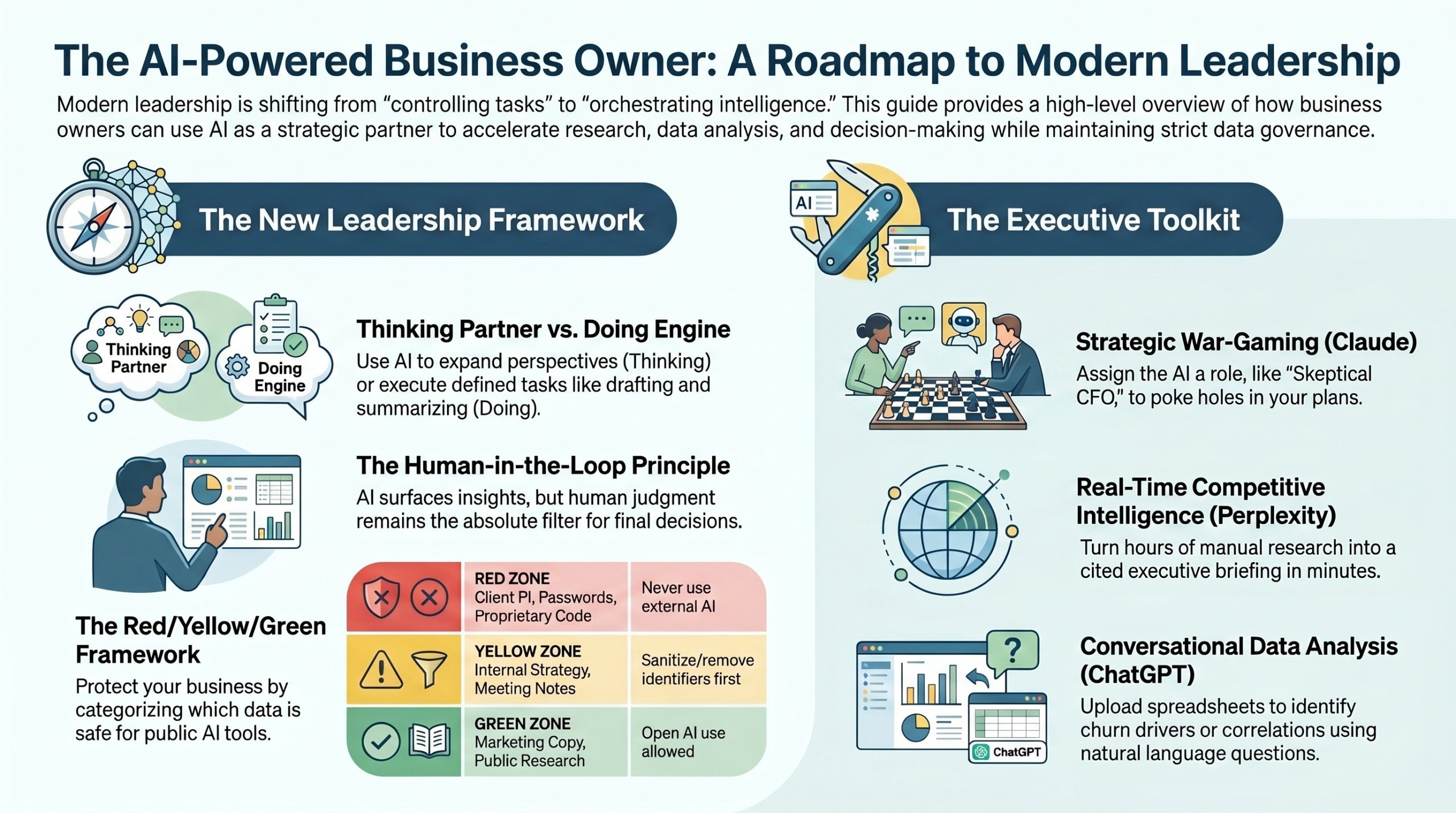
This framework designed to help business leaders move beyond using AI as a simple productivity gadget and toward treating it as an integrated operating system for decision-making. It is built around three pillars — Intelligence (fast, cited research and data parsing), Strategy (scenario planning and war-gaming), and Governance (safe, compliant implementation). The central thesis: leadership has shifted from controlling tasks down a hierarchy to orchestrating a mesh of AI tools, team expertise, and human judgment from a “commander” position.
Presentation of The Executive AI Playbook
Features and Core Concepts
1. The Mindset Shift — From Control to Orchestration
The old hierarchical model (Leader → Manager → Task) cannot solve a time problem by working harder or delegating more. The new model places the executive at the center of a web of AI tools and team expertise, where AI processes complexity at scale, surfaces missed insights, and frees cognitive bandwidth for decisions that genuinely require human judgment.
2. The Two Modes of AI
The playbook draws a clean distinction most leaders blur:
- The Thinking Partner (primary tool: Claude) — surfacing insights, expanding perspective, testing assumptions, generating scenarios. Most leaders neglect this mode, missing the highest leverage AI offers.
- The Doing Engine (ChatGPT, Beautiful.ai) — drafting documents, analyzing data, summarizing meetings, formatting presentations.
3. The Real-Time Intelligence Engine
Using Perplexity-style cited research, two hours of scattered searching collapses into a 10-second synthesized briefing with verifiable sources. The “Executive Prompt” pattern: specify what to highlight, request expert perspectives, define the scope (e.g., “Summarize Competitor X’s product announcements in the last 30 days, highlight AI features, cite analyst reactions”).
4. The Staircase of Insight (Conversational Data Analysis)
A four-step ladder for working with raw data: Ask Broadly → Drill Down → Test Hypotheses → Visualize & Act. The key takeaway: raw data is noise until you ask the right question — AI accelerates hypothesis testing from hours to seconds.
5. The Strategic War-Gaming Shield
Pressure-test plans by assigning AI specific adversarial roles: the Skeptical VC (“list the top 5 reasons this plan might fail”), the Worried CFO, the Strict Regulator. The formula: Stakeholder + Bias + Experience. The more specific the role, the more useful the challenge.
6. The Meeting Funnel — From Talk to Action
Three layers: unstructured audio (Google Meet Gemini, MS Teams Copilot, Sembly AI) → AI extraction of budget/hiring/unresolved questions → an actionable task list with Owner, Deadline, and Success Criteria. Structure creates accountability; without this conversion, summaries sit in folders unused.
7. The Outline-to-Deck Formula
Raw bullet inputs (pipeline numbers, deals at risk, lead sources) → AI translation via Beautiful.ai → visual output in seconds. Human time is reserved for adjusting emphasis to match audience priorities.
8. The Voice Calibration Formula
2–3 authentic human examples + a specific tone directive = an AI style guide blueprint. Feed Claude prior emails, ask it to extract patterns (“phrases you use” / “phrases you avoid”), then simply prompt “Use my style guide” next time to cut drafting time in half without losing emotional authenticity.
9. Business Stack Capability Map
A category-by-category tool inventory: Sembly AI / Krisp for audio & meetings, Synthesia / Vrew for video, ClickUp AI for project management, Conversica for customer interactions.
10. The Human-in-the-Loop Engine
A figure-eight loop locked by what the playbook calls “The Human Delta.” High-speed AI momentum (research via Perplexity, structure via ChatGPT, comms via Claude, design via Beautiful.ai) flows into critical human filtering (organizational politics, emotional reactions, relationship dynamics, final strategic approvals). The thesis: AI doesn’t make human judgment obsolete; it makes it the ONLY thing that matters.
This mirrors a broader insight from current AI thinking — as AI handles specialized tasks, the demand grows for “Creative Generalists” who can connect disparate ideas and exercise judgment, with empathy, communication, and ethical reasoning becoming the differentiating skills (Glasp).
11. The Governance Gap & Data Safety Matrix
The risk scenario is concrete: engineering pastes proprietary code into ChatGPT; sales uploads raw prospect lists. Both feel productive; both create massive exposure. Free AI models train on your inputs. AI adoption without governance is like handing out company credit cards without spending limits.
The three-zone framework:
- 🔴 Red Zone (Never Use External AI): client PII, passwords, proprietary code. Tools allowed: none, unless isolated enterprise instances.
- 🟡 Yellow Zone (Sanitize First): internal strategy docs, raw meeting notes. Strip names, numbers, identifying details before using ChatGPT or Claude.
- 🟢 Green Zone (Open Use): public marketing copy, blog posts, general industry research. Perplexity and public models are fair game.
This echoes guidance from financial services thinking on responsible AI: organizations need explicit guidelines for data privacy and bias prevention to build sustainable trust (Glasp).
12. The AI Integration Roadmap (3 Steps)
- Role Audit — paste your job description into Claude; ask it to identify 3 areas to expand perspective and 3 where human judgment must remain the absolute filter.
- Draft the Policy — use Notion AI to establish baseline guardrails covering data privacy, the Red/Yellow/Green framework, and human oversight.
- Prove the Value — start with one Thinking Partner workflow this week (meeting extraction or war-gaming), prove ROI, then expand across the stack.
Related Context and Broader Perspectives
The playbook’s framing connects to several wider conversations in AI-for-business literature:
- AI augments rather than replaces human capability. AI excels at processing vast data and surfacing data-driven recommendations, but works best when designed to work alongside human analysts rather than replace them — a pattern visible across financial services and product management.
- Operational efficiency gains are real and measurable. Businesses leveraging AI to automate repetitive tasks and surface actionable insights can see profit margin improvements of up to 20%, with the biggest wins coming from supply chain optimization and reducing human error in decision flows (Glasp).
- The “Age of Abundance” framing. As AI handles the mundane operational layer, leaders are freed to focus on creative and strategic work — but only if they intentionally identify which repetitive tasks to delegate to AI versus virtual assistants (Glasp).
- Governance is not optional. Multiple frameworks converge on the need for ethical AI guidelines, particularly around data privacy, bias prevention, and transparency — exactly what the playbook’s Red/Yellow/Green Zone formalizes for the executive level.
Conclusion
The Executive AI Playbook reframes AI adoption as an orchestration problem, not a tool-purchasing problem. Its strongest contribution is forcing a separation between AI as a Thinking Partner (the high-leverage but neglected mode) and AI as a Doing Engine (the obvious but ceiling-limited mode). Layered on top is a pragmatic governance framework that most organizations skip until a data leak forces the conversation. The closing principle — accountability never shifts; real people lead, AI accelerates — is the through-line.
Key Takeaways
- Orchestrate, don’t control. Position yourself as the commander of a tool-and-expertise mesh, not the bottleneck at the top of a hierarchy.
- Use AI to think, not just to do. The highest leverage is in scenario generation, assumption testing, and adversarial role-play before decisions — not in drafting documents after them.
- Structure raw outputs into accountability. Every meeting summary needs Owner + Deadline + Success Criteria, or it’s archival noise.
- Specificity wins in prompting. Vague role-play yields vague pushback; “skeptical VC listing the top 5 reasons this fails” yields usable challenge.
- Govern before you scale. Classify your data into Red/Yellow/Green zones before employees improvise their own — the policy gap is where leaks happen.
- Start with one workflow, prove ROI, then expand. The Role Audit → Policy → Pilot sequence is the minimum viable integration path.
References
- Perplexity, Claude, ChatGPT, Beautiful.ai, Notion AI — the core tool stack referenced
- https://clickup.com/brainSembly AI, Krisp, Synthesia, Vrew, ClickUp AI, Conversica — operational layer tools
- Google Meet Gemini, MS Teams Copilot — meeting capture surfaces
