

Introduction
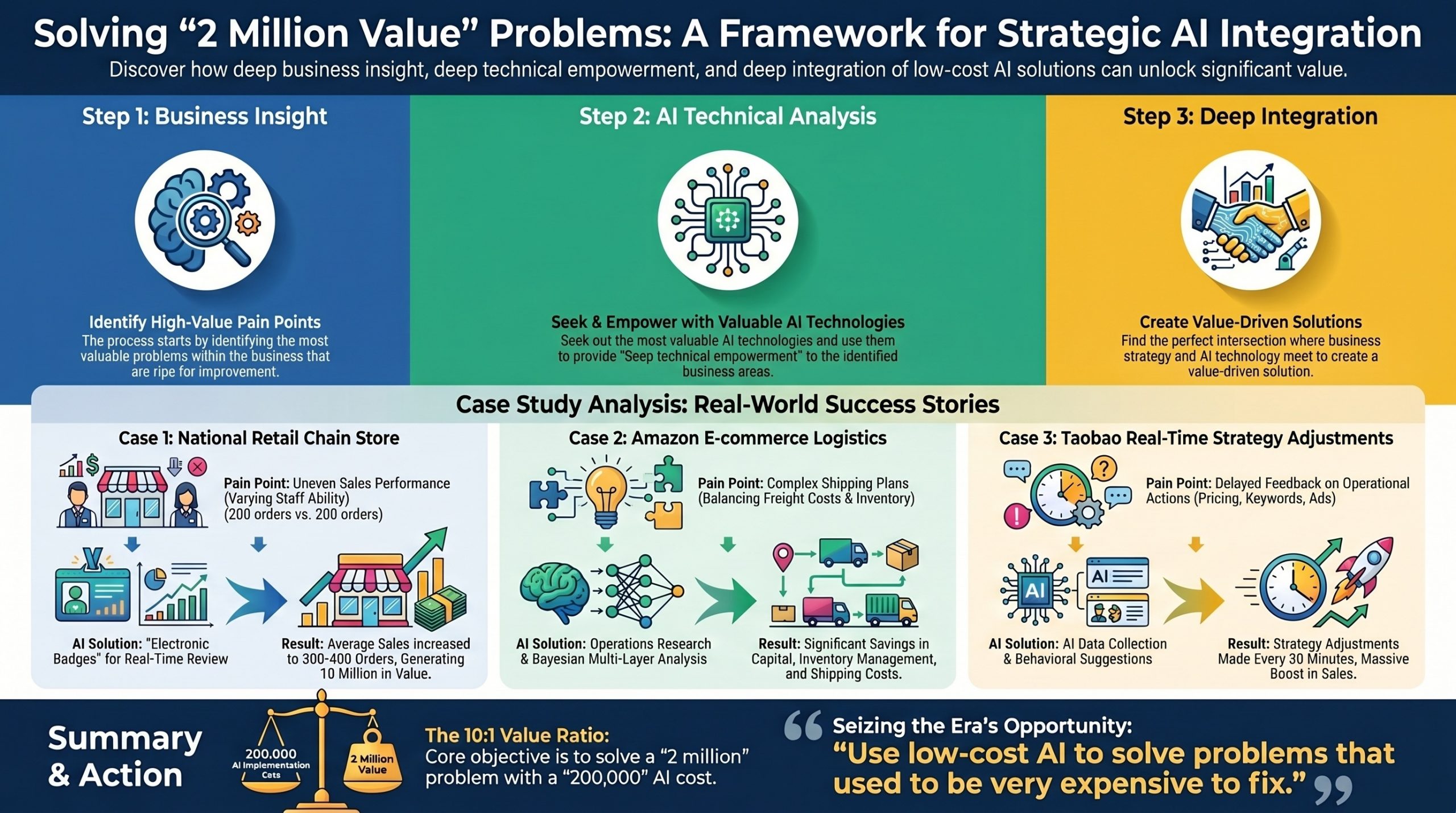
This board-meeting style discussion reframes how business leaders should think about AI adoption. The central thesis is provocative: most companies are asking the wrong question. Instead of “how can AI make my existing work faster?” (drafting meeting minutes, summarizing emails, checking the weather), leaders should be asking, “what is a problem in my business worth $2 million — and can AI solve it?” The session walks through three real entrepreneur case studies where this reframing transformed a polite curiosity about AI into urgent, high-conviction projects.
The Core Concept: The “$2 Million Problem” Framework
The framework rests on a simple but powerful asymmetry:
- Find a problem worth ~$2 million in business value (revenue gain, cost savings, or capital efficiency over ~3 years).
- Solve it for ~$200,000 — roughly the fully-loaded annual cost of one AI-literate engineer working 3–12 months.
- The 10× ROI gap is what makes AI economically transformative today — not because AI is new, but because problems that were once prohibitively expensive to solve have collapsed in cost.
The key mental shift: AI should not be evaluated as an efficiency tool for past workflows. It should be evaluated as an enabler for things you previously thought impossible. Pricing the problem (rather than pricing the AI tool) forces this shift — the moment you ask “what is this worth?” you stop thinking about chatbots and start thinking about business outcomes.
This mirrors a distinction made elsewhere in the AI investment landscape, where one analysis describes “Bet-the-farmers: This user group focuses on building specialized solutions for ‘million-dollar level problems'” — a category of buyers who prioritize solving high-stakes business problems over generic productivity gains.
Three Case Studies of $2M+ AI Problems
Case 1 — National Retail Chain: Electronic Sales Badges
The problem. A multi-hundred-store chain has wide variance in sales performance: top stores close ~500 orders/month, average stores ~200, weak stores struggle to break even. Closing the floor-to-ceiling gap is the question.
The AI solution. Every salesperson wears an electronic badge that records their customer conversations (with appropriate disclosure). Each night, recordings are uploaded, transcribed, and analyzed:
- For top performers: identify what they said and did right — extract patterns from the transcripts.
- For underperformers: identify where they violated training (e.g., leading with price instead of value).
- The next morning’s stand-up uses the previous day’s distilled best practices as fresh training material.
Why it’s worth $2M+. Lifting average store performance from 200 to 350 orders/month, sustained over three years, generates tens of millions in incremental revenue. The mechanism — daily ceiling-to-floor knowledge propagation — was previously impossible at scale because no one could review hundreds of hours of conversation per day.
Case 2 — Amazon FBA Cross-Border E-commerce: Multi-Constraint Inventory Optimization
The problem. A 200+ SKU seller balances competing costs daily: FBA storage fees (penalize over-stocking), stockout losses (penalize under-stocking), sea-freight cost vs. air-freight speed, and capital tied up in goods-in-transit. Four employees full-time still can’t optimize this well.
The AI solution. Frame it as a classical operations research / optimization problem (the speaker notes this is essentially what he studied in university — not a programming problem). Apply Bayesian multi-level analysis across all constraints, fed by daily real-time data, to recommend per-SKU shipping decisions: how much, by which mode, when.
Why it’s worth $2M+. Replaces 4 headcount (~$600K over 3 years), but the larger value is freed working capital, reduced storage fees, fewer stockouts, and faster sell-through. The combined recovery is well into seven figures.
Case 3 — Taobao E-commerce: Real-Time Strategy Adjustment Loop
The problem. Each product has 70+ daily levers — price, keywords, ad spend, imagery. Humans adjust them roughly once a day based on lagging analysis. Which actions actually drove which results is mostly guessed.
The AI solution. Build a closed-loop pipeline:
- Capture every action and its outcome data automatically.
- Generate signals — exposure click-through rate, conversion rate, etc.
- Generate recommendations — AI proposes specific adjustments per SKU.
- Human-in-the-loop decides; the system applies and measures.
- Loop every 30 minutes instead of every 24 hours.
Why it’s worth $20M, not $2M. For a seller doing tens of billions in revenue, compressing the optimization loop 48× is enormous — the entrepreneur immediately revised the value upward by an order of magnitude.
Why This Framework Works Now
Three structural shifts make the $2M-problem framework newly viable:
- Cost collapse. Optimization, transcription, and pattern-extraction problems that required teams of analysts now run for cents per task.
- Modular tooling. Off-the-shelf models mean the engineering effort is integration, not invention. As one industry analysis observes, “Customers now seek off-the-shelf products to solve their immediate business problems, without necessarily delving into the algorithms behind them.”
- Domain-AI combination as the unlock. The speaker’s repeated point — “you don’t need to understand the technology, but you must understand the business” — reflects the reality that the bottleneck has shifted from AI capability to problem identification. The business strategist who can name the $2M problem, paired with the engineer who can wire up the solution, is the winning team. As one engineering leader put it, “take the time to really find out the problems, what people want to actually, what problems people have” — that diagnostic step is the entire game.
Conclusion & Key Takeaways
The framework reframes AI strategy from a technology question to a business question. The session closes with a proposed “$2 Million AI Landing Camp” — a structured methodology for entrepreneurs to identify, scope, and solve their highest-value problem within roughly a year and a $200K budget.
Five key takeaways:
- Price the problem, not the tool. The moment you assign a dollar value to a problem, your evaluation of AI’s worth recalibrates dramatically.
- AI’s killer use case is doing what was previously impossible — not what was previously slow. Speeding up meeting minutes is a distraction; daily ceiling-to-floor knowledge propagation across 500 salespeople was unimaginable last decade.
- Business understanding precedes technical understanding. The entrepreneur who knows their unit economics deeply will out-execute the technologist who only knows models.
- The 10× rule. Aim to solve a $2M problem with a $200K investment. If the ratio is closer to 1:1, the problem isn’t big enough or the solution is over-engineered.
- Closed-loop systems beat one-shot tools. All three case studies share the same architecture — data capture → signal extraction → AI recommendation → human decision → feedback. This loop is the reusable pattern.
Related References
- AI/ML Application Layer & Modular Solutions — the “bet-the-farmers” buyer category and million-dollar-problem specialization: https://glasp.co/hatch/YFpmdnYrdzMz7dvNEzgsd8culHP2/p/dOIStLRAqG89Q60YXIT5
- AI in Business: Profit Margin Impact — the ~20% profit margin uplift potential from operational AI integration: https://glasp.co/hatch/uMghDelPJBc0aBEOsmjARD4s10b2/p/9ZeAF0eEh4B0VtQ6vtcS
- Three Buckets of Generative AI Opportunities (Craft Ventures) — infrastructure, co-pilots, and AI-turbocharged SaaS as complementary investment lenses: https://glasp.co/hatch/bvogel/p/WTBKkiJFB6kHssfGx0VK
- How Engineers Build and Lead in the Age of AI (Glasp Talk #54) — on the primacy of problem-discovery over tool-mastery in the AI era: https://read.glasp.co/p/how-engineers-build-and-lead-in-the
- AI in 2023: The Application Layer Has Arrived — context on why business-layer AI is finally implementable: https://glasp.co/hatch/glasp/p/cZALGoEZtxtr8r6f1A4q
