

Introduction
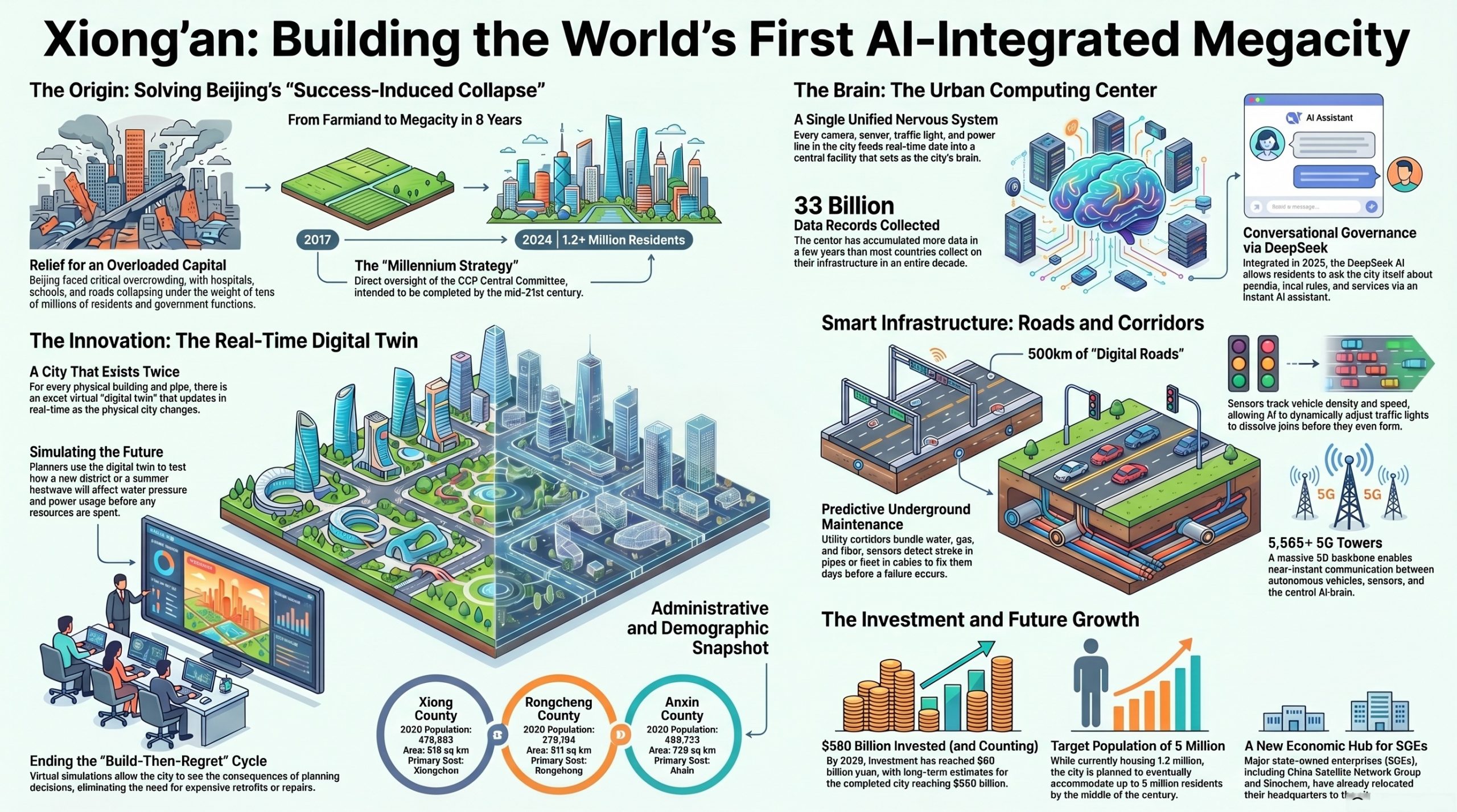
The story of Xiong’an, a Chinese city built from completely empty farmland starting in 2017 that now houses over 1 million residents and runs on a unified artificial intelligence system. Located about 100 km southwest of Beijing, Xiong’an was conceived not as a city expansion or renovation, but as a deliberate answer to a question almost no government has dared to ask: what does a city look like when intelligence is designed into its bones from day one, rather than retrofitted decades later? The video frames Xiong’an not just as an impressive Chinese megaproject but as a working blueprint that could reshape how cities are built worldwide for the next 50 years.
New Features and Core Concept
The defining concept of Xiong’an is that the physical city and a real-time digital twin grow up together as one integrated system, rather than technology being bolted onto existing infrastructure after the fact. Several features illustrate this:
The Urban Computing Center acts as the city’s central brain. Every traffic light, sensor, camera, underground pipe monitor, air quality detector, and government data system feeds into a single facility, which has already accumulated more than 33 billion data records. In 2025, DeepSeek was integrated directly into this center, allowing residents to converse with the city itself about permits, services, and local rules.
Digital roads stretch over 500 kilometers, with embedded sensors tracking vehicle count, speed, direction, and density. Lights upstream slow incoming traffic before jams form, and emergency vehicles get clear paths automatically rerouted ahead of them.
Underground utility corridors bundle water, electricity, fiber, and gas lines together with continuous pressure, temperature, and flow monitoring. The system flags failing pipes or overheating cables before anything breaks, flipping infrastructure maintenance from reactive to predictive.
A 5G backbone of more than 5,565 towers connects every sensor, camera, and autonomous vehicle, while a complete digital twin of the city allows planners to simulate new districts, summer heatwave loads, or zoning changes virtually before committing physical resources.
Why China Built It and What It Costs
The trigger for Xiong’an was Beijing’s success-induced collapse — overcrowded hospitals, gridlocked roads, and overlapping government functions all squeezed into a city never designed for that scale. Rather than expanding outward through suburbs and highways, China chose to relocate pressure off Beijing entirely.
The investment is staggering. By 2026, China has put over 860 billion yuan (around US$120 billion) into the project, with long-term estimates reaching close to US$580 billion — placing it among the most expensive construction projects in human history. Government agencies, state banks, universities, and hospitals have been actively relocated from Beijing, and the city now hosts over 500 software and IT companies plus more than 60 major AI firms inside a dedicated AI industrial park.
The Cities-That-Think Idea in Broader Context
The Xiong’an model belongs to a wider global movement around digital twins and AI-driven urban management. Cities like Singapore have pioneered similar centralized scenario-rehearsal systems, integrating real-time data from dozens of agencies to simulate planning, emergency response, and energy efficiency — making this approach a recognized international benchmark, though Xiong’an applies it at the scale of an entire purpose-built city. Compared to historical urban builders like Robert Moses, who reshaped New York City through highways and bridges in an era that prioritized concrete over coordination, Xiong’an represents a fundamentally different paradigm: shaping a city through information flow rather than poured infrastructure.
The geopolitical layer matters too. The video notes that China is preparing to export the Xiong’an model through its Belt and Road Initiative to over 140 countries facing rapid urban growth. Critics of BRI infrastructure argue this creates asymmetric dependencies — partner states relying on China for technology, financing, and construction materials, which can subtly align their interests with Beijing’s preferences. Smart-city exports could deepen that dynamic in ways traditional roads and ports cannot, since the operating intelligence itself becomes a long-term dependency.
Honest Challenges
The video doesn’t pretend Xiong’an is perfect. Attracting organic talent beyond government-mandated relocations takes years, and engineering a real sense of community and culture in a brand-new city is something no AI system can solve. Whether the population will grow naturally toward the planned 2 to 2.5 million remains an open question.
Conclusion and Key Takeaways
Xiong’an’s most revolutionary contribution isn’t any single technology — it’s the inversion of how cities are built. Traditional urbanism builds first and digitizes later; Xiong’an designs the intelligence first and lets the buildings grow around it. Key takeaways:
- Built from scratch in 8 years, Xiong’an now houses over 1 million people on land that was empty farmland in 2017.
- One unified AI brain runs traffic, utilities, emergency response, and government services through the Urban Computing Center, with DeepSeek added in 2025 for citizen-facing conversation.
- Infrastructure is predictive, not reactive — pipes are repaired before they burst, jams are dissolved before they form.
- A live digital twin lets planners test decisions before making them, eliminating the build-then-regret cycle that defines most cities.
- Massive financial commitment of US$120 billion already spent, potentially reaching US$580 billion long-term.
- Global blueprint potential through BRI export to developing nations, though with real questions about technological dependency.
- Human challenges remain — culture, community, and organic growth cannot be coded.
The deeper question Xiong’an answers, tentatively but measurably, is whether AI can run urban infrastructure better than humans coordinating across siloed departments. As of 2026, the early evidence leans toward yes — and that answer will shape every new district, suburb, and greenfield city built this century.
Related References
- Xiong’an New Area official information: Wikipedia – Xiong’an New Area
- DeepSeek AI integration in Chinese governance: DeepSeek
- Belt and Road Initiative overview: Council on Foreign Relations
- Digital twin city benchmark: Virtual Singapore
- Urban planning paradigms (historical contrast): Robert Moses & New York City urban planning
- China’s structural power through infrastructure: Glasp – Infrastructure and Chinese Power

Interesting to know that xiong’an has developed so much in AI