
Introduction
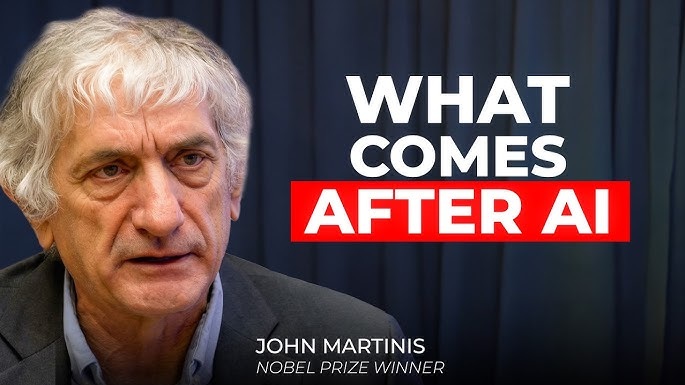
We live in an era where AI feels like the final frontier of disruption — but according to a Nobel Prize-winning physicist, there is something far more consequential waiting just behind it. A features a rare, candid conversation between content creator Ziad Ahmed and John Martinis, the physicist whose 1985 discovery of quantum tunneling in macroscopic electrical circuits effectively laid the hardware foundation for quantum computing. Martinis, who won the 2025 Nobel Prize in Physics for this work and was appointed to President Trump’s science advisory council alongside names like Zuckerberg, Brin, and Jensen Huang, delivers a grounded and sobering timeline: 5 to 10 years before the quantum era arrives in full force. The interview was held at the World Economic Forum in Davos, giving it a distinctly high-stakes geopolitical backdrop.
🔭 What’s Actually Coming After AI?
The honest answer is: not one thing — a convergence of several. The pattern from history is that the next wave doesn’t replace the previous one; it runs on top of it while simultaneously making parts of it obsolete. AI is the platform. What’s coming uses AI as infrastructure.
⚛️ 1. Quantum Computing — The Big One
This is where the 5–10 year urgency is most concrete. As of right now in April 2026:
Quantum computing currently sits firmly in the NISQ era — Noisy Intermediate-Scale Quantum — where processors operate with dozens to a few hundred qubits that remain highly error-prone and fragile. Supaboard So we are not there yet. But the milestones are accelerating fast.
IBM has publicly stated that 2026 will mark the first time a quantum computer will be able to outperform a classical computer on a problem it can solve better than all classical-only methods — the threshold that will unlock breakthroughs in drug discovery and other domains. IBM
In October 2025, Google already demonstrated a 13,000× speedup over the Frontier supercomputer using just 65 qubits for physics simulations. Bqpsim That is a staggering number from a very small machine.
By 2028, IBM’s roadmap targets a “Starling” system operating 200 logical qubits requiring approximately 10,000 physical qubits — a tenfold improvement in efficiency over current surface code methods. Quantum Zeitgeist
The deeper story is the AI × Quantum feedback loop: AI systems are already being used to design quantum circuits that humans cannot conceive, while quantum processors are beginning to accelerate machine learning — each technology accelerating the other’s development. Quantum Zeitgeist
🔐 2. The Cryptography Crisis — Urgent, Not Theoretical
This is the sleeper issue that most people outside cybersecurity and finance are not thinking about. It deserves its own spotlight.
The next decade’s central challenge for the quantum community is integrating quantum computers into broader computational workflows and building the first large-scale, fault-tolerant machines — and this must happen with an open, collaborative approach. IBM
From a security standpoint, the window to act is already open. Institutions that are not migrating toward post-quantum cryptographic standards today are building technical debt that will become a liability. Bitcoin’s legacy wallets, government databases, financial infrastructure — all of these were built before quantum adversaries existed as a realistic threat model.
🤖 3. Humanoid Robots — Closer Than You Think
Experts predict humanoid robots will appear in industrial settings in significant numbers by 2026–2028, with broader adoption through the 2030s. The Innovation Mode This is being driven directly by advances in AI — the reasoning and perception capabilities that were impossible five years ago are now available as commodity inference. The bottleneck shifted from software to hardware actuators and cost reduction, both of which are being solved at scale right now by Tesla, Figure, 1X, and others.
🧠 4. Neurotechnology — The Long Game
Brain-computer interfaces (Neuralink, Synchron, and others) are moving from medical necessity toward performance enhancement. The combination of AI interpretation layers and improved electrode density is compressing what was a 20-year timeline. Within the 5–10 year window, expect BCI to move from paralysis patients toward broader cognitive augmentation trials, memory prosthetics, and real-time language translation interfaces.
🧬 5. AI-Accelerated Biotech
This one may be the least visible but potentially the most consequential. AlphaFold already collapsed decades of protein structure research into a few years. The next phase is AI-designed molecules — therapeutics, materials, and organisms — with quantum simulation as the eventual backend for molecular precision that classical computers cannot achieve.
📊 Where This Leaves You — Practically
The critical insight from the Martinis interview applies broadly here: the gap between theoretical readiness and practical deployment is closing fast, and the organizations acting now are the ones setting the terms. Organizations experimenting today gain a 3–5 year head start in talent, infrastructure, and algorithm development. Bqpsim
For someone in your position — spanning engineering, business strategy, and emerging tech — the 5–10 year window maps roughly like this:
| Horizon | Technology | Action Signal |
|---|---|---|
| Now – 2027 | AI Agents, Agentic Workflows | Deploy, not just experiment |
| 2026 – 2028 | Quantum Advantage (specific tasks) | Learn the landscape, watch IBM/Google milestones |
| 2027 – 2030 | Post-Quantum Cryptography | Audit any systems you manage for encryption vulnerability |
| 2028 – 2032 | Fault-Tolerant Quantum Computing | Competitive advantage in drug, materials, finance |
| 2028+ | Humanoid Robots in Industry | Relevant for manufacturing, F&B, logistics clients |
The core takeaway from Martinis’s worldview — and from what the data is showing across all these fronts — is that the next disruption does not announce itself loudly. The internet did not say “libraries are about to become obsolete.” Quantum computing is not yet saying “your encryption is broken.” But the physics is already written. The hardware is catching up. And unlike the AI wave, which gave almost everyone a two-year warning window, the quantum transition will arrive with far less runway for the unprepared.
YouTube Review | Channel: Ziad Ahmed (Davos Interview Series):
🔬 The Science: What Martinis Actually Discovered
Most people associate quantum mechanics with the invisibly small — atoms, electrons, abstract physics confined to a lab. What Martinis proved is that quantum behavior, specifically the phenomenon of quantum tunneling, can be made to occur inside human-engineered, macroscopic electrical circuits. In plain terms: he built a device you could hold in your hand that still obeyed the bizarre rules of quantum physics — including the ability for particles to pass through barriers rather than bounce off them. That was the conceptual unlock. Once quantum effects could be engineered into machines, the leap from theory to computing hardware became possible. This single insight seeded an entire generation of quantum hardware development, including Google’s superconducting qubit program, which Martinis himself led for years before leaving to found his own company.
💻 What Quantum Computing Actually Changes
Martinis walks through three transformational application domains, grounding each in analogy rather than jargon:
1. Materials & Molecular Design Just as architects design buildings virtually before breaking ground, quantum computers could let chemists and engineers simulate molecules at the atomic level before synthesizing them in the real world. The digital model becomes indistinguishable from physical reality at the molecular scale.
2. Drug Discovery Drug development today is extraordinarily expensive and failure-prone because researchers cannot fully simulate how a molecule will behave inside a living body. Martinis notes that even a 1–2% improvement in molecular insight could translate into enormous savings and breakthroughs. Quantum simulation makes that precision possible.
3. Finance and Beyond Though he doesn’t drill into specifics here, Martinis echoes the field-wide consensus that virtually every computation-heavy sector — finance, logistics, climate modeling, materials science — will be reshaped. The Quantum Insider estimates the market could generate $1 trillion in economic value within 10 years, a figure Martinis calls plausible under an optimistic scenario.
⚙️ The Hardware Bet: Why Martinis Is Doing “The Wrong Thing”
One of the most intellectually honest moments in the interview is Martinis’s description of his own company’s strategy. He acknowledges that most entrepreneurs in the quantum space are building software and algorithms — relatively low-cost, high-optionality bets. His company, by contrast, is making a definitive hardware bet: investing in building a large-scale, fully error-corrected quantum computer using semiconductor fabrication techniques rather than academic-grade, artisanal qubit manufacturing.
He draws explicit parallels to Peter Thiel’s “Zero to One” framework — the idea of definite optimism, knowing precisely what you want to build rather than hedging across vague possibilities. He also references Nvidia’s strategic positioning before GPUs had an obvious mass market — a parallel that resonates strongly given Jensen Huang’s current seat on the same presidential advisory council.
The target: 1 million physical qubits operating with corrected error rates — the threshold where Martinis believes real, general-purpose quantum value will be unlocked.
🔐 The Crypto Question: Is Bitcoin Safe?
This is where the interview gets most urgent for everyday audiences. Martinis confirms:
- Older Bitcoin, encoded under legacy cryptographic standards, could potentially be broken by a sufficiently advanced quantum computer.
- Newer versions of Bitcoin use stronger encryption that is more resistant, and holders of older Bitcoin can migrate to stronger encryption by “pulling it out and re-encrypting it.”
- However, a large quantity of unclaimed, dormant old Bitcoin sitting in wallets represents a serious vulnerability — and a potential commercial target for whoever builds a powerful enough quantum machine first.
- His CEO is actively engaging the US Treasury about these risks, recognizing that regulatory and legal frameworks need to precede the technology rather than respond to it.
Importantly, this is not a fringe concern. The potential consequences of a quantum computer breaking encryption are wide-ranging — military intelligence, banking information, and industry secrets are among the categories of data at risk, and the danger extends not just to future breaches but to past data that adversaries may already be storing with the intention of decoding it once quantum computing matures. NIST has been running a quantum-safe cryptography program for about a decade, and algorithms are already downloadable for organizations ready to implement them.
🕐 Timeline: 5–10 Years
Martinis is careful not to sensationalize. He positions his 5–10 year estimate as an optimistic-but-realistic warning — a signal for industries to begin preparing now. He notes that Google’s CEO Sundar Pichai has been publicly stating 3–5 years, which Martinis interprets as CEO-level ambition signaling rather than scientific consensus. IBM has cited similarly conservative 5–10 year windows. Critically, Google has already deployed quantum-resistant protocols on portions of its own traffic — a quiet but powerful signal that the biggest players are not waiting.
🎲 Black Swans, Setbacks, and the Nobel Call
One of the most humanizing segments of the video is Martinis reflecting on career pivots driven by failure. He was effectively pushed out of Google after the quantum supremacy experiment — a painful transition from a project he had worked on since graduate school. Yet he frames that exit as the catalyst for his most creative thinking: freed from institutional constraints, he co-founded a company and developed entirely new architectural ideas for scalable qubits. His wife, upon receiving the middle-of-the-night Nobel Prize notification, let him sleep rather than wake him — quietly managing the reporters at the door until 6 AM. It’s a small story that says a lot about how these disruptions, personal and technological, rarely arrive the way we expect.
🧭 Conclusion & Key Takeaways
This conversation is a calibration exercise. AI is the story of right now; quantum computing is the story of the next decade — and the Nobel Prize signals that the underlying science is no longer speculative. The disruption pattern mirrors what we’ve seen before: the internet didn’t improve libraries, it made them obsolete. Quantum computing will not make classical encryption better — it will make it breakable.
Key Takeaways:
- Quantum tunneling in engineered circuits — Martinis’s 1985 discovery — is the scientific foundation of all modern quantum computing hardware.
- Drug discovery, materials science, and molecular simulation are the clearest near-term use cases.
- A general-purpose, error-corrected quantum computer requires approximately 1 million physical qubits — still a significant engineering gap, but one that is closing.
- Bitcoin’s legacy encryption is genuinely vulnerable; migration to quantum-safe cryptography is not optional but urgent, and regulators are being looped in now.
- The timeline is 5–10 years — short enough to act on career, investment, and infrastructure decisions today.
- The hardware layer is the highest-leverage, highest-risk bet; software and algorithm plays are abundant but won’t matter without better machines underneath them.
- Institutional giants (Google, IBM, JP Morgan) are already deploying quantum-resistant systems — the race is underway whether your industry knows it or not.
📚 Related References
- Google Willow Quantum Processor (December 2024) — Google’s announcement of a processor completing in minutes what would take classical supercomputers longer than the age of the universe.
- Peter Shor’s Algorithm (1994) — The theoretical proof that quantum computers can break RSA encryption; the mathematical basis for current cryptographic urgency.
- NIST Post-Quantum Cryptography Program — A decade-long US government initiative to standardize quantum-safe encryption algorithms; algorithms are already publicly available.
- Peter Thiel — Zero to One — The business philosophy framework Martinis explicitly invokes to explain his “definite optimist” hardware-first strategy.
- The Quantum Insider Market Report — Projects $1 trillion in quantum economic value within 10 years under an optimistic scenario.
- Glasp Insight — “The Race to Save Our Secrets From the Computers of the Future” on Glasp: https://glasp.co/hatch/orjsbmjlbff16n9e/p/gd2RglkYrbtbROKoKpxZ — a well-curated reading on the encryption vulnerability timeline and NIST’s quantum-safe cryptography response, directly relevant to the Bitcoin and cybersecurity themes in this video.
