

Introduction
A fruitfly that was never born is walking around right now — entirely in silico. Scientists have taken a real fruitfly’s brain, mapped every single neuron, and dropped it into a simulated body inside a virtual 3D environment. Without any training data or AI learning, the emulated fly immediately started behaving like a fly. This landmark achievement in whole-brain emulation raises some of the most profound questions in science, philosophy, and technology: What is consciousness? Can it be copied? And if humans are next — do we all eventually live forever inside a machine? Know more from the video.
🧠 Eon Systems & FlyWire: The Full Story
These two projects are deeply intertwined — FlyWire built the map, and Eon Systems ran it. Together they represent the most significant milestone in whole-brain emulation to date.
Part 1: FlyWire — Building the Atlas
What Is FlyWire?
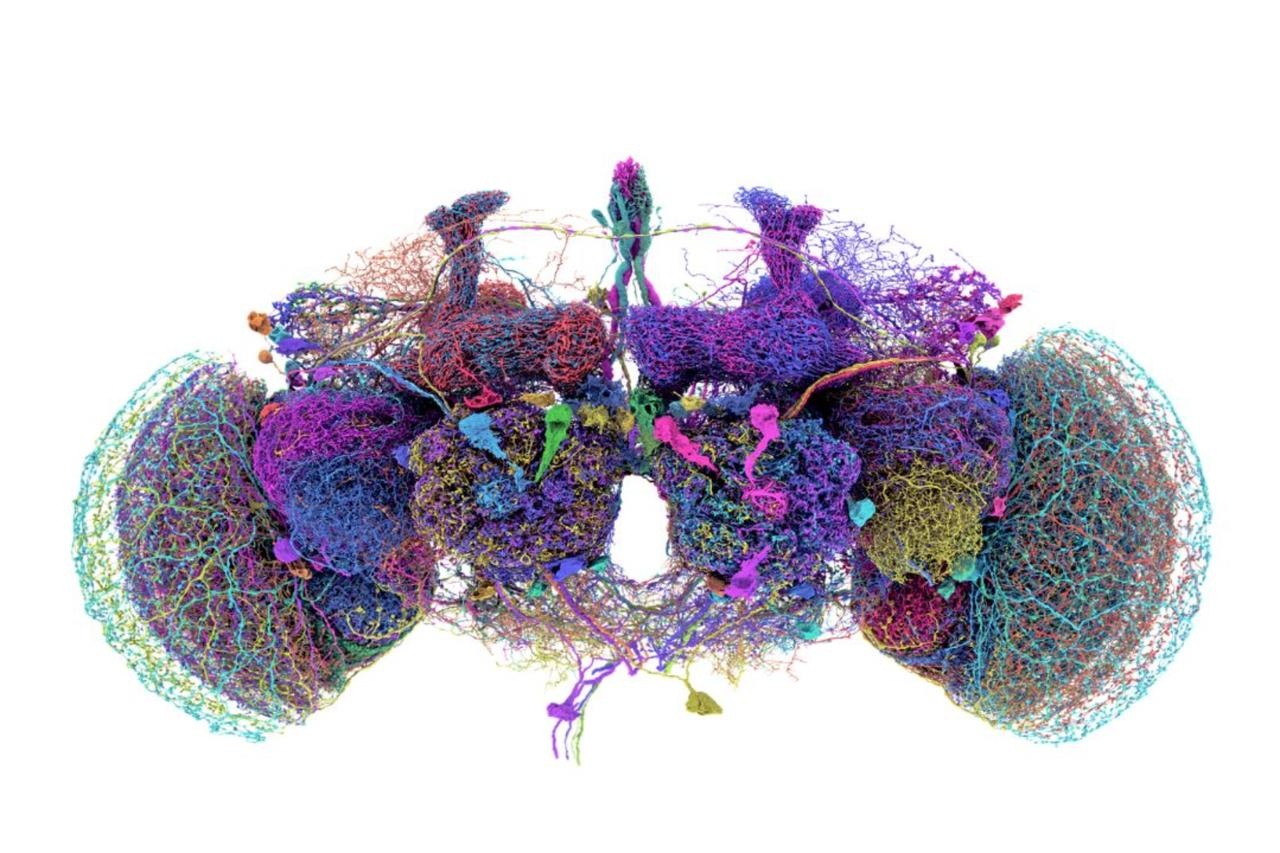
FlyWire is a Princeton University-led international consortium whose singular mission was to produce the first complete neuron-by-neuron, synapse-by-synapse wiring diagram — called a connectome — of the adult Drosophila melanogaster (fruit fly) brain. The FlyWire Consortium comprises members from more than 146 labs at 122 institutions, with major contributions from teams at the University of Cambridge and the University of Vermont.
How They Built It
The construction process was a remarkable hybrid of cutting-edge AI, professional science, and crowdsourcing:
The map was built from 21 million images taken of a female fruit fly brain by a team of scientists led by Davi Bock, then at the Howard Hughes Medical Institute’s Janelia Research Campus. Those raw electron microscopy images alone were not a connectome — they had to be interpreted.
Since 2019, the researchers and gamers of FlyWire have collectively contributed 33 person-years to proofreading and annotating the results of the AI model. Without AI, the project would have taken almost 50 thousand person-years. Human volunteers served as proofreaders — checking AI-generated segmentations, adding cell type labels, and assembling the pieces into one massive whole.
What They Produced
The map was developed by the FlyWire Consortium, which is based at Princeton University and made up of teams in more than 76 laboratories with 287 researchers around the world as well as volunteer gamers. The final result: 140K neurons across the central brain and optic lobes, proofread by experts; 50M+ synapses including neurotransmitter information; and over 100K+ cell type annotations contributed by the FlyWire community.
Particular attention was given to the visual system because most of the fly brain is dedicated to vision — this is the first time the cell types and connections of a biological visual system have been revealed in their entirety. In total, the group has identified around 140,000 neurons — 98% of which have been typed — and over 50 million synapses.
Codex — The Public Explorer
To make the comprehensive map easily accessible, the FlyWire team developed Codex (Connectome Data Explorer), which enables anyone with internet access to navigate all neurons and synaptic pathways in the brain map, without having to download huge amounts of data or use advanced analysis tools. Codex is free and has already been used by over 10,000 registered users worldwide.
You can explore it yourself at flywire.ai.
Why the Fruit Fly?
Fruit flies share many behaviors with humans as well as 75% of the genes that cause genetic diseases. That genetic overlap makes the fly a scientifically powerful model for understanding human neurological conditions. FlyWire researchers also classified and annotated more than 8,400 types of cells found in the connectome — classified based on location in the brain, connections, developmental origin, and shape.
Part 2: Eon Systems — Running the Atlas
Who Are They?
A team at Eon Systems PBC, led by senior scientist Philip Shiu, has demonstrated the world’s first embodied whole-brain emulation — not an AI trained to mimic biology, not a reinforcement learning policy, but a literal copy of a biological brain, neuron by neuron, synapse by synapse, running inside a physics-simulated body. The company is co-founded by Dr. Alex Wissner-Gross, a Harvard/MIT physicist.
The 2024 Disembodied Brain Model
The story begins a step earlier. In October 2024, Shiu and collaborators published a computational model of the entire adult fruit fly brain with over 125,000 neurons and 50 million synaptic connections, built using the FlyWire connectome and machine learning to predict neurotransmitter identity. That model predicted motor behavior with 95% accuracy. But it had a critical limitation: it was a brain with nowhere to go — no body, no environment, no feedback loop.
March 2026: The Ghost Finds Its Machine
On March 7, 2026, a small San Francisco company called Eon Systems released a video online that most of the world scrolled past without a second glance. In that video, a fruit fly walked — the world’s first whole-brain emulation that actually moves.
The full loop has four parts: first, sensory events in the virtual world are mapped onto identified sensory neurons or sensory pathways; second, brain activity is updated in a connectome-constrained neural model; third, selected descending outputs are translated into low-dimensional motor commands for the body; fourth, the resulting movement changes the sensory state, which is fed back into the brain. They currently run the syncing steps between brain and body every 15 ms.
The physics engine used is MuJoCo, running the NeuroMechFly v2 framework for the virtual fly body.
What Makes It Different From Everything Before
The distinction matters enormously. DeepMind and Janelia’s recent MuJoCo fly used reinforcement learning, not connectome-derived neural dynamics, to control a simulated body. Eon’s fly is the actual ghost in the machine — using a brain of genuine complexity with 127,400 neurons and 50 million connections, real biological circuitry validated against optogenetics and calcium imaging — producing not a learned imitation of biological behavior but the biological computation itself. As Wissner-Gross described it: DeepMind’s fly is a recording; Eon’s fly is the ghost.
Earlier research often focused on only one part of the problem. Some projects mapped nervous systems in detail but did not link them to an active body. Others built realistic simulated animals that could move well, but these were controlled by reinforcement learning or engineered control systems rather than by a brain model reconstructed from biological wiring. Eon’s work brings these elements together.
Behaviors Demonstrated
The virtual fly shows behaviors like walking, grooming, and feeding — and these actions were not programmed as simple animations. They came from the brain model’s own neural circuits, as sensory input traveled through the connectome and motor output returned to the body.
Honest About Limitations
To their credit, Eon is transparent. Their results should not yet be interpreted as proof that structure alone is sufficient to recover the entire behavioral repertoire of the fly in a scientifically rigorous way. Pure structure-to-behavior is the direction they want to explore, but for a broad embodied repertoire it will likely require additional learning, additional priors, more detailed motor interfaces, and more functional data. The current embodied fly is best understood as a research platform and a demonstration platform.
Part 3: The Roadmap — What Comes Next
The Scale Challenge
Eon’s mission is to produce the world’s largest connectome and highest-fidelity brain emulation, targeting a complete digital emulation of a mouse brain and laying the groundwork for eventual human-scale emulation. A mouse brain contains roughly 70 million neurons — 560 times the fly’s count — and the team is currently amassing the connectomic and functional recording data needed to attempt it, combining expansion microscopy to map every neural connection with tens of thousands of hours of calcium and voltage imaging to capture how those networks activate in living tissue.
Philip Shiu stated: “This really suggests that getting a mouse connectome, and eventually a human connectome, will be incredibly valuable. We can imagine a world where we can simulate a mouse brain, or eventually a human brain, and really get fundamental insights into the causes of various mental health disorders and about how the brain works.”
The Three-Pronged Vision
Eon’s grand three-pronged vision: understanding the brain by creating perfect models to study neurological diseases; discovering intelligence by reverse-engineering the algorithms evolution produced in the most expensive training run in history; and uploading humanity — offering a path to artificial superintelligence that is fundamentally aligned with human values because it is human.
Video about the FlyWire
What the Scientists Actually Did
The team, led by researcher Michael Andreg, uploaded the fruitfly’s connectome — the complete wiring diagram of its brain — and ran it using just four elements:
- The graph of neural connections — how every neuron links to every other
- Synaptic weights — the strength of each connection (similar in concept to how LLMs assign importance to data)
- Excitatory and inhibitory neuron maps — the neurons that say “go” or “stop”
- Leaky integrate-and-fire rules — the governing logic for when a neuron fires
The result: 91% behavioral accuracy. Sensory input flowed in, neural activity propagated through the full connectome, motor commands flowed out, and a physically simulated body moved — closing the loop from perception to action. No reinforcement learning. No training run. Just biology, copied.
The team emphasizes this is not an animation or an AI policy mimicking biology. It is a neuron-to-neuron copy of a biological brain, derived from electron microscopy data, running live in simulation.
From C. elegans to the Fruitfly: A Rapid Progression
This work builds on earlier efforts like the OpenWorm project, which emulated the nervous system of C. elegans — a roundworm with just 302 neurons. That was considered a milestone. The fruitfly operates with approximately 125,000 neurons, representing a dramatic leap in complexity achieved in roughly a year. To put the scale in perspective:
| Animal | Neurons |
|---|---|
| C. elegans (roundworm) | 302 |
| Starfish | 500 |
| Fruitfly | ~150,000 |
| Ant | 250,000 |
| Honeybee | ~1 million |
| Turtle | 8 million |
| Bat | 35 million |
| Octopus | 500 million |
| Western Gorilla | 9 billion |
| Human | ~86 billion |
The trajectory is steep. The question is not if we get to 86 billion neurons, but when.
Why It Matters: Three Big Payoffs
The team sees whole-brain emulation as unlocking three transformative capabilities:
1. Understanding and Treating Brain Disease A fully simulated human brain lets scientists model what happens when things go wrong — Alzheimer’s, Parkinson’s, depression — and test solutions in silico before ever touching a patient.
2. Discovering Evolution’s Intelligence Algorithms Evolution has been running the most expensive training run in history for millions of years, optimizing every animal brain on Earth. If we can extract those algorithms and apply them to AI development, we may unlock capabilities that large language models alone cannot reach. The video frames it vividly: imagine finding ChatGPT already trained, out in nature — no billions spent, no compute required. Nature already did the work.
3. Consciousness Upload The team openly uses the word “uploading.” If a human brain can be fully emulated neuron by neuron, is the result genuinely you? Could you think a thousand times faster by scaling up the GPUs? Could a million copies of your brain collaborate in parallel while you remain human-in-the-loop?
Simulation Theory and What It All Points To
The video connects this research to simulation theory — the philosophical idea that our experienced reality is itself a vast computational simulation. As AI infrastructure scales (massive data centers, accelerating hardware, frontier model investment), the same technology capable of simulating artificial intelligence becomes capable of simulating biological intelligence. The line between the two blurs.
A striking additional example: a petri dish of human brain cells has been demonstrated controlling the video game Doom — with the cells receiving game state as input and firing signals to control the character. It sounds absurd, yet it happened.
The simulation theory debate extends into deep philosophical territory: a perfect simulation is indistinguishable from reality, making it impossible to find direct evidence that we are — or are not — inside one. Furthermore, if a machine were to pass the Turing test convincingly, questions arise about whether emulating consciousness is equivalent to being conscious — a debate that remains unresolved.
Conclusion
The simulated fruitfly is not a curiosity — it is a proof of concept for one of the most consequential technology paths humanity has ever opened. In the span of roughly a year, whole-brain emulation went from a 302-neuron worm to a 125,000-neuron fly behaving authentically in a virtual world. The roadmap to 86 billion human neurons is long, but the pace of software, hardware, and neuroscience is accelerating.
🔑 Key Takeaways
- FlyWire spent ~5 years (2019–2024) building the open-access atlas of the complete adult fly brain — 140K neurons, 50M synapses — using AI, 200+ scientists, and thousands of volunteer gamers
- Eon Systems took that open atlas and, for the first time ever, ran it inside a physics-simulated body — closing the full sensory-motor loop
- The key neuron model used is Leaky Integrate-and-Fire (LIF) — simple rules that, when applied to the complete biological wiring diagram, produce emergent natural behavior
- This is fundamentally different from DeepMind’s fly, which used reinforcement learning — Eon’s fly runs on actual biological circuitry, not a trained imitation
- The next target is the mouse brain (~70M neurons), then eventually the human brain (~86B neurons)
- The connectome data is publicly available — any researcher or company can build on it at flywire.ai and codex.flywire.ai
Further Reading:
- A real fruitfly’s brain has been digitized and embodied in a physics-simulated 3D environment, achieving 91% behavioral accuracy with no AI training.
- The four core components — connection graph, synaptic weights, neuron polarity map, and firing rules — are sufficient to reproduce emergent biological behavior.
- Evolution is reframed as the ultimate training run; emulation lets us inherit its results for free.
- Three major applications: brain disease research, bio-inspired AI algorithms, and eventual consciousness upload.
- The same computational infrastructure being built for AI could, in principle, simulate human consciousness at scale.
- Fundamental questions remain unanswered: Is the fly experiencing anything? If a human brain is uploaded perfectly, is it you?
Related References
- FlyWire.ai — Interactive 3D connectome map of the fruitfly brain (Princeton University): flywire.ai
- OpenWorm Project — C. elegans whole-brain emulation effort: openworm.org
- DishBrain / Human cells playing Doom
- Simulation Theory overview — Nick Bostrom’s foundational paper: simulation-argument.com
- Eon Systems official update: eon.systems/updates/embodied-brain-emulation
- Princeton FlyWire announcement: princeton.edu
- Nature flagship paper (Dorkenwald et al., 2024): doi.org/10.1038/s41586-024-07558-y
- Berkeley News feature on Philip Shiu: news.berkeley.edu
