

Introduction
DeepSeek has launched 2026 with groundbreaking research that could drive the next major AI breakthrough. Their latest paper, “Manifold-Constrained Hyper-Connections (mHC),” builds upon ByteDance’s Hyper-Connections concept to address fundamental architectural limitations in large language models. This innovation challenges a design element that has remained virtually unchanged since 2016—residual connections—by introducing a mathematically constrained approach that preserves training stability while expanding model expressiveness. Video Inside.
All About DeepSeek Manifold Constrained Hyperconnections (MHC)
DeepSeek’s Manifold Constrained Hyperconnections (mHC) represents a groundbreaking architectural innovation in deep learning that addresses a decade-old limitation in neural network design. Released in late December 2024/early January 2025, mHC solves the fundamental trade-off between stability and expressiveness in residual connections, enabling stable training of larger, more powerful AI models with only 6.7% additional training overhead.
1. The Historical Context: Residual Connections
The Original Innovation (2015-2016)
Residual connections, introduced with ResNet in 2016, revolutionized deep learning by solving the vanishing/exploding gradient problem. Before residual connections:
- Training deep networks was fragile – stacking many layers caused gradients to either fade to zero or explode
- Performance degraded with depth – adding more layers actually made models worse
- Learning slowed down – signals couldn’t propagate effectively through the network
How Residual Connections Work
The solution was elegantly simple: create a “shortcut” that allows information to bypass layers:
Output = F(x, W) + x
Where:
- F(x, W) is the transformation learned by the layer
- x is the input (passed unchanged)
- The + x is the residual connection (identity mapping)
This design ensures:
- Stable gradient flow during backpropagation
- Identity mapping preservation – information can pass through unchanged
- Deep networks become trainable – you can stack hundreds of layers reliably
The Trade-off
While residual connections enabled modern deep learning, they came with a critical limitation:
All information must flow through a single narrow pathway.
Think of it as a highway with only one lane – stable and reliable, but limited in capacity. As models grew more sophisticated and tackled harder reasoning tasks, this single-stream bottleneck quietly became a constraint on performance.
2. Hyper-Connections: The Failed Improvement
The Promise
Researchers recently proposed Hyper-Connections (HC) to address this bottleneck by:
- Widening the residual stream into multiple parallel streams
- Allowing streams to interact and exchange information
- Providing more internal workspace for complex reasoning
The formula becomes:
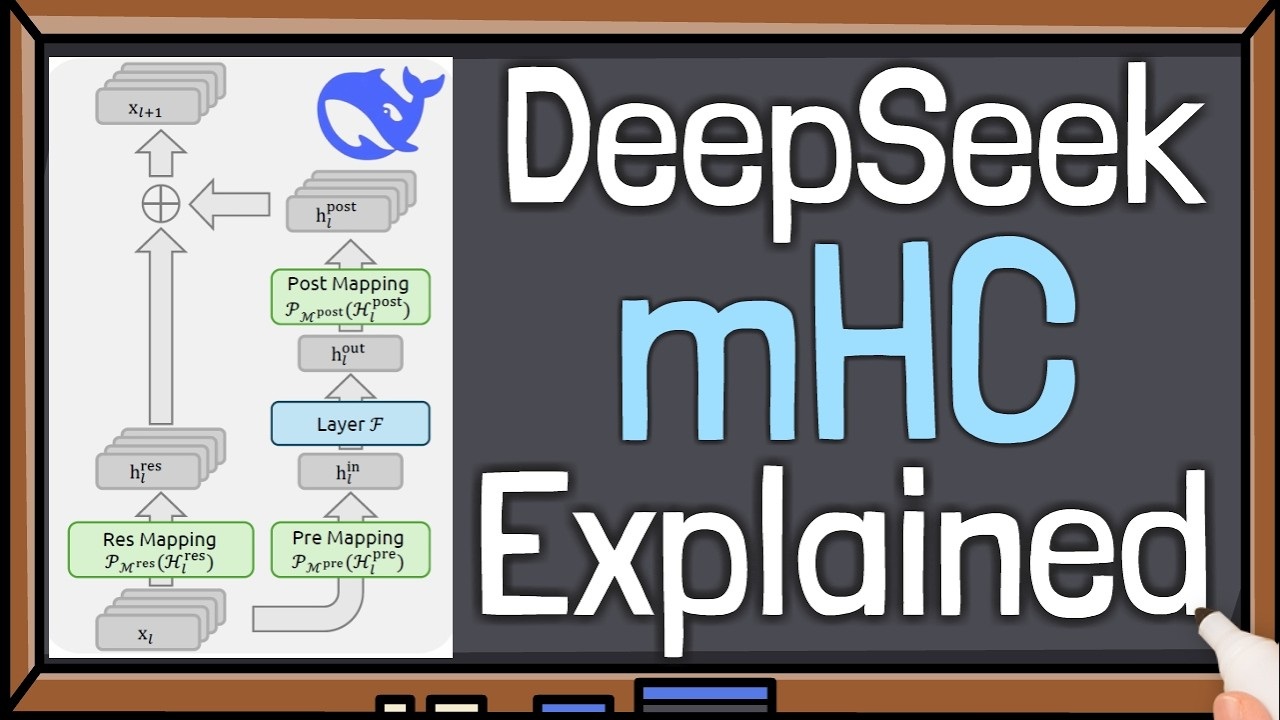
x[l+1] = H_res * x[l] + H_post^T * F(H_pre * x[l], W[l])
Where:
- H_pre – projects input into the layer
- H_post – projects output back to residual stream
- H_res – mixes information between residual streams
The Fatal Flaw
Hyper-Connections showed promise in early training but suffered from catastrophic late-stage instability:
- Training looks normal initially – loss decreases, metrics improve
- Then sudden collapse – around step 12,000 or later
- Signal amplification explodes – reaching 3,000x to 10,000x magnitude
- Gradient norms spike – training becomes unrecoverable
Root cause: Unconstrained mixing matrices allow signals to amplify layer after layer. With no mathematical guarantee of stability, the system eventually breaks down.
This made Hyper-Connections unusable for production models where training runs cost millions and take months.
3. DeepSeek’s Solution: Manifold Constrained Hyper-Connections
The Core Innovation
mHC keeps the multi-stream architecture of Hyper-Connections but adds a mathematical constraint that guarantees stability:
Force all mixing matrices to be doubly stochastic – meaning they live on the Birkhoff Polytope.
What is a Doubly Stochastic Matrix?
A doubly stochastic matrix has three properties:
- All entries are non-negative (≥ 0)
- Every row sums to 1
- Every column sums to 1
Intuitive meaning: Information can be redistributed and blended, but the total amount remains constant – no amplification or dampening.
Why This Works: The Birkhoff Polytope
The set of all doubly stochastic matrices forms a geometric structure called the Birkhoff Polytope, which has crucial properties:
Birkhoff-von Neumann Theorem: Every doubly stochastic matrix can be expressed as a weighted average (convex combination) of permutation matrices.
Permutation matrices just shuffle – they don’t amplify. Weighted averages of shuffles don’t amplify either.
Key insight: When you multiply doubly stochastic matrices together (as happens when signals propagate through layers), the result is still doubly stochastic.
This multiplicative closure property means:
- No matter how deep the network
- No matter how many layers signals pass through
- Signal magnitude stays bounded near 1.0x
Mathematical Formulation
The mHC layer update is:
x[l+1] = π(H_res) * x[l] + H_post^T * F(H_pre * x[l], W[l])
Where π is the projection onto the Birkhoff Polytope using the Sinkhorn-Knopp algorithm.
Additional constraints:
- H_pre and H_post are non-negative (enforced via sigmoid activation)
- H_res is doubly stochastic (enforced via Sinkhorn-Knopp)
4. The Sinkhorn-Knopp Algorithm (1967)
Historical Context
The Sinkhorn-Knopp algorithm, published in 1967 by Richard Sinkhorn and Paul Knopp, was originally developed for matrix balancing in numerical analysis. DeepSeek brilliantly adapted this 57-year-old mathematical technique to solve a modern AI problem.
How It Works
The algorithm converts any positive matrix into a doubly stochastic matrix through iterative row and column normalization:
Simplified pseudo-code
def sinkhorn_knopp(M, iterations=20):
S = exp(M) # Make all entries positive
for _ in range(iterations):
    # Normalize rows
    row_sums = sum(S, axis=1)
    S = S / row_sums

    # Normalize columns
    col_sums = sum(S, axis=0)
    S = S / col_sums

return S  # Now doubly stochastic
### Convergence Properties
- **Provably convergent** - mathematically guaranteed to reach a doubly stochastic matrix
- **Fast convergence** - 20 iterations are sufficient for practical use
- **Differentiable** - gradients can flow backward through the iterations for end-to-end learning
### The Manifold Dial Effect
Research shows the constraint's effect is **almost instantaneous**:
- **At k=0 iterations** (unconstrained): signal gain explodes to 10^16
- **At k=1 iteration**: gain collapses to near 1.0
- **At k=20 iterations**: fully stabilized at ~1.6x gain
The transition happens in a **single iteration** - it's not a gradual effect but rather an on/off switch controlled by the constraint.
---
## 5. Engineering Optimizations: Making mHC Practical
The mathematical elegance would be meaningless without efficient implementation. DeepSeek's team performed extensive engineering work to make mHC viable at scale.
### Challenge: Memory and Compute Overhead
Widening the residual stream from 1 to 4 channels (4x expansion) naturally increases:
- **Memory access operations** - more data moving between GPU and memory
- **Compute requirements** - 20 Sinkhorn iterations per layer
- **Memory footprint** - storing intermediate activations
### Solution 1: Kernel Fusion (TileLang)
**Custom GPU kernels** written in TileLang that:
- **Fuse multiple operations** into single kernels
- **Use shared memory** to reduce bandwidth bottlenecks
- **Employ mixed-precision strategies** for optimal speed/accuracy balance
**Result**: Operations that normally require multiple memory transfers are completed in one pass.
### Solution 2: Selective Recomputation
**Trade memory for compute**:
- **Discard intermediate activations** after the forward pass
- **Recompute them on-the-fly** during backpropagation
- **Dramatically reduces VRAM requirements**
This is especially effective because:
- Memory bandwidth is the bottleneck (the "memory wall")
- Modern GPUs have excess compute capacity
- Trading compute for memory saves overall training time
### Solution 3: DualPipe Scheduling
**Overlap communication with computation**:
- **Pipeline parallelism** for multi-GPU training
- **Hide data transfer latency** behind normal compute operations
- **Carefully orchestrate** forward pass, backward pass, and weight updates
### The Result: Only 6.7% Overhead
Despite quadrupling internal capacity, mHC adds:
- **6.7% increase in training time**
- **6.27% hardware overhead**
This is a **tiny price** to pay for 400% expansion in information flow capacity.
---
## 6. Experimental Results & Performance
### Model Scales Tested
DeepSeek trained three model sizes:
- **3B parameters** - trained on 1 trillion tokens
- **9B parameters**
- **27B parameters**
All models used the **DeepSeek-V3 architecture** with:
- Multi-Head Latent Attention (MLA)
- Mixture-of-Experts (MoE) with sparse activation
- Residual stream expansion factor of 4
### Benchmark Performance (27B Model)
Comparing mHC vs. Hyper-Connections (HC) vs. Baseline:
| Benchmark | Baseline | HC | mHC | Improvement |
|-----------|----------|-----|-----|-------------|
| **BBH** (reasoning) | 43.8% | 48.9% | **51.0%** | +7.2pp |
| **DROP** (reading) | 47.0% | 51.2% | **53.9%** | +6.9pp |
| **GSM8K** (math) | 46.7% | 51.5% | **53.8%** | +7.1pp |
| **MMLU** (knowledge) | 59.0% | 61.8% | **63.4%** | +4.4pp |
| **HellaSwag** | 86.0% | 87.1% | **87.5%** | +1.5pp |
| **PIQA** | 82.4% | 83.2% | **83.8%** | +1.4pp |
**Key observations**:
- mHC consistently outperforms both baseline and unconstrained HC
- Largest gains on **reasoning-heavy tasks** (BBH, DROP, GSM8K)
- Improvements of 7-10 percentage points are **substantial** at this scale
### Training Stability Metrics
**Signal Amplification (Amax Gain Magnitude)**:
- **Baseline**: ~1.0x (stable but limited capacity)
- **HC**: 3,000x to 10,000x (catastrophic explosion)
- **mHC**: ~1.6x (stable with expanded capacity)
**Reduction**: Three orders of magnitude improvement in stability.
**Training Loss**:
- mHC achieved **0.021 lower final loss** than baseline
- No sudden spikes or instabilities throughout training
- Smooth convergence across all model scales
**Gradient Norms**:
- HC: Wild fluctuations, often spiking into thousands
- mHC: Remained bounded and predictable throughout training
### Scaling Properties
**Compute Scaling** (3B → 9B → 27B):
- Performance advantages **persist across scales**
- Benefits actually **increase slightly** at larger sizes
- No signs of diminishing returns
**Token Scaling** (3B model trained to 1T tokens):
- Loss improvement **stable from early training to convergence**
- Benefits not limited to final stages of training
- mHC helps throughout the entire training trajectory
**Depth Scaling** (up to 64 layers):
- Composite gain stays near 1.6x **regardless of depth**
- HC explodes exponentially with depth
- Baseline stays at 1.0x but with limited capacity
---
## 7. How mHC Compares to Other Approaches
### vs. Standard Residual Connections
| Aspect | Residual | mHC |
|--------|----------|-----|
| Stability | ✅ Excellent | ✅ Excellent |
| Capacity | ❌ Limited (single stream) | ✅ High (4 streams) |
| Expressiveness | ❌ Constrained | ✅ Rich mixing |
| Overhead | ✅ Minimal | ✅ Low (6.7%) |
### vs. Unconstrained Hyper-Connections
| Aspect | HC | mHC |
|--------|-----|-----|
| Capacity | ✅ High | ✅ High |
| Stability | ❌ Fails at scale | ✅ Stable |
| Training reliability | ❌ Collapses late | ✅ Reliable |
| Production ready | ❌ No | ✅ Yes |
### vs. Other Architecture Innovations
**Dense Connections (DenseNet)**:
- Connects each layer to every other layer
- Creates memory bottleneck
- Doesn't address gradient flow as elegantly
**Highway Networks**:
- Learned gating mechanisms for skip connections
- Adds complexity without clear stability guarantees
- mHC's mathematical constraint is more principled
**Attention Mechanisms**:
- Operate within layers (content-based routing)
- mHC operates between layers (structural routing)
- Complementary innovations, not competing
---
## 8. Theoretical Foundations
### Why Doubly Stochastic Matrices Work
**Spectral Properties**:
- Maximum eigenvalue is exactly 1
- All other eigenvalues have magnitude ≤ 1
- This bounds signal propagation automatically
**Compositional Stability**:
- Product of doubly stochastic matrices is doubly stochastic
- Deep compositions stay within the safe manifold
- No need for gradient clipping or other ad-hoc fixes
**Convex Combination Interpretation**:
- Each stream receives a weighted mix of all input streams
- Weights are normalized (sum to 1)
- Acts like a soft permutation - rearranging without amplifying
### Connection to Optimal Transport
The Sinkhorn-Knopp algorithm is actually the **entropy-regularized optimal transport** problem:minimize ⟨H_res, C⟩ + ε * KL_divergence(H_res)
subject to: H_res is doubly stochastic
This connects mHC to a rich mathematical framework with:
- Geometric interpretation (transport on manifolds)
- Optimization guarantees
- Connections to information theory

### Why 1967 Mathematics Still Matters

**Machine learning keeps rediscovering techniques from numerical analysis and optimization.**

The Sinkhorn-Knopp algorithm wasn't designed for neural networks, but it fits perfectly because:
- Deep learning is fundamentally about **iterative optimization**
- Neural networks need **differentiable constraints**
- Scale requires **computationally efficient** solutions

mHC is a reminder that **old papers contain valuable machinery** waiting to be applied to new problems.

---

## 9. Implementation Details

### Network Architecture
For each layer l:
- Pre-projection: h = H_pre * x[l]
- Layer computation: y = F(h, W[l])
- Post-projection: z = H_post^T * y
- Residual mixing: r = SinkhornKnopp(H_res) * x[l]
- Combine: x[l+1] = r + z
Learnable Parameters
Per-layer matrices:
H_res_logits∈ R^(s×s) – learned then projected to doubly stochasticH_pre_logits∈ R^(s×d) – learned then passed through sigmoidH_post_logits∈ R^(s×d) – learned then passed through sigmoid
Where:
- s = residual stream width (4x baseline)
- d = layer dimension
Training Configuration
Sinkhorn-Knopp settings:
- 20 iterations per forward pass
- Gradients backpropagate through all iterations
- Added small constant (ε ≈ 10^-6) for numerical stability
Optimization:
- Standard Adam optimizer
- Learning rates similar to baseline models
- No special tuning required for mHC
Memory Management
Activation recomputation:
- Forward: compute and discard mHC activations
- Backward: recompute activations on-the-fly
- Saves ~30% VRAM with minimal time cost
Kernel fusion:
- Row normalization + column normalization fused
- Exponential + normalization fused
- Mixed FP16/FP32 precision for optimal speed
5. Strategic Implications
For DeepSeek
Timeline:
- January 2025: DeepSeek-R1 shocked industry with cost-effective reasoning
- December 2024: mHC paper published
- Q1 2025 (expected): DeepSeek-R2 or V4 likely incorporating mHC
Pattern: DeepSeek publishes foundational research before product releases
- R1 launch was preceded by RL fine-tuning papers
- mHC likely powers next flagship model
CEO involvement: Liang Wenfeng co-authored the paper – signals strategic importance
For the AI Industry
Paradigm shift:
- Challenges assumption that scaling requires proportional compute growth
- Shows architectural innovation can match the gains from scale
- Opens new dimension for improvement beyond “bigger models”
Open-source approach:
- Full paper published on arXiv
- Methodology fully disclosed
- Enables global research community to build on ideas
Competitive dynamics:
- OpenAI, Google, Anthropic will likely experiment with similar constraints
- DeepSeek maintains implementation advantage
- But democratizes the core insight
Economic Impact
Training cost reduction:
- DeepSeek-V3: $5.6M training cost (vs. GPT-4’s ~$100M)
- mHC adds only 6.7% to training time
- Enables smaller players to compete
API pricing pressure:
- DeepSeek API: $0.55 per million input tokens
- OpenAI API: significantly higher
- mHC sustains cost advantage
Infrastructure implications:
- Less dependent on cutting-edge GPUs
- Compute efficiency matters more than raw scale
- Challenges NVIDIA’s dominance narrative
6. Limitations and Open Questions
Known Limitations
Implementation complexity:
- Requires custom kernels and careful engineering
- Not plug-and-play for existing frameworks
- Steep learning curve for practitioners
Validation needed:
- Independent replication by other labs crucial
- Long-term stability at 100B+ parameters unclear
- Real-world production deployment still being tested
Hardware optimization:
- Current GPUs optimized for traditional dense operations
- mHC might benefit from specialized hardware
- Potential for further speedups with custom accelerators
Open Research Questions
Scaling limits:
- Does mHC maintain benefits at 100B, 500B, 1T parameters?
- What’s the optimal expansion factor (currently 4x)?
- Can we go wider than 4 streams?
Alternative manifolds:
- Birkhoff polytope is one choice – are there better geometric constraints?
- Could we use different manifolds for different layers?
- Domain-specific constraints for specialized tasks?
Theoretical understanding:
- Why exactly does mHC improve reasoning more than other tasks?
- What’s the connection to mixture-of-experts architectures?
- Can we predict optimal architecture from task properties?
Combination with other techniques:
- How does mHC interact with mixture-of-experts?
- Does it compose well with long-context architectures?
- Potential synergies with retrieval-augmented generation?
7. Practical Takeaways
For ML Researchers
Key insight: Macro-architecture (how layers connect) deserves more attention than it gets.
We spend enormous effort on:
- Attention mechanism variants
- FFN architectures
- Normalization schemes
But the topology of the network – how information flows between layers – has similar potential for improvement.
Action items:
- Study mHC paper and implementation
- Experiment with manifold constraints in your domain
- Look for other optimization/numerical analysis techniques to adapt
For ML Engineers
When to use mHC:
- Training large models (9B+ parameters)
- Compute-constrained environments
- Tasks requiring strong reasoning capabilities
When to wait:
- Small models (< 1B parameters) – overhead not worth it
- Production systems until more validation
- If you can’t implement custom kernels
Implementation pathway:
- Start with reference implementations (PyTorch available on GitHub)
- Benchmark on your specific workload
- Profile to find bottlenecks
- Optimize incrementally
For AI Leaders
Strategic considerations:
Architectural innovation matters: Don’t assume scaling laws are the only path to better models. Fundamental design improvements can deliver equivalent gains at lower cost.
Open research pays off: DeepSeek’s transparent approach builds credibility and attracts talent. Consider similar strategies.
Cost efficiency is competitive advantage: As compute becomes more expensive and regulated, efficiency innovations become strategic assets.
Long-term investment: mHC represents years of research. Building similar capabilities requires sustained commitment to fundamental research.
8. Future Directions
Near-term (2025-2026)
Wider adoption:
- Major labs testing mHC in their training pipelines
- Integration into popular frameworks (PyTorch, JAX)
- Emergence of best practices and tutorials
Production deployment:
- DeepSeek’s next model (R2 or V4) likely uses mHC
- Performance validation in real-world applications
- Cost-benefit analysis at production scale
Hardware optimization:
- GPU vendors optimizing for manifold projections
- Custom kernels from NVIDIA/AMD
- Potential ASIC designs incorporating mHC
Mid-term (2026-2028)
Theoretical advances:
- Better understanding of why mHC improves reasoning
- Discovery of optimal manifold constraints for different tasks
- Mathematical frameworks for analyzing network topology
Architectural combinations:
- mHC + mixture-of-experts hybrids
- Integration with long-context mechanisms
- Specialized architectures for multimodal models
Scaling validation:
- Testing at 100B-1T parameter scales
- Long-training-run stability (multiple epochs)
- Generalization across domains beyond language
Long-term (2028+)
Paradigm shift:
- Network topology becomes primary design consideration
- Automatic discovery of optimal connection patterns
- Task-specific architectural search including manifold selection
Biological inspiration:
- Connections to neuroscience (brain connectivity patterns)
- Information-theoretic principles from biological networks
- Novel constraint types inspired by neural systems
Fundamental limits:
- Characterizing what’s possible with constrained architectures
- Proving optimality of certain manifold choices
- Unified theory of network topology design
9. Related Work and Context
Foundational Papers
ResNet (2015): Deep Residual Learning for Image Recognition
- Introduced residual connections
- Solved vanishing gradient problem
- Foundation for all modern architectures
Identity Mappings in ResNets (2016): He et al.
- Analyzed why residual connections work
- Emphasized importance of identity mapping
- Theoretical foundation mHC builds on
Hyper-Connections (2024): ByteDance research
- Proposed widening residual stream
- Showed promise but instability
- Direct predecessor to mHC
Mathematical Foundations
Sinkhorn-Knopp (1967): Original algorithm paper
- Matrix balancing in numerical analysis
- Convergence proofs and properties
- Still cited 57 years later
Birkhoff-von Neumann Theorem: Classical result in combinatorics
- Every doubly stochastic matrix is convex combination of permutations
- Geometric properties of Birkhoff polytope
- Fundamental to understanding mHC’s stability
Optimal Transport: Modern framework
- Entropic regularization of transport problems
- Connection to machine learning
- Growing field with deep connections to AI
Contemporary Innovations
Mixture-of-Experts: Sparse activation patterns
- DeepSeek-V3 uses MoE + mHC together
- Complementary approaches to scaling
- Both address efficiency constraints
Long Context: Handling extended sequences
- Different bottleneck than internal flow
- Potentially compatible with mHC
- Active research area
Multimodal Architectures: Vision-language models
- Could benefit from mHC’s richer information flow
- Cross-modal reasoning might particularly benefit
- Natural extension of current work
Video : DeekSeek mHC Explained
Related sections of the Video
Understanding the Foundation: Residual Connections
Residual connections, first introduced with ResNet in 2016, have become a cornerstone of modern LLM architecture. These connections create dual pathways for information flow: one path processes input through architectural modules (attention mechanisms, feed-forward networks), while a residual stream passes the original input forward unchanged. The two streams combine through element-wise summation, forming the block’s output.
According to research highlighted on Glasp, residual connections ensure uninterrupted gradient flow during backpropagation, allowing for efficient optimization of network weights—a crucial design choice that enables the Transformer to balance expressiveness and optimization. The identity mapping created by residual connections maintains a constant gradient of 1, effectively mitigating vanishing gradients during training. This stability has made residual connections fundamental to training deep networks at scale.
The Evolution: Hyper-Connections
ByteDance’s 2025 Hyper-Connections paper aimed to generalize residual connections by widening the residual stream itself. Instead of a single residual vector, the input expands into multiple components (typically 4) that mix together at every layer using learned mappings. This expansion occurs only in the residual stream; the input projects back down to model dimension before processing through expensive components like attention or feed-forward layers, minimizing computational overhead.
Hyper-Connections introduced learnable residual mapping matrices that allow models to dynamically determine how information mixes and propagates across the residual stream. This design significantly increases expressive power—the network gains much greater flexibility in how information flows across layers. However, this flexibility comes with a critical trade-off: unlike standard residual connections, the identity mapping is no longer guaranteed by the architecture itself.
The Problem: Training Instability
DeepSeek identified a fundamental flaw in Hyper-Connections: the learned mixing weight matrices are unconstrained. Without architectural guarantees, the residual stream can drift away from identity mapping, causing signal magnitudes to either explode or vanish during both forward passes and backpropagation. This phenomenon breaks the fundamental premise of residual learning—unimpeded signal flow—leading to training instability in deeper or larger-scale models.
The Solution: Manifold-Constrained Hyper-Connections
Manifold-Constrained Hyper-Connections (mHC) addresses this instability while preserving Hyper-Connections’ expressive power. The architecture remains structurally identical to Hyper-Connections, but the residual mixing matrices now face two mathematical constraints:
- Non-negativity: All matrix entries must be non-negative
- Double stochasticity: Each row and column must sum to one
These constraints are enforced using the Sinkhorn-Knopp algorithm from 1967. Doubly stochastic matrices ensure that every output residual receives the same total input signal amount, and every input residual contributes equally to outputs. The widened residual stream thus preserves an identity-like residual at a global level while information remains free to mix across multiple paths.
Additionally, mHC enforces non-negativity on pre- and post-projection matrices using sigmoid functions. This prevents signal cancellation from positive and negative coefficient compositions, further stabilizing training at scale. These architectural innovations echo broader trends in LLM optimization research, where careful architectural design proves crucial for training stability and performance.
Experimental Results
DeepSeek evaluated mHC using 27-billion parameter models with mixture-of-experts architectures inspired by DeepSeek V3. All Hyper-Connection variants used an expansion rate of 4. The results demonstrated:
Performance Improvements: Both Hyper-Connection models outperformed baselines across multiple downstream benchmarks, confirming that widening the residual stream drives performance gains. Manifold-Constrained Hyper-Connections consistently achieved the strongest results, indicating that constraints preserve Hyper-Connections benefits while broadly improving downstream performance.
Training Stability: Standard Hyper-Connections showed instability around iteration 12,000, with loss diverging significantly from baseline. Manifold-Constrained Hyper-Connections completely mitigated this issue, maintaining stable loss curves throughout training. Gradient norm analysis revealed that while Hyper-Connections exhibited clear instability, mHC closely followed baseline behavior, indicating smooth and well-behaved gradients throughout training.
Conclusion: Why mHC Matters
DeepSeek’s Manifold-Constrained Hyper-Connections represents a significant advancement in LLM architecture by addressing a fundamental tension between expressiveness and stability. After nearly a decade of architectural stasis around residual connections, mHC demonstrates that principled mathematical constraints can unlock new capabilities while preserving the training guarantees that made residual learning successful.
The Big Picture
For the past decade, residual connections were treated as solved infrastructure. They worked, they scaled, and people stopped questioning them. DeepSeek showed that even foundational assumptions can be improved.
mHC demonstrates that:
- Architectural innovation still has headroom – we’re not stuck scaling existing designs
- Mathematical rigor beats heuristics – principled constraints outperform ad-hoc fixes
- Old techniques have new applications – 1967 algorithms solving 2025 problems
- Efficiency matters strategically – cost advantages compound into market leadership
- Open research accelerates progress – transparency benefits the entire field
The Fundamental Insight
You can widen the highway without causing crashes – you just need the right traffic laws.
Standard residual connections are like a single-lane highway: stable but constrained. Hyper-connections tried to add lanes but caused chaos. mHC adds lanes with traffic rules (doubly stochastic constraints) that guarantee safe flow.
The rules are mathematical, not heuristic. They’re enforced by geometry, not hyperparameters. And they work by construction, not by hope.
Looking Forward
mHC is likely just the beginning of a renaissance in network topology design. Once researchers realize that connection patterns can be rethought, we’ll see:
- Systematic exploration of manifold constraints
- Automatic discovery of optimal topologies
- Task-specific architectures with specialized connection patterns
- Unified theories of how information should flow in neural networks
The question isn’t whether mHC will be adopted – it’s what comes after mHC.
Final Thought
Sometimes the biggest breakthroughs come from asking obvious questions that everyone stopped asking.
Why do residual connections have to be single-stream? They don’t. DeepSeek proved it. And in doing so, they’ve opened a door that’s been closed for a decade.
References and Resources
Original Papers
- mHC Paper: arXiv:2512.24880 – “mHC: Manifold-Constrained Hyper-Connections”
- Hyper-Connections: arXiv:2409.19606 – ByteDance’s precursor work
- ResNet: “Deep Residual Learning for Image Recognition” (CVPR 2016)
- Sinkhorn-Knopp: “Concerning nonnegative matrices and doubly stochastic matrices” (1967)
Implementation
- GitHub Repository: tokenbender/mHC – PyTorch implementation
- DeepSeek Models: Available on HuggingFace
- TileLang: GPU kernel language used for optimization
Further Reading
- AI Papers Academy: Detailed mHC breakdown
- Subhadip Mitra: Interactive visualization of mHC stability
